
Read the accounting context
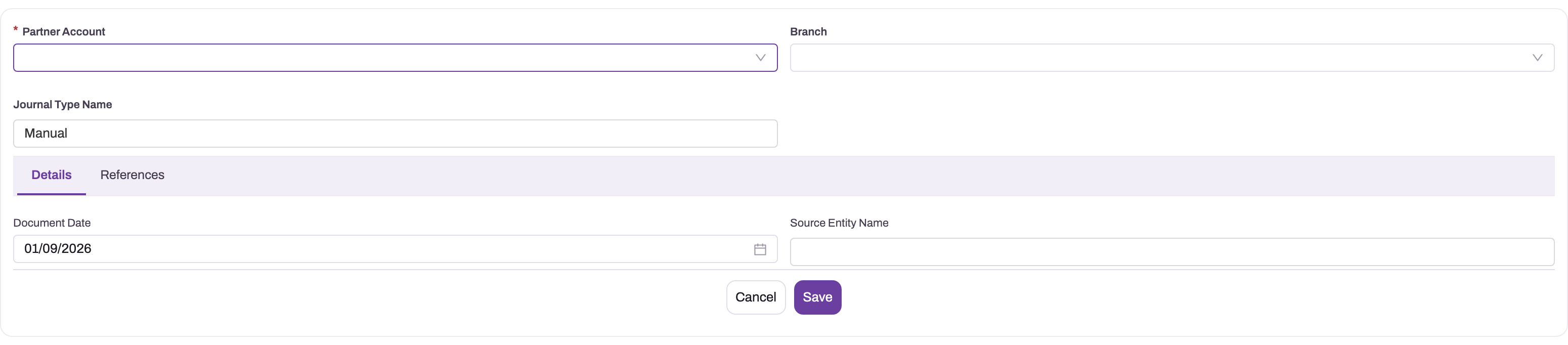
- 1
Partner Account supplies the company scope used when fiscal periods and GL context are resolved.
- 2
Branch supplies the organizational dimension for reporting and controls.
- 3
Journal Type defaults to Manual on this blank form; use source fields, not this label alone, to identify provenance.
- 4
Document Date determines the fiscal period and whether posting is allowed.
- 5
Source Entity preserves provenance when a journal represents another business event.
The manual-journal header demonstrates Finance's governing coordinates: partner account, branch, journal type, document date and source reference. The partner account scopes fiscal-period and GL resolution, the date selects the fiscal period, and source provenance explains why the accounting event exists. Manual is the create-form default, but it is not reliable evidence that an existing row was entered by hand: document-generated draft journals can carry that value too. Use Source Entity Name, Source Record and narration to establish provenance.
Before posting, verify the period is open, debits equal credits, dimensions are complete and control-account lines carry required party context. Prefer invoice, bill, payment, inventory or asset workflows where they exist, because their journals retain stronger source-to-ledger evidence.
xMatix Finance is a double-entry ledger shared by operational documents and direct finance workflows. A business document affects the ledger only when its implemented posting action or service runs; approval by itself is not a universal posting trigger. This section documents the ledger model, the day-to-day procedures, and the statement screens.
The mental model
Four ideas explain most of what you will see in the Finance app:
- The journal is the ledger. A value movement reaches the ledger as a balanced journal. Posted lines are immutable; the supported correction is a linked reversal rather than an edited line.
- Posting is document-specific. Invoice, bill, payment, inventory, depreciation and other handlers each define their own posting action and validation. Confirm the generated journal instead of assuming that a status change posted it. Invoice e-invoice and e-way-bill actions also depend on their configured provider path.
- Statements read the posted ledger. Trial Balance, P&L, Balance Sheet and the other statement services derive their results from posted period balances when the statement is generated. There is no separate report datastore for an accountant to maintain.
- Dimensions are resolved at posting. Journal-line dimensions can come from the header, GL defaults and the selected branch. Verify the resulting branch and business unit on the saved lines; missing configuration can still leave an intended reporting slice incomplete.
The Finance app
| Area | What it holds |
|---|---|
| Home | The finance landing page |
| Documents | Invoices, bills, expense vouchers, payments, journals, GL accounts |
| Adjustments | Credit notes and debit notes |
| Banking | Bank transfers, bank statements, cheque transactions, cheque registers |
| Statements | The fifteen statement screens — see Financial statements |
| Reports and Dashboards | Finance reports and the finance dashboard collection |
| Settings | The setup masters: fiscal years, business units, cost centers, bank accounts, budgets, posting definitions, accounting books, inventory valuation policies, revenue recognition schedules and more |
What a person sees in the Finance app is governed by their security profile, installed app/page metadata and tenant configuration. Check all three when a screen is absent.
What is in this section
- Chart of accounts, books and periods — GL accounts, accounting books, posting definitions and the fiscal calendar.
- Working with journals — manual journals, posting, reversal and recurring journals.
- AR and AP subledgers — how documents create open items, settle, and reconcile to control accounts.
- Recording and applying payments — customer receipts and supplier payments.
- Banking — bank accounts, statements and the cheque register.
- Bank reconciliation — the match workspace, suggestions and auto-reconcile.
- Financial statements — every statement screen and what it answers.
- Closing a period — the close checklist, period statuses and year-end close.
- Budgets and budget control — budgets, availability and budget vs actual.
- Revenue recognition — deferred revenue schedules and scheduled recognition runs.
- Interest on overdue payments — policies, accrual runs and posting.
- Fixed assets — the asset register, depreciation policies and asset blocks.
- Running depreciation — recurring depreciation runs and disposals.
Payroll accounting and expense claims have their own products — see xMatix Payroll and xMatix Expenses — and post into this same ledger.
Related topics
- xMatix Finance & Accounting product overview
- Apps, entities and records — how xMatix screens are organized.
- Administration guide — access, security and data management.