YOUR HELPDESK
Ends at the ticket
It logs the complaint — the technician, the part, the visit happen elsewhere.

Jobs dispatched over chat apps. AMCs tracked in spreadsheets. Technicians offline half the day.
Run your service network like a system.
Service organizations share one shape: assets in the customer's premises, contracts with clocks, technicians on the road, and spare parts everywhere except where they're needed.
From the moment the contract fires to the moment the job closes, one clock is running — and every step feeds it.
Thirteen typed field-service activities cover what technicians actually do — each lands on the right record with no custom development.
Explore Field Service →AMCs meter by time and usage; PM tasks generate the visit before the failure; service campaigns sweep whole fleets in waves.
Explore Service →Contracts, capacity, execution, billing — and the agents on the night shift.
Service organisations in India — HVAC and refrigeration, elevators, solar, inverters and batteries, appliances, medical equipment, facility management — share one shape: assets on the customer's premises, AMCs with response-time clocks, technicians on the road, and spare parts everywhere except the job. Too many still dispatch over chat groups and track AMCs in spreadsheets. Field service management software has to run that loop on one record: the contract that generates the job, the dispatch that assigns it, the technician who executes it offline, the bill or warranty claim that closes it, and the SLA clock over all of it. xMatix runs field service on the same platform as sales, inventory and finance, with GST invoicing from the job itself.
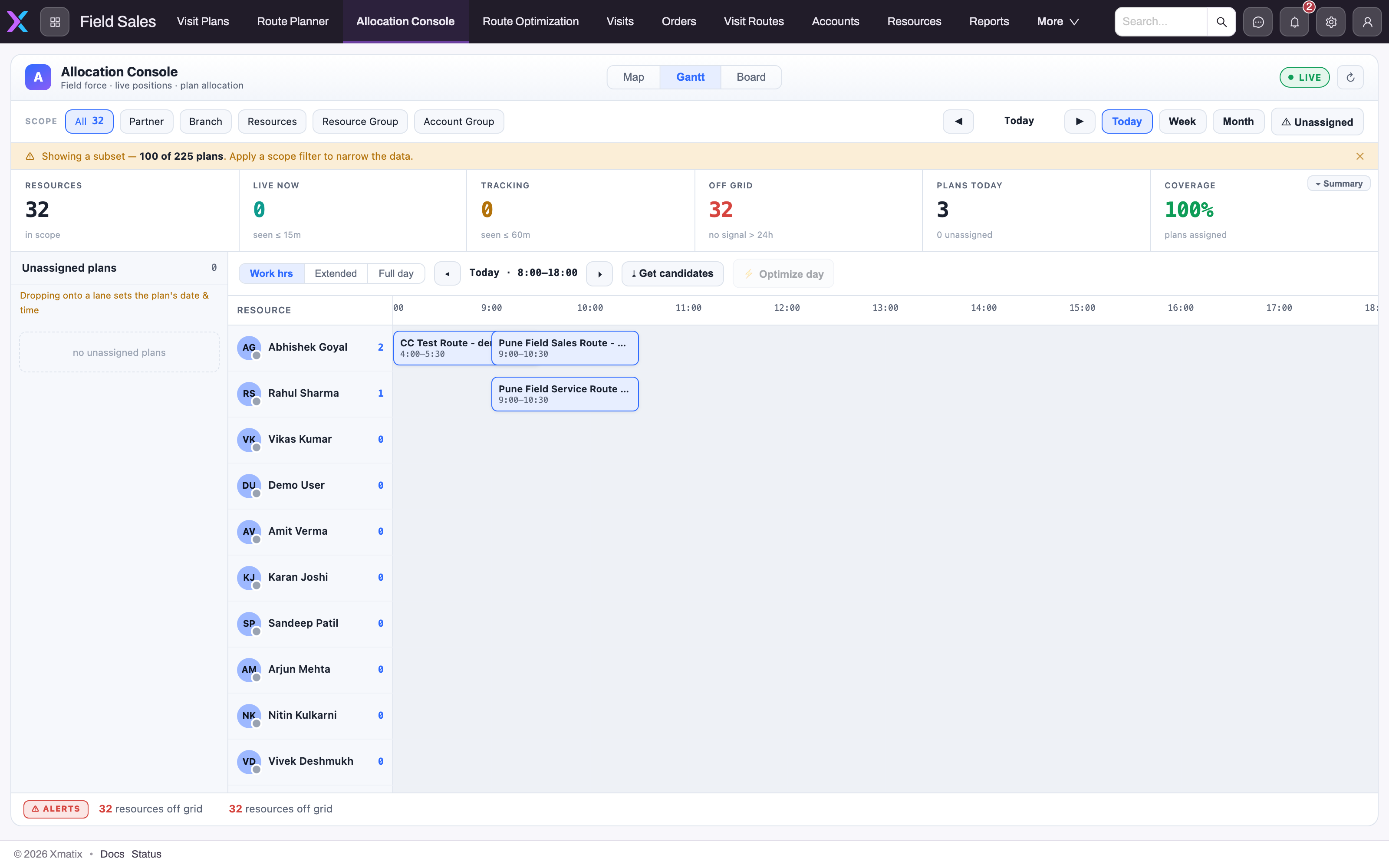
AMC contracts meter by time and usage and generate preventive-maintenance jobs before the breakdown. Each job starts its SLA clock at creation. The dispatcher plans on Map, Gantt and Board views, with "Optimize day" filling free slots from the backlog. Technicians check in inside a geofence, run typed activities — parts onto the job card, time into timesheets, meter readings, safety checklists, signatures — offline, and the job closes into a bill on site or a warranty claim.
| Need | Helpdesk / ticketing | Stand-alone FSM app | Field service on xMatix |
|---|---|---|---|
| Log the complaint and track the SLA | Yes | Partly | Yes |
| AMC contracts that generate PM jobs | No | Sometimes | Yes |
| Dispatch on map, Gantt and board | No | Yes | Yes |
| Offline technician app with typed activities | No | Yes | Yes |
| Spares consumed from van or branch stock | No | Integration needed | Yes — same inventory ledger |
| GST invoice or warranty claim from the job | No | Integration needed | Yes — same books |
A category comparison, not a review of any named product.
Organisations whose product is installed at the customer's site: HVAC and refrigeration, elevators and escalators, solar and energy systems, appliances, medical and lab equipment, kitchen and retail equipment, water systems and facility management.
Yes. Check-in, checklists, photos, parts, time and signatures are captured offline in basement plant rooms and remote sites anywhere in India, and sync through a durable outbox when the network returns.
AMCs meter entitlements by time and usage, preventive-maintenance tasks generate the visit before the failure, and renewals are raised in time — each generated job starting its own SLA clock.
Yes. Approved estimates become bill-on-site invoices from the job card, carrying GST on the line for service businesses in India, while covered lines are claimed under warranty or the contract automatically.