Your CRM
Ends at the sale
The test drive, the delivery, the first service — invisible after the deal closes.

Leads in one system. Service bays in another. Warranty claims in email. Run the dealership as one business.
Evaluating dealership software? Explore xMatix Auto DMS for capabilities, the dealership workflow and implementation questions.
Showroom, workshop and back office against one vehicle record — the short version, before the capability pages below.
Request a demo →Your CRM
The test drive, the delivery, the first service — invisible after the deal closes.
Your DMS / ERP
Invoices without the customer context — no case, no claim, no history.
Your service tool
Bay schedules and job cards that sales and finance never see.
Your AI tool
It charts idle bays and stale leads. Someone still has to rebook them.
The showroom and the workshop run different days — but every step lands on the same customer and vehicle record.
Service lane
Service campaigns are scoped by serial or engine-series range and chased in reminder waves — and when the vehicle arrives for anything else, the mandatory campaign job is forced onto the order.
Explore Service →A vehicle-off-road purchase order is raised straight from the job card — the clock, the part and the bay it holds are one screen, not three phone calls.
Explore Procurement →AMCs meter on time, hours or kilometres with grace bands; coupons burn down on the contract; multi-payer lines split one job across OEM, dealer and customer shares.
Explore Service →From the first enquiry to the settled claim — each page explains the discipline first and the machinery second.
What a dealer management system should run — and how one record carries it all.
Read the deep diveEvery source in one pipeline — scored, deduplicated, nurtured to booking.
Read the deep diveSlot-booked demo fleet, KYC before the keys, odometer out and in.
Read the deep diveA finance case on the deal: requested, approved, disbursed — reconciled.
Read the deep diveMandatory and optional components, priced by rule, quoted with approvals.
Read the deep diveScanner inward, inspection checklists, branch transfers with identity intact.
Read the deep diveVIN allocation, GST/e-invoice, RTO outputs, checklist, delivery appointment.
Read the deep diveContracts born at invoicing; service leads that generate themselves.
Read the deep diveApproved estimates, skill-matched technicians, bays booked by the hour.
Read the deep divePayer decided per line; claims written from the job card, settled line by line.
Read the deep diveEvery document posts itself; incentives computed and paid through payroll.
Read the deep diveThe work that happens before anyone logs in — governed and approval-gated.
Read the deep diveAn Indian dealership is two businesses under one roof — a showroom that sells vehicles and a workshop that services them for a decade — with an OEM relationship running through both and GST, e-invoicing and RTO paperwork on every vehicle that leaves the yard. Automotive dealer management software (an auto DMS) is the system of record for all of it: the enquiry, the test drive, the VIN in stock, the invoice and registration, the job card, the warranty claim and the ledger entry. xMatix runs those on one platform, so the customer and the vehicle keep one history from the first walk-in to the fifth service, across branches.
The sales lane runs lead → test drive → quote and finance → booking → invoice, RTO and delivery. The service lane runs appointment → check-in → health check → estimate → job card → invoice → warranty claim. Both land on the same customer and the same VIN, which is why a declined red item from last month's health check can become this month's follow-up call, and why a warranty claim rejected on one line can be reworked without a spreadsheet. The full definition and module walk-through is on auto DMS software.
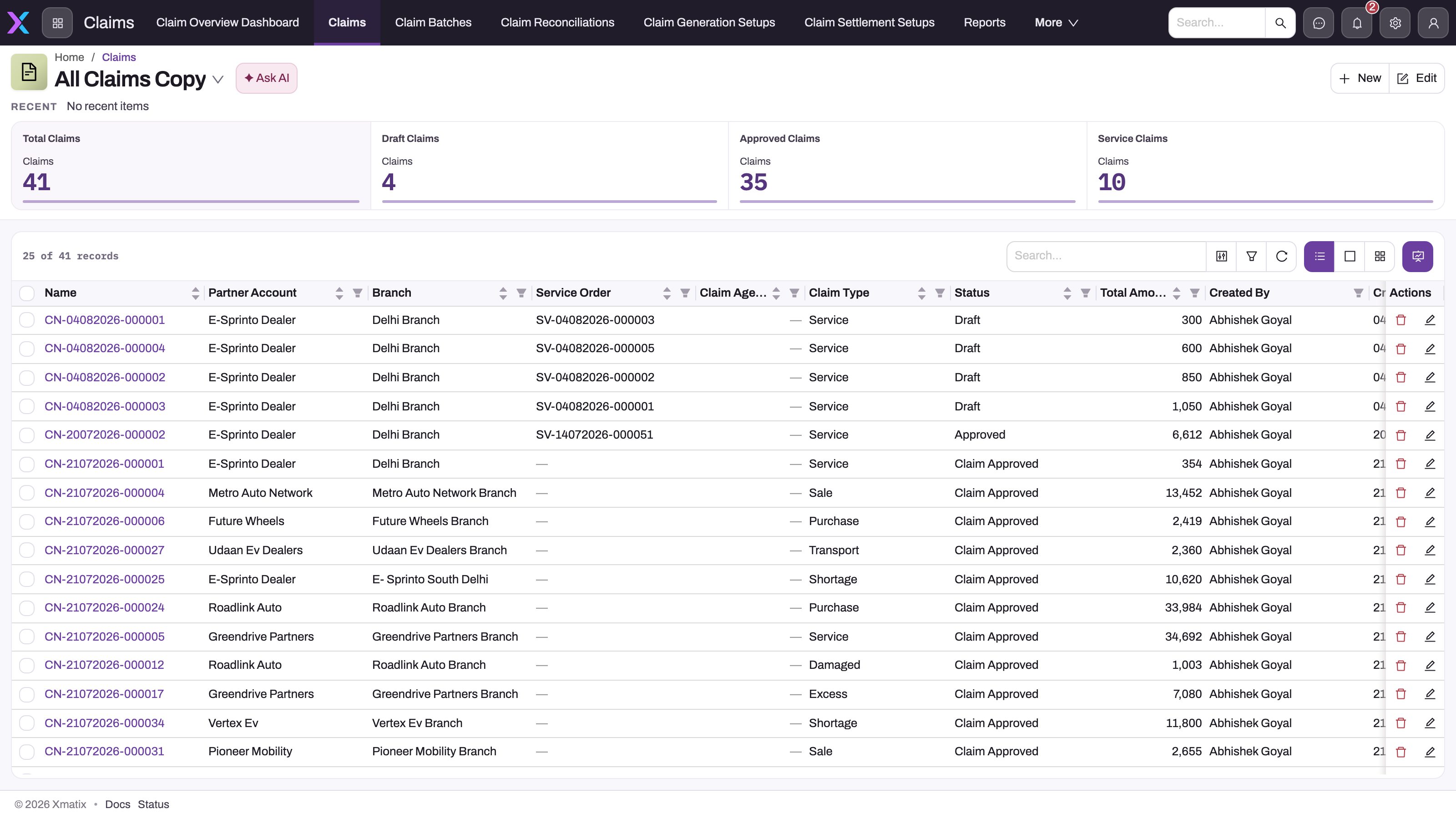
Dealer management systems are bought rarely and kept for years, so check the seams, not the screens:
| Check | Why it matters for an Indian dealership |
|---|---|
| One customer record from lead to fifth service | Service retention and resale both start from knowing who bought what and when |
| VIN identity across branch transfers and PDI | Multi-branch groups move stock constantly; the vehicle's history must move with it |
| GST invoice, e-invoice and RTO outputs from the sale | Re-keying the invoice into a separate tax or registration tool is where errors enter |
| Payer decided per job line | One job card can split across OEM warranty, insurance, extended contract and customer |
| Warranty claims written from the job card | Claims assembled by hand are claims rejected late and reworked twice |
| Documents that post to the ledger | Month-end becomes a review instead of a reconciliation |
| Offline in the workshop | Basement bays and yard inspections cannot wait for signal |
The twelve-question version is in evaluating a dealer management system.
An auto DMS — a dealer management system — is the software a vehicle dealership runs its whole business on: showroom sales, test drives, quotes and finance, VIN stock, the workshop, parts, warranty claims and the dealership's accounting, as one system of record.
Yes. The vehicle invoice carries GST on the line, generates the e-invoice and produces the RTO outputs and delivery checklist from the same record; e-way bills and TDS/TCS sit in the same books under India compliance.
Cars, two-wheelers, commercial vehicles and tractors, for single-site dealers and multi-branch dealer groups. OEM interfaces are confirmed during discovery, because each OEM's requirements differ.
Yes. A typical path scopes branches and integrations, prepares customers, VINs and opening balances, configures roles, taxes and posting rules, then pilots one sale, one service job, one claim and one payment end to end before each branch moves over.