
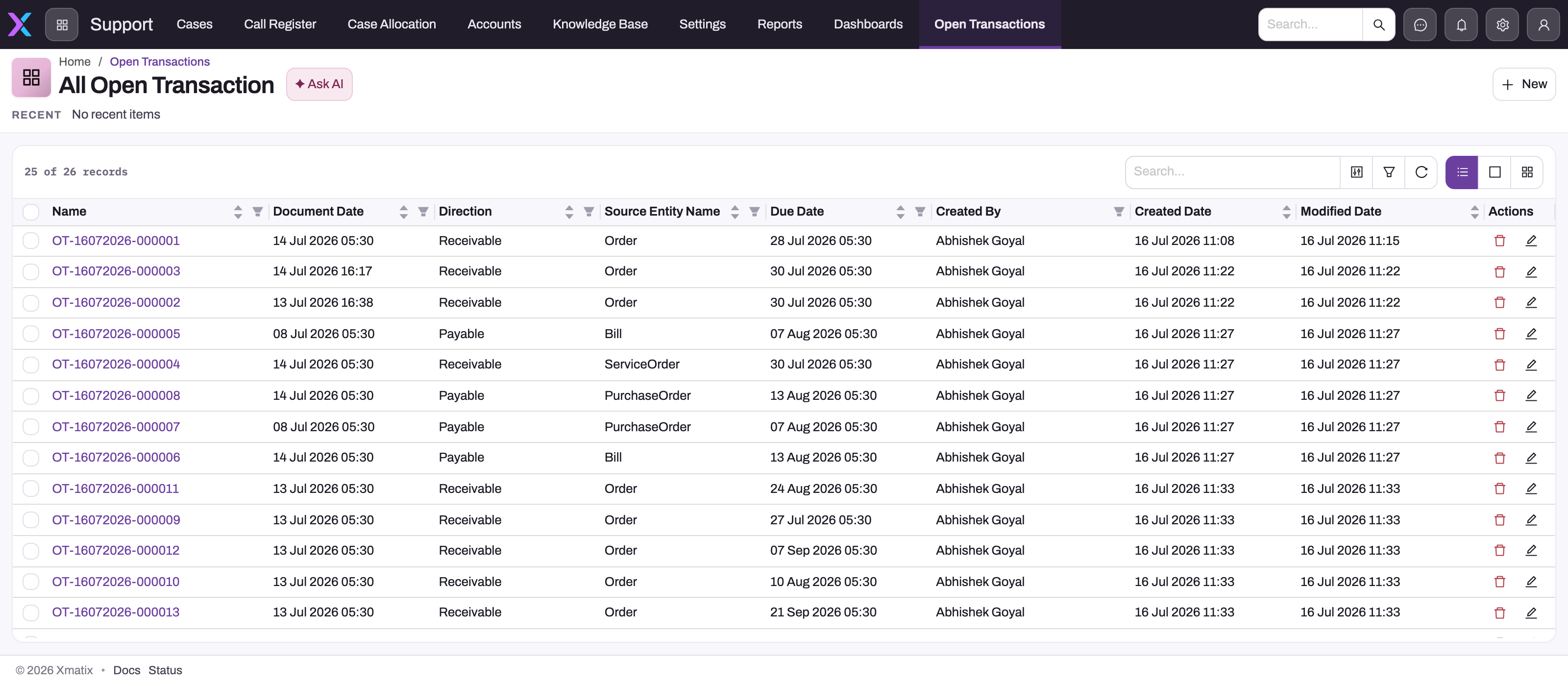
The receivables and payables subledgers answer the question the general ledger cannot: who owes what, and since when. Open Transaction records can be sourced from orders, service orders, bills and other posting flows, as the populated demo2 register shows. Settlement allocations reduce those obligations; reconciliation must still be verified rather than assumed from the model.
Read the screen
- 1
Name is the open item's traceable identity and links settlement work back to the originating obligation.
- 2
Document Date establishes when the receivable or payable entered the subledger.
- 3
Direction separates amounts to collect from amounts to pay, keeping AR and AP interpretation explicit.
- 4
Source Entity and Due Date connect the item to its originating document and ageing position.
- 5
Search, filters and refresh narrow the register without altering the underlying settlement evidence.
The Open Transactions register is the operational face of the subledger. Name identifies the open item, Document Date fixes when the obligation entered the books, and Direction separates receivables from payables. Source Entity is the route back to the invoice, bill, payment or adjustment that created the balance, while Due Date supplies the ageing clock. Together these fields let a reviewer answer not only how much remains unsettled, but why it exists and when action is expected.
Use search and filters to isolate one party, direction, source or due-date window, then open the source before correcting anything. The register is derived settlement evidence, so an unexplained item should normally be resolved at its originating document or through an explicit allocation, credit note or payment—not by disguising the balance with a manual control-account journal. The screenshot uses visible synthetic demo2 data so readers can follow realistic rows, values and controls together; production exports and screenshots must still remain inside authorized channels.
How documents post
Posting handlers can create ledger and open-item effects for their document types. A GL account must resolve for each posting role. Party enforcement on a control-account line depends on the account's stored IsControlAccount flag; choosing a visible Control Type without setting that flag is not sufficient. Payment inserts can also post immediately when their finance partner resolves, rather than waiting for a universal approval stage.
| When this posts | Also captured |
|---|---|
| Sales invoice | Output tax detail, any tax collected at source, and the cost-of-goods journal for delivered lines |
| Vendor bill | Input tax detail and any tax withheld at source |
| Payment | Tax withheld at payment, where the applicable section deducts at payment time |
Withholding entries adjust the open item directly — tax withheld on a bill reduces what you owe the supplier, and tax collected on an invoice grows what the customer owes — so the open balance always reflects what is actually payable or collectible.
Open items and settlement
Each posted receivable or payable becomes an open item carrying the document number, due date, original amount and open amount. Receipts and payments settle open items through settlement allocations: an allocation records how much of which payment was applied to which item. Partial settlements are normal — an item stays open for its remainder until allocations cover it fully. See Recording and applying payments for the procedure.
Ageing, statements and credit limits
The subledger drives three everyday tools:
- Ageing — open items bucketed by how long past due they are, per customer or supplier.
- Party statement — the running account of documents and payments for one party.
- Credit-limit checks — where the calling order/invoice flow invokes the check and its required configuration resolves. The current checks are conditional and can fail open when prerequisites are absent, so verify each deployed source path before treating the limit as a hard control.
Overdue receivables can also accrue interest under a policy — see Interest on overdue payments.
Reconciling to the control accounts
The AR and AP control accounts are intended to summarize the subledgers inside the general ledger. Reconciliation compares posted GL balance with the detail it summarizes and investigates the signed difference. The unexposed PeriodCloseService includes an open-items-to-allocations check, but the current Fiscal Period Close action bypasses that service; close owners must run and retain this reconciliation themselves.
Common questions
Why doesn't the AR control account equal my ageing?
Run the control-account reconciliation report — it shows the signed difference and lets you chase it down. The usual causes are documents approved but not yet posted, and manual journals written directly against the control account without a matching open item. Prevention beats cure: keep manual postings off the control accounts and let documents own them.
An invoice is missing from the ageing. Why?
It never posted to the ledger, so it has no open item. The ageing is built from open items, not from the invoice list — an invoice still in draft, or one whose posting failed, is invisible to it. Check the invoice's posting status; once it posts, the open item and its ageing bucket appear.
Can I post a manual journal to a receivable or payable account?
Treat a manual posting to a receivable or payable account as a last resort. When the account is correctly flagged IsControlAccount, the line must carry the party. The journal still does not automatically create or settle the corresponding Open Transaction, so it can create a reconciliation difference. Prefer the source document that fits the business event.