
When you pay a contractor, book a rent bill, or sell above a section's threshold, income-tax law can require your company to hold back tax (TDS) or collect it (TCS) and pass it to the government. xMatix connects posting-time withholding, monthly challan actions, quarterly-return computation and certificates through the withholding register. Review each transition and its evidence; shared source data reduces re-keying but does not eliminate the need for reconciliation or access controls.
Read the challan
- 1
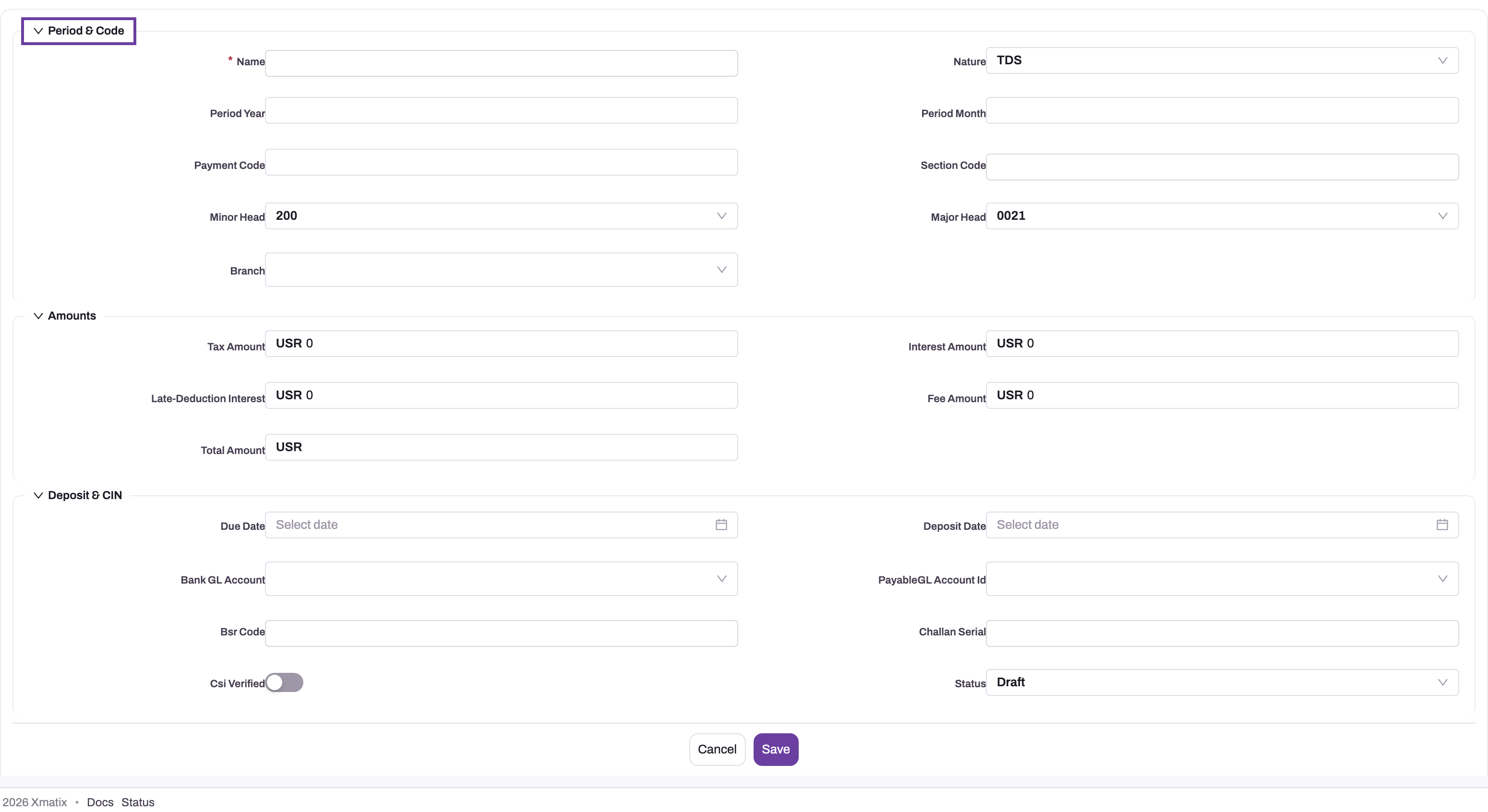
Period & Code identifies the withholding nature, year, month, payment code and statutory section.
- 2
Branch, major head and minor head complete the government payment classification.
- 3
Tax Amount is separated from interest and fee components so the deposit remains explainable.
- 4
Interest, late-deduction interest and fees preserve why the total exceeds the underlying tax.
- 5
Deposit date, bank and CIN or challan serial fields retain payment evidence; restrict generic edits after posting because status alone is not a technical lock.
The challan form separates statutory classification from money and payment proof. Period year and month, nature, section code, payment code and major/minor heads say which obligation is being deposited. Tax amount is shown separately from interest, late-deduction interest and fees so reviewers can explain why the total differs from the underlying withholding. Synthetic demo2 values remain visible in this guide so the complete control structure can be understood; real registration, banking and payment identifiers must not be published.
The Deposit & CIN section closes the loop from liability to evidence. Due date explains timeliness, deposit date proves when cash moved, bank GL account provides the book side and BSR code, challan serial or CIN fields provide the government acknowledgement. Before marking the challan paid, reconcile its tax amount to the undeposited register, its total to the bank posting and its statutory codes to the period's obligation.
The controlled challan actions treat posted amounts as immutable, but the generic TDS Challan save validator does not currently freeze a Deposited or Verified row. A user with generic edit permission can change fields, including amounts or status, without using Correct Challan. Restrict generic edit access after posting and audit any such change; do not rely on the status alone as a technical lock.
One-time setup
- Provision the statutory catalog. On the TDS Sections screen, Provision Statutory Catalog loads the sections with their rates, thresholds and deduction points as data. When a Finance Act changes them, re-provisioning updates the catalog — rates are never hard-coded.
- Record the company's TAN on the company account; every challan, return and certificate quotes it.
- Classify your parties. On each vendor and customer: the PAN (without a valid one, the law forces deduction at the penal higher rate, and the return reports it with the corresponding remarks code), the deductee type (individual, company, firm…) which selects the rate on dual-rate sections, optionally a default TDS section that pre-tags new bill lines (a section you pick on the line always wins), and a TDS applicable switch for genuinely exempt parties.
- Record lower/nil-deduction certificates. A certificate from the assessing officer is captured with its number, section, certified rate, amount limit and validity. It is applied automatically while valid and within its limit — consumption is tracked, and an exhausted or expired certificate stops applying on its own. Certificate rows carry the proper remarks code on the return.
Day to day — it happens at posting
- Vendor bills and payments deduct at whichever point the section prescribes — bill, payment, or the earlier of the two — and never twice. The vendor's payable is reduced, so you naturally pay the net.
- Customer invoices collect TCS on top: the receivable is increased by the collected amount, and a receipt against an invoice can trigger collection for sections that collect at payment time. Reversing an invoice reverses its collection cleanly.
- Thresholds are assessed cumulatively across the financial year per party and section, so deduction starts exactly when the yearly total crosses the line.
- Every event lands in the TDS Transactions register — party, PAN, section, rate, amount, and later the challan and certificate references. The TDS Summary and TCS Summary screens in the Tax Center are reporting views over this register.
Salary TDS is computed by payroll and deposits through its own statutory challans alongside PF and ESI; its quarterly return is part of the same return pipeline below.
Monthly — deposit challans
Prepare Monthly Challans drafts one challan per payment code and per major head — company deductees and others deposit under different heads, so one code can correctly produce two challans — covering every undeposited deduction of the month. Re-running is safe: late-posted bills top up the existing draft, nothing duplicates.
After paying at the bank, Post Challan with the deposit date records the payment in the ledger, marks every covered deduction deposited, and computes both statutory interest legs when applicable — late deduction and late deposit — as of the deposit date. Record the bank's CIN (BSR code, tender date, serial number); the quarterly return cannot validate without it. Verify Against CSI matches your recorded CINs against the portal's challan-status file and flips matched challans to Verified.
A deposited challan whose head, code or CIN was corrected at the bank or portal is updated with Correct Challan: the corrected values are applied, every action-driven change is kept in a correction log, a changed CIN goes back for re-verification, and an already-filed return that quoted old values can be identified for correction. The Correct Challan action deliberately accepts only head, payment/section code, CIN fields and deposit date—not amounts.
That restriction belongs to the action contract, not to every save path. Generic entity editing can currently bypass the intended amount immutability. Use permission and audit controls to keep Deposited/Verified challans out of generic edit flows until the handler enforces a record-wide lock.
Quarterly — the returns
The quarter's return headers (the vendor-TDS, TCS and salary forms) are drafted for you — by the scheduled compliance job or manually — and each moves through Draft → Computed → Validated → Filed:
- Compute assembles every deduction of the quarter and maps each to its depositing challan. Recompute freely until filing; it always rebuilds from the live register.
- Validate runs the pre-file checklist early, so problems surface on your side: missing or invalid PANs, department-rejected PANs (these block filing), deductions not yet deposited, incomplete CINs, challan over-use or short deposit, and missing certificate numbers on lower-deduction rows.
- Export renders the computed return as the caret-delimited e-return statement text that the government's return-preparation and validation utilities accept — the last step before uploading on the portal.
- Mark Filed records the portal acknowledgment and date; a late filing's fee is computed so the cost is on record. A filed return is locked — corrections go through Create Correction, which drafts a linked correction statement you compute, validate and file the same way.
PAN hygiene is part of the pipeline: run the department's bulk PAN verification and import the results — every party gets stamped Verified, Invalid or Name mismatch, and validation uses those stamps (rejected PANs block; never-verified ones warn).
After filing — certificates
On a filed return, Generate Certificates builds the certificate register: one numbered certificate per deductee — the non-salary TDS certificate for the vendor return, the TCS certificate for the collection return, and the salary certificate rows for the salary return — and stamps the certificate number back onto every underlying deduction, so the ledger, the certificate and the deductee's own statement all cite the same reference. Mark certificates Issued as you hand them over; issued certificates lock the register.
The scheduled front half
The compliance job (finance.tds-compliance.provision) runs the routine's front half unattended for every deductor company: it drafts the month's deposit challans and ensures the quarter's return headers exist. It is existence-checked and idempotent — your team reviews, pays and files.
Statutory rates, thresholds and due dates come from the provisioned catalog and the return logic, and change with the law — confirm current rules with your tax advisor.
Related topics
- TDS reconciliation — Form 26AS and the books-to-returns tie-out.
- Bills — where vendor-side deduction begins.
- Invoicing and payments — where collection begins.