
A bill is the supplier's invoice recorded in xMatix — the payable end of the procure-to-pay chain. Bills are released from a purchase order or a goods receipt, or entered directly. The line links differ by path: order-side release always sets the purchase-order-line link and adds the receipt-line link when receipt lines exist; receipt-side release sets only the receipt-line link; a keyed-in bill has neither.
Open the Procurement app and choose Bills. The list is titled All Bills; a saved bill has Lines, Details, Related and Approval tabs, an Amounts panel with a Payment summary, a status stepper under the header, and Post General Ledger and Post Inventory in the record header.
Where bills come from
| Source | Actions | What the bill gets |
|---|---|---|
| Purchase order | Release Invoice, Selective Release Invoice | Header: the order's branch, partner account, supplier and document date, linked to the order. Lines: for an order line with receipt lines still to invoice, one bill line per receipt line carrying both the purchase-order-line and goods-receipt-line links, the receipt's lot and its pending invoice quantity; for a line with nothing received, one bill line with the order-line link only. Selective takes ticked lines with a requested quantity, validated against the order line's pending invoice quantity. |
| Goods receipt | Release Bill | Header: the receipt's branch, partner account, supplier and document date, linked to the receipt. Lines: one per receipt line with pending invoice quantity, carrying the goods-receipt-line link only, the line's tax group and lot. |
| Direct entry | New | A header you fill in; lines you add. No source links, so nothing rolls back into an order or receipt and the lines cannot be matched. |
Each order line tracks its pending invoice quantity separately from its receipt progress, so billing can run ahead of or behind receiving, and one order can be billed across several invoices. Item lines are priced from the bill's price list when they are created — the unit cost on the order or receipt is not copied — so always compare the lines with the supplier's invoice.
Read the screen
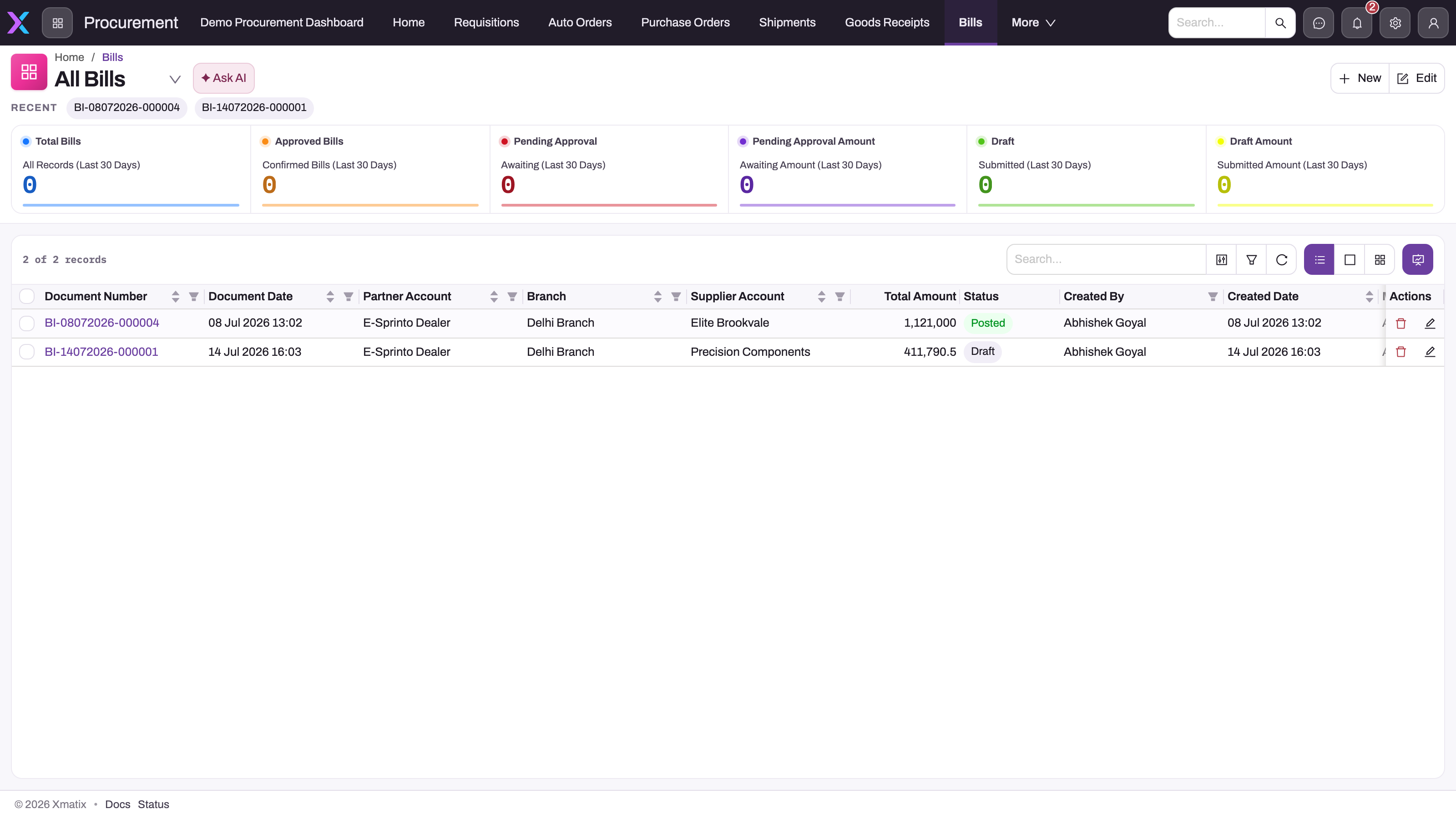
- 1
Open the bill by its document number to reach the Lines tab, Post General Ledger and Post Inventory.
- 2
Supplier Account is the vendor being paid - the party on the payable that posting raises; it is locked after save.
- 3
Total Amount is rolled up from the bill lines, which are priced from the bill's price list rather than copied from the order.
- 4
Status is advanced by a person on the saved bill; Post General Ledger does not set it to Posted.
- 5
The approval and draft counters read the same manual Status and the platform's approval requests, not the ledger.
- 6
New keys in a bill directly; its lines carry no order or receipt link and cannot be matched.
The list identifies bills by supplier, branch, date, total and Status. Status (Draft, Approved, Rejected, Posted) is a manual marker: the stepper on the saved bill advances it one step at a time when you click, and neither posting nor payment writes it. Read payment state from the Amounts panel and posting state from the GL Posted flag on Details.
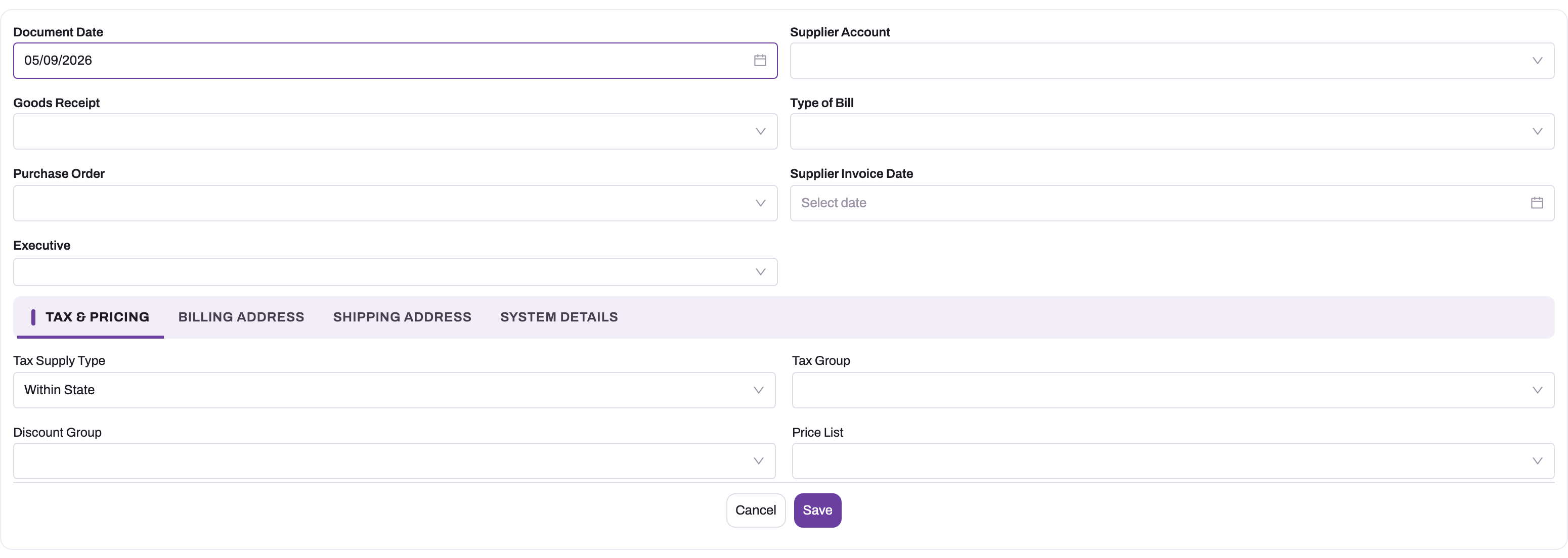
- 1
Document Date is the date the bill is booked in your ledgers; stamped with today.
- 2
Supplier Account is the vendor being paid - the party on the payable that posting raises; it is locked after save.
- 3
Goods Receipt and Purchase Order are the source links a release fills in; Purchase Order is locked after save. A keyed-in bill has neither and cannot be matched.
- 4
Type of Bill (Purchase, Expense, OTC Purchase) classifies the bill; Supplier Invoice Date records the vendor's own date.
- 5
Tax Supply Type picks the tax lane and Tax Group the header taxes.
- 6
Price List is what new bill lines are priced from; Discount Group supplies their discounts.
The create form
| Field | Where | What it does |
|---|---|---|
| Document Date | Header | The date the bill is booked in your ledgers; stamped with today. |
| Supplier Account | Header | The vendor being paid — the party on the payable. Defaults to the branch's default supplier; locked after save. |
| Goods Receipt, Purchase Order | Header | Source links; filled by the release that created the bill. Purchase Order is locked after save. |
| Type of Bill | Header | Purchase Bill, Expense Bill or OTC Purchase Bill — a classification for reporting. |
| Supplier Invoice Date, Supplier Invoice Number, Supplier Invoice Amount | Header / Details | The vendor's own document references, kept apart from your document number and date. |
| Executive | Header | The person responsible for the bill. |
| Tax Supply Type, Tax Group | Tax & Pricing | The tax lane (Within State, Outside State, Exempt, Exports, SEZ) and header tax group. |
| Discount Group, Price List | Tax & Pricing | Defaulted to the purchase-type discount group and price list; lines discount and price from them. |
| Billing Address, Shipping Address | Their tabs | Defaulted from the partner account's addresses. |
| Partner Account, Branch | System Details | The organization that owes the money and the branch; both locked after save. |
| Due Date, Payment Terms | Details | Due Date is copied onto the payable open item when the bill posts and drives ageing. |
| GL Posting Type | Details | Which control account the header credits: blank or Credit posts to accounts payable; a cash or bank type posts to that account instead. |
| Is RCM | Details | Marks a reverse-charge bill: the tax portion is self-assessed when the bill posts. |
Lines
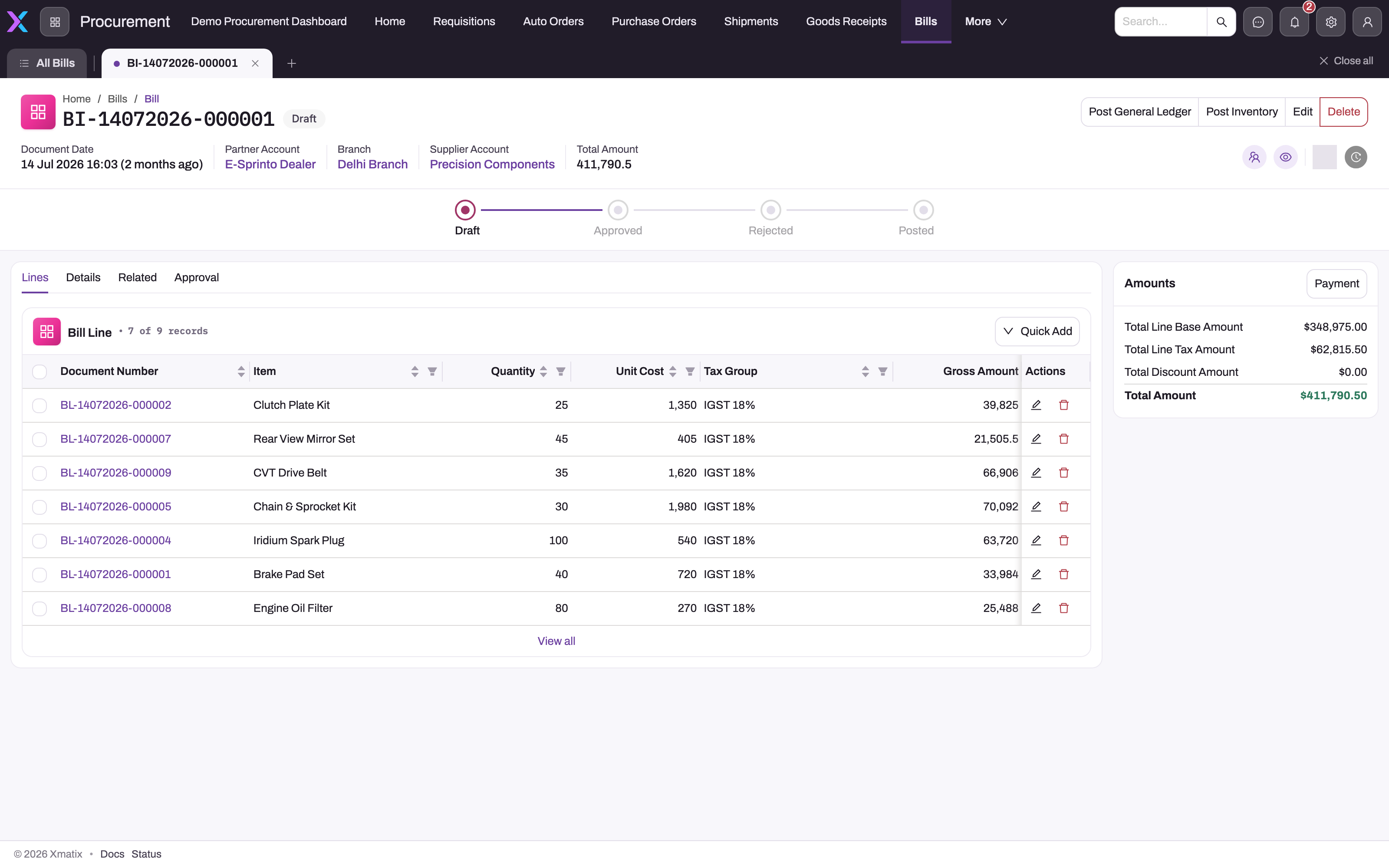
- 1
Post General Ledger books the bill (debit accrual, inventory or expense plus input tax, credit payable) and raises the payable open item; Post Inventory posts lines that have no ledger reference yet.
- 2
Draft - Approved - Rejected - Posted is advanced by clicking; neither posting nor payment sets it, and the one-step rule means Posted is reached via Rejected.
- 3
Quantity is what is being billed; on a released bill it is the pending invoice quantity of the order or receipt line it points at.
- 4
Unit Cost was looked up from the bill's price list when the line was created - not copied from the order - so compare it with the supplier's invoice before posting.
- 5
Gross Amount is quantity x unit cost plus the line's tax snapshot less discounts; it rolls into the Amounts panel.
- 6
Amounts shows the roll-ups and Total Amount; Payment opens the settlement summary (total, adjusted, open, payments) - the real payment state, unlike Status.
- 7
Approval hosts the platform's approval requests; Details holds Due Date, GL Posting Type, Is RCM and the GL Posted flag.
Add lines with Quick Add or let a release create them. Each line carries Quantity, Unit Cost (looked up from the bill's price list on creation, overridable; Unit Cost 2 takes precedence in the amount when set), discounts, a snapshot of its taxes, Gross Amount, and three fields that decide how it posts:
- Goods Receipt Line — set, the line clears the goods-received-not-invoiced accrual the receipt already raised, so inventory is not debited twice; unset, the line debits inventory or expense according to its GL Posting Type.
- GL Posting Type — Inventory or Expense for lines that did not come from a receipt.
- TDS Section — a withholding section. New lines without one inherit the vendor's default section; a section on the line deducts withholding tax when the bill posts.
Guards: unit cost cannot be negative; the source links (purchase-order line, goods-receipt line) cannot be changed; the item and SKU of a receipt-sourced line are locked; a line's quantity cannot drop below what has been returned against it, and a line with returned quantity cannot be deleted.
Posting
A bill is a document first and an accounting entry second. Posting is explicit and lives in the record header:
- Post General Ledger approves the bill for posting and writes one balanced journal: debit goods-received-not-invoiced (receipt-linked lines) or inventory / expense (other lines) plus input tax; credit accounts payable (or the cash/bank account chosen by GL Posting Type). It raises a payable open item carrying the Due Date, deducts TDS for lines with a withholding section (debit payable, credit TDS payable), records the input-tax transactions used by tax returns, and — for purchases raised against a service order — writes the billed cost back onto the service-order line. Re-posting reverses the previous journal before writing the new one.
- Post Inventory posts the bill lines that have no inventory-ledger reference yet to the inventory ledger; it refuses with No Bill Lines found for Inventory Posting when every line is already posted. Use it for the flows where the bill, not a receipt, is the stock document.
Once posted, the bill is an open payable. Open Amount and Adjusted Amount on the header, and the Payment summary in the Amounts panel (total, adjusted, open, and the payments and adjustments behind them), show how much supplier payments have settled — not Status.
Reviewing before payment
The three-way match service is read-only and has no standard screen or payment gate. It counts only bill lines that carry the purchase-order-line link, so a bill released from a goods receipt — or keyed in — is absent from its result even when it is perfectly valid. If your process receives before billing and you want both links, release the invoice from the purchase order after the receipt exists.
Common questions
Do I have to receive the goods before recording the bill?
No. Release the bill from the purchase order while the order line still has pending invoice quantity; the line carries the order-line link only. If the same order is invoiced after receipt lines exist, the order-side release builds the bill lines from the receipt lines and carries both links.
The supplier's invoice does not match what we received. Record it or not?
Record what the supplier actually invoiced — quantity and unit cost on the lines, the supplier's own number, date and amount on the header — then compare the receipt lines' received quantity and the order lines' unit cost with it. The standard product does not block payment automatically; the comparison and the decision are yours.
Can a manually entered bill be matched?
Only if its lines have the purchase-order-line link, which a keyed-in bill does not get. A bill released from a goods receipt is in the same position: it carries the receipt-line link only.
Why is the unit cost on a released bill different from the order?
Because bill lines are priced from the bill's price list when they are created; the order's or receipt's unit cost is not copied (except for description-only charge lines). Correct the unit cost on the bill line to match the supplier's invoice before posting.
Does Post Adjustments do anything?
No. It appears on the bill but is not implemented — running it returns an error. Apply supplier payments and adjustments from the payment side; the bill reflects them in Open Amount and Adjusted Amount.