
The chart of accounts is the list of GL accounts every journal line posts to. Around it sit three structures that decide how postings happen: accounting books (parallel valuation perspectives per company), posting definitions (which account each document line hits), and the fiscal calendar (which dates are open for posting). All four are maintained in the Finance app's Settings area.
Read the screen
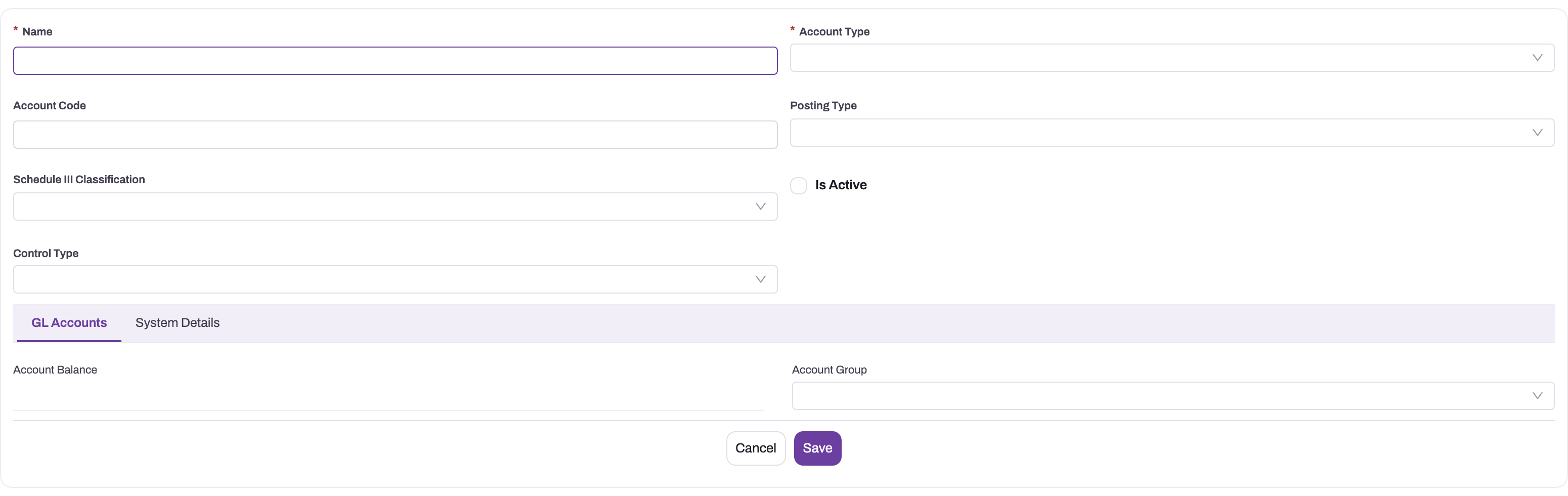
- 1
Name is required; Account Code is the optional durable code used in reporting and integrations.
- 2
Account Type records the economic category; Posting Type is a separate classification immediately below it.
- 3
Schedule III Classification is the primary statutory placement used by the statements, with Account Type as fallback.
- 4
Control Type labels the intended subledger role. Party enforcement also depends on IsControlAccount, which this create layout does not expose.
- 5
The GL Accounts tab includes Account Balance and Account Group; a new unsaved account has no balance yet.
The account form turns a reporting idea into a ledger master. Begin with a durable Name and optional Account Code, then select the Account Type that matches the economic substance. For statement placement, the current report code prefers Schedule III Classification and falls back to Account Type; it does not derive placement from Posting Type alone.
Use Control Type to label the intended subledger role, but note that the posting guard checks the separate IsControlAccount flag. The standard create layout shown here does not expose that flag and there is no automatic synchronization from Control Type. Selecting a Control Type alone therefore does not guarantee that party context will be enforced. Administrators must set and verify both concepts through a layout or seeded configuration that exposes the real control flag.
GL accounts
Each GL account carries an Account Type and can carry a Schedule III classification. Statements use Schedule III when present and otherwise fall back to Account Type. Verify an account in the actual statement after configuration; a visible Posting Type value is not the placement rule used by that report path.
Control accounts
A control account is intended to summarize a subledger inside the general ledger. Party enforcement applies when IsControlAccount is actually true. Because the create layout exposes Control Type but not that flag, validate the stored account before relying on the following reconciliation intent:
| Control type | Summarizes |
|---|---|
| Accounts Receivable | Customer open items |
| Accounts Payable | Supplier open items |
| Bank | Bank account activity |
| Inventory | Inventory value layers |
| Tax payable / tax credit | Output and input tax captured from documents |
| Withholding payable | Tax withheld or collected on documents |
| Inter-business-unit | Cross-division balances |
Reconciliation reports compare each control account's posted balance against the detail it summarizes and flag any difference — see AR and AP subledgers.
Accounting books
An accounting book is a valuation perspective for a company. Books can be marked active and primary, but the audited model does not enforce a unique primary book per company. Statement code takes the first active primary book it finds. Configure exactly one by policy and add a validation/report to detect duplicates; otherwise statement selection can depend on query order. Tax and Management books may carry separate valuation policy, but do not assume “primary” is protected by a database uniqueness constraint.
Posting definitions
A posting definition decides which GL account a document line debits or credits. Definitions are keyed by the document type, the posting role (receivable, income, tax and so on) and the tax type, and can be scoped to a specific item, customer or supplier. When a document posts, the most specific matching definition wins; if none matches, the platform falls back to the company's chart by account type. A typical setup seeds definitions for: the AR and AP controls, cash and bank by payment mode, sales income, purchases and inventory, cost of goods sold, and the tax accounts.
If no account resolves for a line, the document does not post and the error names the missing role — fix the posting definition rather than posting manually.
Fiscal years and periods
The fiscal calendar gates posting: the current journal validator accepts only a period whose status is Open.
- Create a fiscal year (name, start and end date) and generate its periods — twelve monthly periods, created Open.
- The exposed Fiscal Period actions implement Open → Closed, Closed → Open, and Lock. There is no first-party Soft Close action, and posting does not include a “soft-closed with permission” branch.
- A journal's posting period is derived from its document or journal date, validated against the open period — a March invoice entered in April still lands in March.
Common questions
What happens when a document line cannot resolve a GL account?
The posting fails with a message naming the unresolved role — it never guesses an account. Add or correct the posting definition for that document type and role, then approve the document again. A party is also mandatory on any control-account line, so a receivable or payable line without a customer or supplier fails the same way.
Can I post into last month?
Only while last month's period is Open. A Closed period must be reopened before posting; a Locked period is not accepted. The period comes from the journal date, so backdating targets the earlier period only if that period is Open.
Do I need more than one accounting book?
Most organizations need one active primary book for the statement path. The platform does not enforce that uniqueness, so verify it administratively before adding Tax or Management books. Test each report's book selection and valuation semantics rather than assuming every posting is reused identically.