
Read a visit
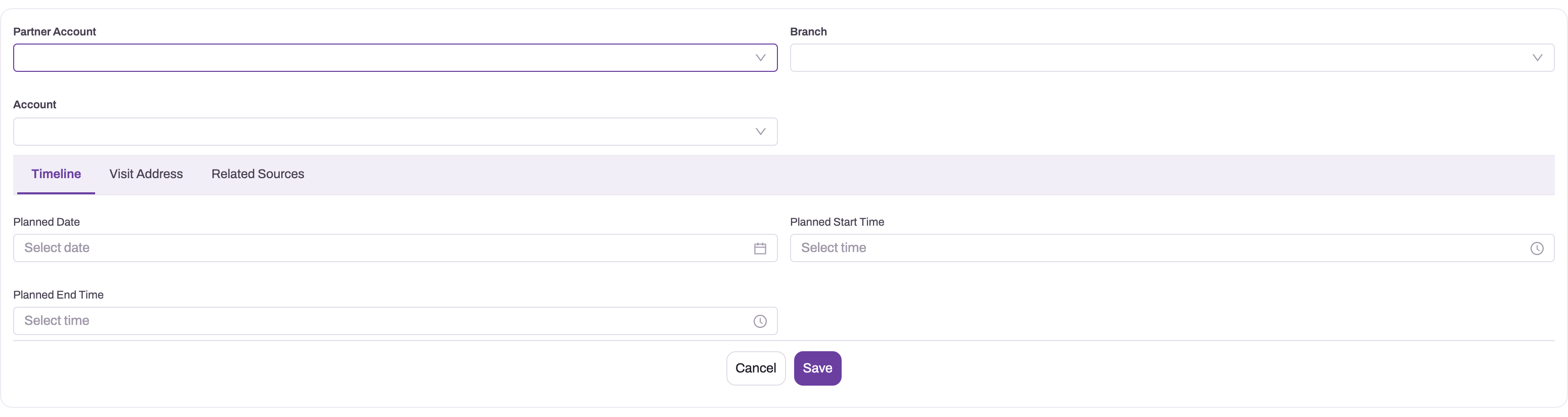
- 1
Partner Account identifies the outlet organization being visited.
- 2
Branch selects the exact physical outlet in a multi-branch account.
- 3
Account carries the commercial context used by orders and follow-up activities.
- 4
Timeline, Visit Address and Related Sources separate schedule, place and plan provenance.
- 5
Planned date and start/end times are the baseline for actual visit execution.
Each route stop becomes a Visit that joins customer context to a planned execution window. Partner Account identifies the outlet organization, Branch selects the exact location, and Account supplies the commercial context used by orders and follow-ups. Timeline holds the planned date and start/end times; Visit Address defines place; and Related Sources traces the visit back to its plan, route, template or originating activity.
Before the day begins, synchronize and verify outlet, address, local window, mandatory work and source plan. At the outlet, start the intended visit and attach tasks, checklists, photos, signatures, notes and orders to that record, even when the device queues changes offline. End with an explicit Productive, Non-productive or Cancelled outcome and the required reason or completion evidence. After synchronization, reconcile actual timing and outcomes against the plan rather than creating replacement visits that split the audit trail.
A field day in xMatix is one visit plan: the day's container, listing every outlet the executive should reach. Each stop on the plan is a visit, each visit carries the tasks and activities to complete at that outlet — checklists, photos, a signature, an order — and the order captured during a visit is linked back to it. The whole day runs on the mobile app, and because the app is offline-first, it runs the same way with or without coverage.
The hierarchy
| Object | What it is | Where it comes from |
|---|---|---|
| Visit plan | One executive's day: the ordered list of outlets | Generated from the beat's schedule, created manually, or created by a van run |
| Visit | One stop: an outlet, a planned position in the day, a status and an outcome | Built from the beat's approved stops when the plan is created |
| Task / activity | A unit of work inside a visit: checklist, photo, signature, order, payment… | Expanded from the visit task template attached to the beat or plan |
| Order | The commercial result of a productive visit | Captured in the Take Order activity, linked to the visit |
A day on mobile
The visit-plans hub is the executive's home screen: the current plan as a hero card, upcoming plans below it, past plans behind them. Opening a plan shows the agenda — the stops as a timeline or on a map, switchable between three stop orders: the planned sequence, the road-optimized sequence, and the "Mostly Followed" sequence learned from how the route has actually been driven (see Optimize a route).
At the outlet, the executive starts the visit — which stamps the time and, where configured, the device location — and works through the activity list. Mandatory activities are marked; a running timer shows the visit in progress. Ending the visit asks for an explicit outcome: Productive (which requires the mandatory activities to be done), Non-productive or Cancelled, the latter two with a reason. That outcome discipline is what makes coverage and strike-rate reporting honest.
Offline by design
Every screen in the flow reads from the data already on the device, and every save — a completed checklist, a captured photo, an order — queues in the device outbox until connectivity returns. Starting and ending visits, completing activities and taking orders all work offline; the queued work syncs in the background and is visible on a pending-changes screen until it lands. The full mechanics are described in how offline-first mobile works.
Common questions
Do I have to visit outlets in the planned order?
No. The sequence is guidance, not a lock — you can open and complete any visit on the plan. The plan agenda even shows you the "Mostly Followed" order learned from actual execution history, precisely because real days deviate from planned ones. What matters for reporting is that every visit ends with an explicit outcome.
What happens to visits I never reach?
They stay open until you cancel them, or until the automatic cleanup does: an administrator can set a margin after which overdue plans lapse and their unfinished visits are cancelled, so stale work does not pile up. See Visit plans.
Where does the order I take go?
It is created as a normal sales order, linked to the visit it was captured on. Offline it queues in the outbox first; once synced it is visible to the back office like any other order, and the plan's summary rolls up the day's captured order value.