
Read the visit record
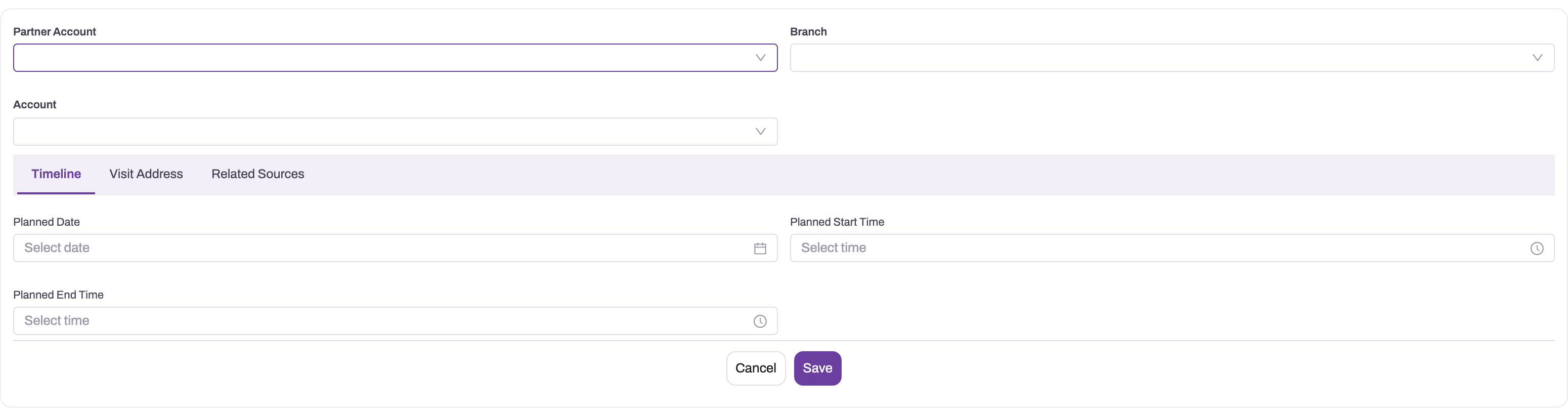
- 1
Partner Account identifies the customer organization the executive will visit.
- 2
Branch selects the responsible operating location.
- 3
Account preserves the commercial customer context used by downstream work.
- 4
Timeline, Visit Address and Related Sources separate schedule, place and provenance.
- 5
Planned date and time establish the baseline; this documentation capture never presses Save.
The Visit is the execution record that connects route planning to an actual outlet interaction. Partner Account identifies the customer organization, Branch selects the exact outlet, and Account preserves the commercial context used by orders and follow-up work. Timeline carries the planned date and start/end window, Visit Address establishes place, and Related Sources ties the visit back to its visit plan, beat or originating activity.
Planners should verify outlet, branch, address, local working window and source plan before releasing the day. Field users should synchronize assignments while online, open the intended visit, then attach check-in/out, tasks, checklists, photos, signatures, orders and notes to that record even when captures temporarily queue offline. At day end, compare actual completion and commercial outcomes with the planned timeline and source. This is an unsaved New Visit header, so no customer has been selected and Save is not pressed; the blanks are form state, not redaction.
xMatix Field Sales runs the whole route-to-market loop: territories are split into beats, beats generate visit plans, sales executives execute those plans on the mobile app — checking in at each outlet, working through tasks and checklists, taking orders — and the day settles back into the office as orders, collections and van-run reconciliations. The mobile app is offline-first, so a field day with patchy coverage still completes normally.
How the pieces fit
Planning flows downhill. A territory is split across executives into beats (visit routes) — each beat a named list of outlet stops with a weekly rhythm. Beats generate visit plans — one plan per executive per working day. A plan contains visits, one per outlet, and each visit carries the tasks and activities the executive must complete there: checklists, photos, signatures, an order. Van-sales days add a stock dimension: a load is released onto the van in the morning and reconciled — stock and cash — in the evening.
What is in this section
| Page | What it covers |
|---|---|
| Visits and the field day | The plan → visit → activity → order model, and how a day runs on mobile |
| Complete a visit | Step by step: check in, work the tasks, take the order, check out |
| Visit plans | The day container: automatic generation from route schedules, and stale-plan cleanup |
| Beats and routes | What a beat is: stops, schedules and stored stop orders |
| Optimize a route | Road-network sequencing of a beat, and the three sequence kinds |
| Territory planning | Splitting outlets across executives with balance, shift and capacity constraints |
| Van sales | Load the van, sell on route, settle cash and reconcile stock |
| Prospecting | Finding nearby outlets and onboarding a prospect on the spot |
| Attendance | Mobile check-in before the day starts, and automatic checkout |
| Checklists and tasks | Task templates, checklist templates, and the activity catalog reference |
| Planograms and shelf audits | Planogram records, shelf products and audit results on a visit |
Where the work happens
Executives live on the xMatix mobile app: the visit-plans hub, the day's agenda, visit execution and van runs are all mobile screens, built to work offline — see how offline-first mobile works. Planners and dispatchers work on the web: authoring beats and templates, running territory and route optimization, releasing van loads and reconciling them at day end. Administrators switch on the automated parts — plan generation, attendance gates, capacity checks — in settings.