
Read the beat definition
- 1
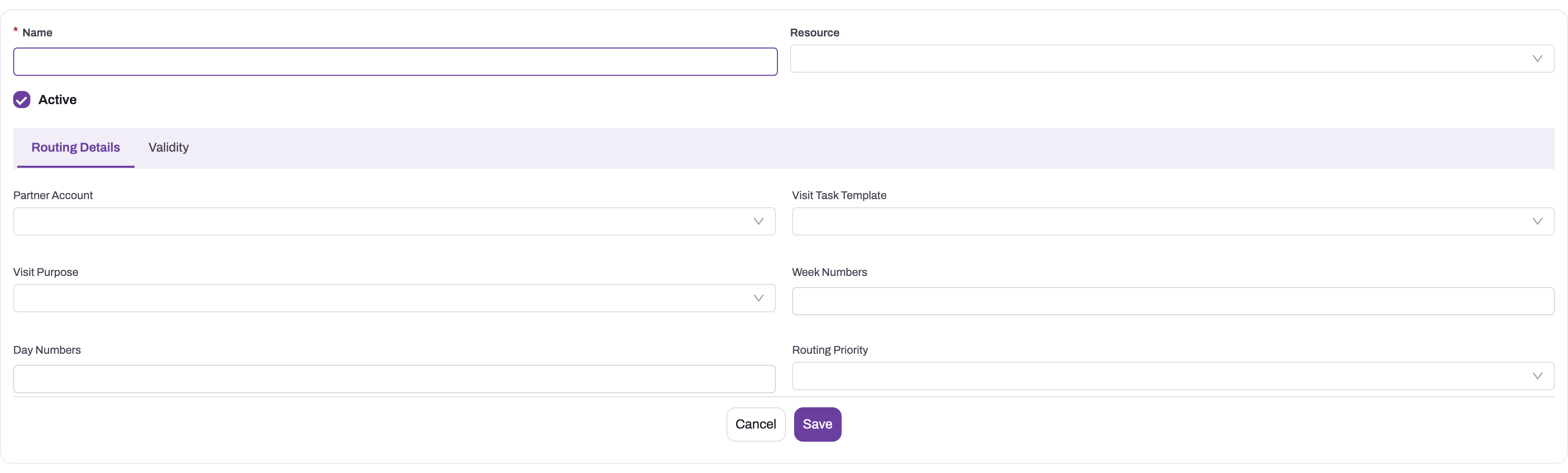
Name identifies the reusable beat in planning and daily agendas.
- 2
Resource assigns the executive responsible for generated plans.
- 3
Active and Validity decide whether the route can generate future work.
- 4
Visit Task Template determines the activities copied onto generated visits.
- 5
Week numbers, day numbers and priority define the route's recurring calendar rhythm.
A Visit Route is the reusable beat from which daily plans are generated. Name identifies it, Resource assigns the responsible executive, Active and Validity control whether it can produce future work, and Partner Account plus Visit Purpose provide commercial scope. Visit Task Template determines the work copied onto visits, while Week Numbers, Day Numbers and Routing Priority encode the recurring calendar rhythm.
Before approval, verify the executive is active, the validity window includes intended service dates, schedule numbers follow your organization's convention, every approved stop has coordinates, and the task duration fits the shift. Treat stop order as explicit versioned data: preserve planned, optimized and observed sequences rather than assuming row order is authoritative. After changing ownership or schedule, inspect upcoming plans for duplicates or gaps because an existing plan for a beat and date deliberately suppresses regeneration.
A beat — a visit route in xMatix — is the reusable definition of a field journey: a named list of outlet stops, assigned to a sales executive, with a weekly schedule that says which days it runs. Beats are the planning layer; the daily visit plans executives actually work are generated from them. Related beats are collected into route groups, which is also the level at which territory planning operates.
What a route carries
| Element | Meaning |
|---|---|
| Executive | The resource the route belongs to — generated plans are assigned to them |
| Stops | The outlets on the beat, each with a sequence number and coordinates |
| Schedule | Day-of-week flags, optional week-of-month numbers, optional start time |
| Effective window | From/to dates outside which the route generates nothing |
| Visit task template | Expanded onto every visit when a plan is created — the work expected at each stop |
| Visit purpose | Carried onto generated plans and visits for reporting |
Stops
Each route entry points at an outlet (a customer account), holds its position in the authored order, and carries the outlet's coordinates — the input everything geographic depends on: route optimization, distance on the agenda map, and the nearby-outlets feed. Stops have a status; only approved stops generate visits and take part in optimization, so a proposed stop (for example one added from the field through prospecting) can wait for a planner's approval before it changes anyone's day.
Stop orders are stored, not implied
A route does not have just one order. xMatix stores route sequences — versioned orderings of the same stops — of three kinds: the Planned order as authored, the Optimized order computed over road-network data, and the Mostly Followed order learned from how executives actually drove the beat. Each new computation is appended as a run with its distance and duration, and the current run of each kind is what planners apply and executives see on the agenda. How to produce and apply them is covered in Optimize a route.
Common questions
What is the difference between a route and a visit plan?
The route is the template; the plan is one dated instance of it. Editing a route changes future plans only — days already generated keep the stops and order they were built with.
What happens when I deactivate a route?
It stops generating plans immediately, but nothing historical is touched: past plans, visits and orders remain. Territory planning uses the same mechanism when it replaces a group's routes — old routes are deactivated, not deleted, so history stays intact.
Can the same outlet be on two routes?
Yes — nothing prevents an outlet appearing on multiple beats, which is common during route transitions. Be deliberate about it, though: each route generates its own visits, so an outlet on two active beats gets visited under both.