
xMatix CRM is the front end of the revenue funnel: it captures interest as leads, qualifies it into opportunities, prices it as quotes, and hands the won deal to Sales as an order — with accounts as the customer master underneath, product configuration and demo bookings on the deal, and calls, tasks and notes logged against every record along the way. This page maps the module and links every topic in this section.
The CRM app
The CRM app appears in your navigation when your administrator has granted it. Its standard entries are:
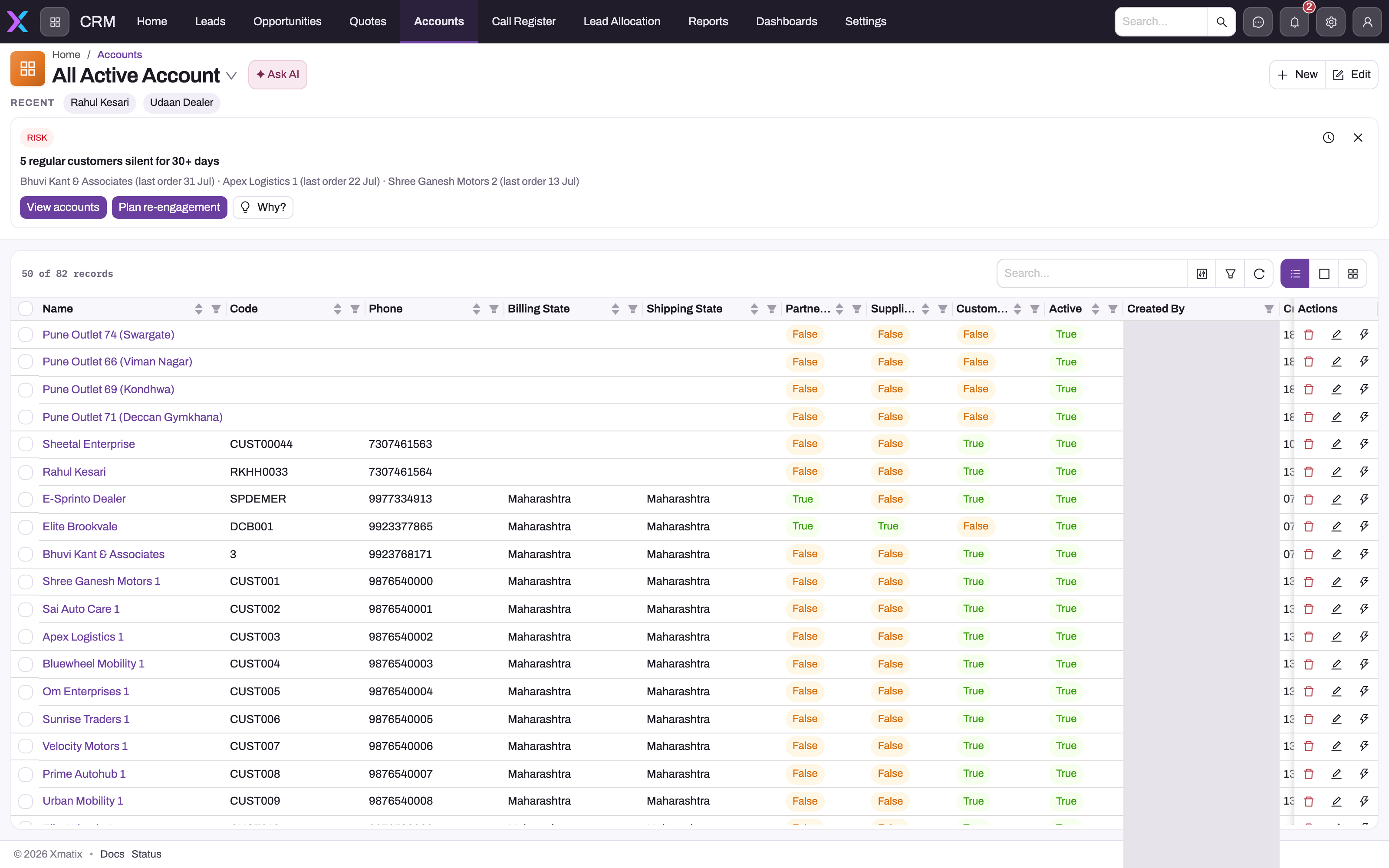
- 1
The CRM navigation: Leads, Opportunities and Quotes are the funnel; Accounts is the shared master; Call Register and Lead Allocation support the team; Reports and Dashboards report on it.
- 2
All Active Account is the saved view; the caret switches views and New creates a master record.
- 3
Sense AI nudges surface risks in context — here customers who have gone quiet — with actions to open the accounts or plan re-engagement.
- 4
Name, Code and Phone are the durable identity used by lead matching and duplicate checks.
- 5
Partner, Supplier, Customer and Active are independent flags on one record — a dealer you also sell to is still a single account.
- 6
Search, filters, refresh and the layout switch narrow or reshape the list without changing data.
| Entry | What it holds |
|---|---|
| Home | Landing page with summary cards |
| Leads | Raw interest: captured, worked and converted |
| Opportunities | Qualified deals with lines, pricing and generation actions |
| Quotes | Priced offers with approve/decline and order generation |
| Accounts | The customer master shared with the rest of xMatix |
| Call Register | Inbound and outbound phone calls, linked to the records they were about |
| Lead Allocation | Assigning leads to sellers |
| Reports, Dashboards | CRM reporting |
| Settings | The module's masters and scheduling configuration |
Administrators can add further entries to the app — Case (support cases, documented in the Support section) and Appointment (bookings against branch capacity, preview) are common additions — so your navigation may differ from the standard set.
Because accounts, items, price lists and branches are shared platform masters, a deal priced in CRM and the order it becomes in Sales read the same data — nothing is re-keyed at the handover.
The funnel at a glance
A lead converts into an account (if the customer is new), a contact and an opportunity. The opportunity carries the deal's lines and pricing and can generate a quote, a sales order or a service order. The current quote-generation path does not enforce a one-quote or non-empty-lines guard, while the direct order and service-order paths have their own checks. A quote records approved or declined flags, but order creation currently excludes only declined quotes rather than requiring approval. Details and safeguards are on each page below.
Section map
| Page | What it covers |
|---|---|
| Accounts | The customer master: roles, relationships, hierarchy and account groups |
| Leads | Capturing, qualifying and converting leads — and what conversion creates |
| Opportunities | Working the deal and generating quotes, orders and service orders |
| Quotes | The quote lifecycle: pricing, approve/decline, creating the order |
| Product configurator and demos | Configuring package products on deals, and booking product demos |
| Appointments | Appointment types, slot templates, bookable resources and scheduling (preview) |
| Activities | Calls, tasks, meetings and notes — the shared engagement layer |
| CRM configuration | Administrator reference for scheduling setup and account groups |
| Troubleshooting | The blocks CRM users actually hit, and what each one means |
What lives elsewhere
Support cases, SLA policies and the knowledge base are documented in the Support section. Order fulfilment, invoicing, pricing rules and trade schemes are in the Sales section — start with creating a sales order for what happens after CRM hands the deal over. Field visits and beat plans are under Field Sales.