
An opportunity is a qualified deal being worked: it carries the account, the lines being sold, and real pricing — the same price lists, discount groups and taxes the eventual order will use. When the deal is ready, it can generate a quote, sales order or service order, but the guards are action-specific; the current quote path does not enforce the same duplicate and line checks as the two order paths.
Prerequisites
- Access to the CRM app with create permission on the Opportunity entity.
- The customer exists as an account (or arrives via lead conversion, which creates it).
Procedure
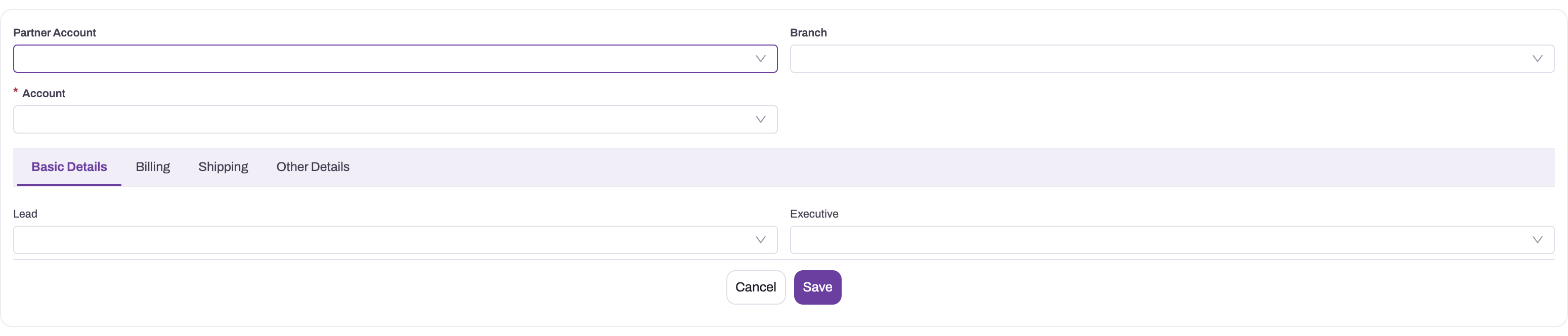
- 1
Partner Account selects the commercial organization handling the deal.
- 2
Branch supplies operational defaults and becomes locked after creation.
- 3
Account is required and drives price list, discounts, addresses and tax defaults.
- 4
Lead preserves the originating qualification trail when the deal was converted.
- 5
Executive records the owner responsible for progressing the opportunity.
Step 1 — Create the opportunity
Opportunities arrive two ways: lead conversion creates one linked to the lead, or you choose New in the Opportunity list and pick the account, partner account and branch. Search for and verify the customer before selecting it, then confirm the partner and branch—those organizational fields are locked after creation. On save, the deal pulls today's document date, the applicable sale price list, discount group, billing and shipping addresses, and header tax context. Reopen the record and verify each default against the account before adding lines; correct source master data rather than compensating repeatedly on the deal.
Step 2 — Build the lines
Add one line per item and enter the commercial quantity and required configuration; prices fill from the effective price list (see how prices resolve). Converted leads and linked service contracts can pre-populate lines, so review before adding anything manually. Header discount cascades to all lines, while changing price as on reprices every line—perform either action deliberately and recheck exceptions afterward. Configure package components with the product configurator, then reconcile line count, quantity, unit price, discount, tax and total to the customer's requirement.
Step 3 — Work the deal
Track the deal on the record: update status only when the corresponding commercial event occurred, log calls, tasks and meetings on the timeline, and always leave a dated next action (Activities). Use Book Appointment for a product demo and verify the resulting booking from both records. Before Confirm or Cancel, review every line and open task because either action cascades to the lines and is one-way. After the action, verify header and line statuses agree and the pipeline summary moved to the correct stage.
Step 4 — Generate the next document
From the opportunity, generate whichever document the deal needs:
| Action | Creates | Guarded by |
|---|---|---|
| Generate Quote | A quote header carrying the deal's context; existing lines are copied when present | No current duplicate or non-empty-lines guard; check related quotes and lines first |
| Generate Order | A sales order linked to the opportunity, lines copied from it | Once per opportunity; needs at least one line |
| Generate Service Order | A service order for work to be performed | Once per opportunity; needs at least one line |
The three are independent—generating a quote does not technically prevent a direct order later, so choose the approved commercial path before clicking. Before Generate Quote, inspect related quotes because a second click can create another one and an empty opportunity can produce a header-only quote. For order and service-order actions, review the confirmation, run once and wait for the linked result instead of retrying during navigation. Open the generated document and reconcile customer, branch, partner, source link, lines and totals.
Expected result
The opportunity carries the correct locked customer, partner and branch context; its lines reconcile to the expected pricing, discounts and taxes; and its activities support the current stage. Related-document review prevents accidental duplicate or header-only quotes, while the direct order and service-order paths enforce their own line and duplicate checks.
Common problems
Generation of a sale order or service order fails when the opportunity has no lines, and their duplicate messages mean the linked document already exists. Generate Quote currently lacks both guards, so the absence of an error is not proof that the click was safe—review related quotes first. If you need to change the partner account or branch, you can't; create a new opportunity with the right context.
Common questions
Where is the pipeline view?
Opportunities are a list like any other, so the pipeline is a view: filter and group by status, save it, and it is one click away — see personalizing lists and views. CRM dashboards and reports cover funnel reporting.
Should I generate the order from the opportunity or the quote?
If the customer needs a formal offer first, generate the quote, record their decision on it, and create the order from the accepted quote—the order then links to both. If no quote is needed, generate the order directly. The direct order path has a duplicate guard; the quote path does not, so inspect related quotes before generating another.
Can I reprice an opportunity that has gone stale?
Yes — change its price as on date (or run the reprice action); price list prices re-apply to all lines as of that date. Repricing requires the opportunity to have lines.