
Labour on a service order is recorded on time sheets. A time sheet is created from the order and carries one line per labour line on the job; technicians stamp work start, pause and end on those lines, and the order's own work flags — and with them the status a workshop watches — derive from what the time sheet lines say.
Prerequisites
- A service order with work-item lines — lines whose item is of the Work Item type and whose open quantity (quantity less cancelled quantity) is above zero. Only those go on a time sheet; part lines never do.
- Technicians set up as resources, so lines can carry who did the work.
- Access to the Service Order Time Sheet entity through your security profile. Time sheets belong to no app's navigation; reach them from the service order or directly by their list.
Procedure
- 1
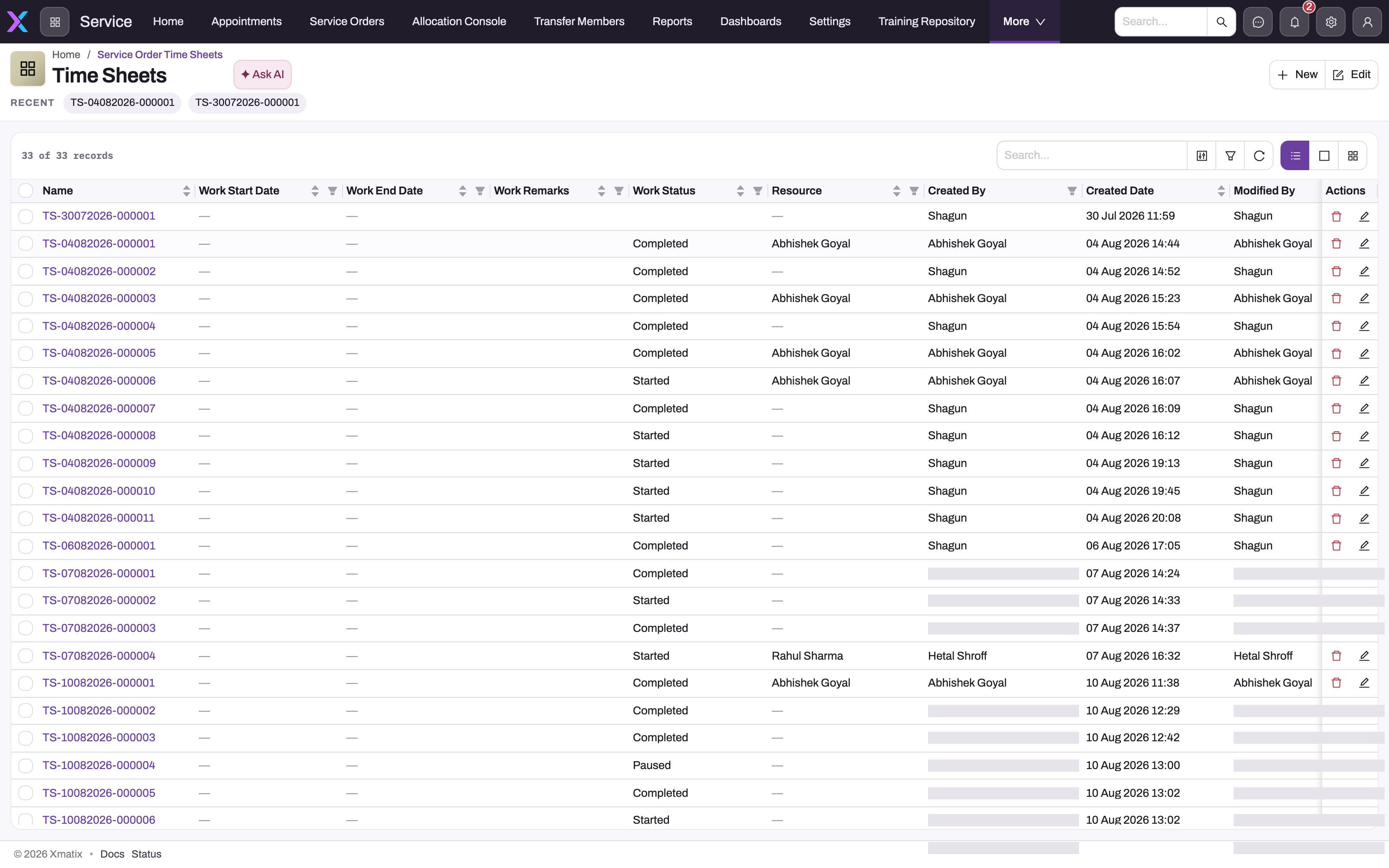
The list title, record count and recent chips identify the population; open a sheet from its Name to run Start, Pause or End.
- 2
Work Start Date and Work End Date are the earliest line start and the final end, written by the stage actions — never typed in the grid.
- 3
Work Status is recomputed from the line segment chains; a Started sheet has a running segment, a Paused one a closed segment awaiting Start.
- 4
Resource is the technician the sheet defaults its lines to; a blank resource is something to correct on the sheet, not in the grid.
- 5
Search, column filters and refresh isolate one technician or status without changing any time-sheet state.
Begin in the Time Sheets list (the entity is Service Order Time Sheet, reached directly at /ServiceOrderTimeSheet or from the service order's related records). The list shows each sheet's work start and end dates, work status, resource, work remarks and audit columns across the workshop population; the stamp columns stay blank until lines have been started and ended. Use it to find the exact labour record before opening it: a row with no resource or no terminal work stamp is evidence to investigate, not a duration to repair in the grid. Search and filters isolate one technician or status without changing any time-sheet state. Sheets created before the status formula was introduced can still show older wording (Started, Completed) in the Work Status column; the current vocabulary is Work Started, Work Paused and Work Ended.
- 1
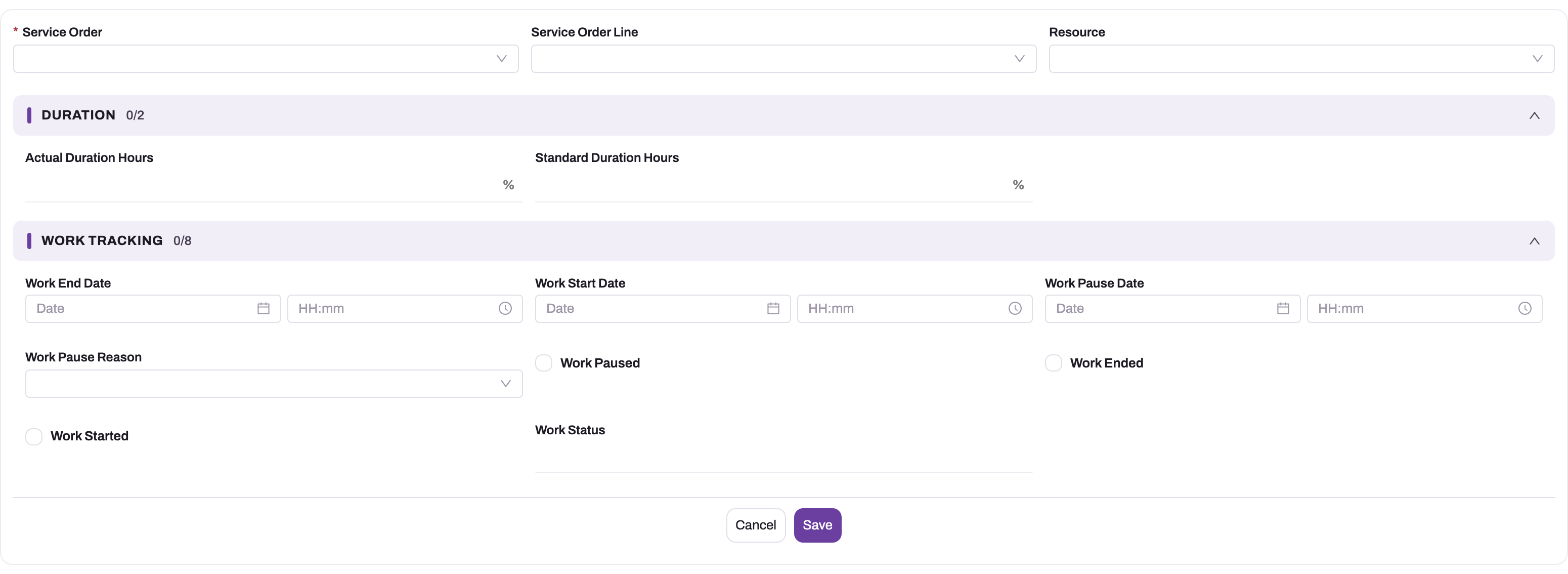
Service Order is the only required field and fixes which job the sheet belongs to; it cannot be moved to another order later.
- 2
Service Order Line narrows the sheet to one work-item line; the Create Time Sheet action on the order does this per line for you.
- 3
Resource is the technician new lines default to when the order line names none.
- 4
Actual and Standard Duration Hours are computed from the line segment chains — leave them blank.
- 5
Work Start, Pause and End dates are stamped by the server at the moment each stage action runs; the form does not accept a user-entered time.
- 6
Work Pause Reason is the picklist a Pause must carry; the Work Started/Paused/Ended flags and Work Status are recomputed, not set here.
The hand-created form (New on the list) makes the ownership chain explicit: Service Order (required), Service Order Line and Resource first, then the Duration and Work Tracking sections. Duration hours, the work stamps and the Work Started/Paused/Ended flags are derived from the stage actions; values typed here are dropped on save, so use the form for the ownership fields only. In day-to-day use you rarely need it — Create Time Sheet on the service order builds the sheet and its lines for you.
Step 1 — Create the time sheet
On the service order, run Create Time Sheet and select the lines to include (selecting none includes all eligible lines). A line is eligible when its item is a Work Item, it has open quantity, and it is not already covered by a sheet, so the picker stops offering a line once it is on one; the action refuses with No service order line is pending time sheet creation when nothing eligible is left. The action creates the sheet linked to the order and adds one time sheet line per selected labour line — item copied from the order line, the technician taken from the order line where it has one and otherwise from the sheet's resource (which defaults from the order's technician or resource). Creating the sheet does not start the clock: the new lines carry no work-start stamp until Start is run. Each covered order line is linked back to the sheet and marked as time-sheet generated, and the order's own Is Time Sheet Generated flag turns on only once every open work-item line on the order is covered.
Step 2 — Start the work
On the time sheet, select the lines and run Start. The server stamps the current time; the action does not accept a user-entered timestamp. The first start opens the line's first work segment. Starting again after a pause opens a new segment, so Start is also how you resume and every earlier interval is preserved. If your layout shows a separate Resume action, it is not implemented on the server and fails — use Start.
Step 3 — Pause when work stops
Run Pause and supply a Work Pause Reason — the reason is required, and it is a picklist your administrator maintains (the shipped values are Paused-Non Availability of Stock and Paused- Non Availability of Technician). The server closes the currently running segment at the current time. A reason supplied with the action applies to the selected lines; a line that already carries a reason keeps it when none is supplied; a line with no reason from either source fails the action before anything is stamped (Work Pause Reason is required when the work is set to Paused.), so a pause never half-applies.
Step 4 — End the work
Run End while the line has a running segment. The server closes that segment at the current time and completes the segment chain. A line cannot be ended before it has started (Work End cannot be marked before Work Start) or while it is paused (Work on this line is paused and that segment is closed. Start it again before marking Work End.), and a line already ended is refused. Ended lines are what the order's completion gate looks for.
Step 5 — Read the roll-up
Each time sheet line shows a Status of Work Started, Work Paused or Work Ended, and the sheet header a Work Status; both, like the parent order's work flags, are recomputed from the current segment chains and are not permanent milestones — starting a new segment after a pause makes the line active again. The header's work start is the earliest line start, its work end appears only once every chain has ended, actual duration is the sum of the closed segments, and paused duration is derived from the gaps between them. These are server-computed fields: a value typed into them is ignored on save and recomputed on the next stage action.
- 1
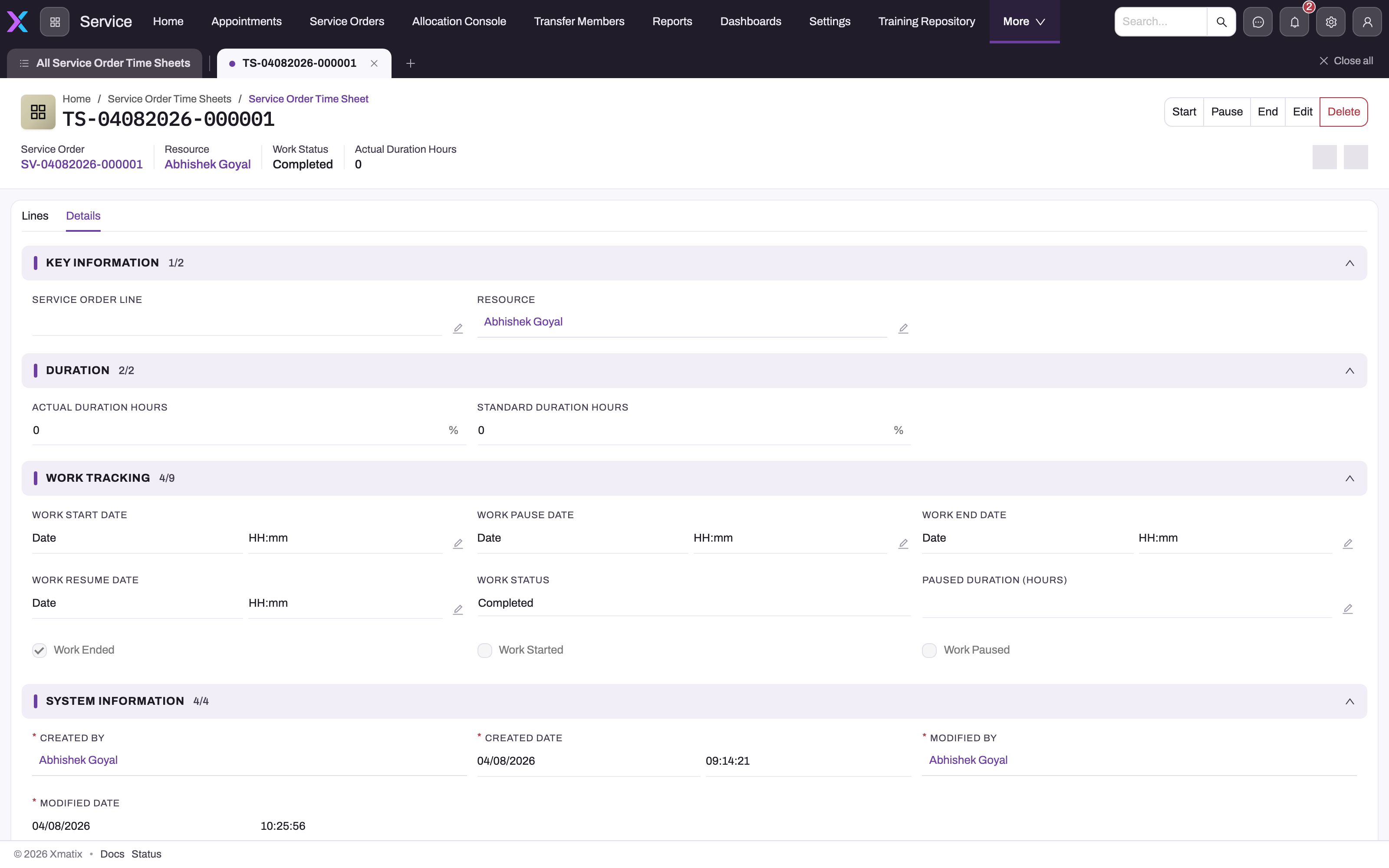
Start, Pause and End are the only supported way to stamp work; Edit changes ownership fields, and Delete removes the sheet.
- 2
The header statistics link the sheet to its service order and resource and show the derived Work Status and actual hours.
- 3
Lines holds one row per labour line; Details is the header view shown here.
- 4
Key Information: the service-order line and resource are the fields a person maintains.
- 5
Work Tracking: start, pause, resume and end stamps, Work Status and the Work Started/Paused/Ended flags are recomputed on every stage action — typed values are dropped.
- 6
Actual Duration Hours is the sum of closed segments; Standard Duration Hours comes from the work item. Both read zero on a sheet with no lines, as here.
On the saved record the header shows the service order, resource, Work Status and actual hours, and the action bar carries Start, Pause, End, Edit and Delete — the supported way to stamp work. The Lines tab lists the sheet's lines (item, resource, status, start and end stamps, actual duration) with Quick Add for a line entered by hand. Use Details to reconcile the roll-up with its inputs: Key Information links the sheet to the service-order line and resource; Duration shows actual and standard hours; Work Tracking exposes the start, pause, resume and end stamps, the derived Work Status and the Work Started/Paused/Ended flags; System Information records the audit trail. On this demo sheet the status reads Completed while the stamps are blank — the sheet has no lines, which is exactly why the stamps and durations show nothing.
Two side effects of the stamps are worth knowing. Logged time becomes money: when a segment closes, service-order lines priced on an Actual Hours (or capped actual hours) basis are repriced from the recorded duration, unless someone has already edited the line's quantity by hand — the order's explicit Reprice action is what overrides that. And when the workshop uses service bays in Labour mode, the time sheet carries Allocate Bays and a bay-candidates lookup, so a wash or alignment operation claims its bay for the duration of the line rather than for the whole job.
Expected result
Each selected labour line appears once on a time sheet linked to the correct order and technician. Its uninterrupted work intervals appear as an ordered segment chain, pause reasons are retained, and computed work and pause durations agree with those intervals. The parent order reflects the chains' current aggregate state. If completion is blocked, find the work-item line without a completed chain or cancellation rather than trying to change duration or status flags.
Common problems
The pause was refused asking for a reason. Every paused line needs a pause reason (Work Pause Reason is required when the work is set to Paused.). Supply one with the action, or put it on the line first — the refusal names the exact lines missing one.
"Work Start is not allowed on one or more selected time sheet lines." / "Work End is not allowed …" A selected line is in the wrong stage for that action — starting a line that is already running, or ending one that has not started, is paused or has already ended. The failure lists every offending line at once and nothing is stamped; fix the selection and re-run.
A part line is missing from the time sheet. By design: time sheets carry labour only. Parts move through fulfilment, allocation and picking on the order itself.
I typed the duration hours and they vanished. Standard and actual duration, the work stamps and the status flags are system-maintained. Client-supplied values for computed fields are discarded on save; use Start, Pause and End to record the correct segment chain.
I can't move a time sheet to another order. The sheet's service order (and each line's order line) is fixed at creation. Create a new sheet on the right order.
The order won't reach Work Completed. Service order cannot be marked as Work Completed until all work item lines have work ended — the message adds how many work-item lines have not ended and how many of those have no time sheet yet. End the work on every applicable line, or cancel work that will not be done, then set the status. Part allocation is a separate fulfilment concern and does not trigger this gate. Invoice generation likewise refuses while a sheet on the order is still open.
Common questions
Can one order have several time sheets?
Yes — Create Time Sheet takes a selection of lines, so a job split across technicians or days can be recorded on separate sheets. The order's work flags consider the lines on each sheet as it progresses, and Is Time Sheet Generated turns on only when every open work-item line is covered.
Who is recorded as having done the work?
Each time sheet line carries a resource — the technician — copied from the order line's technician when the sheet is created, otherwise from the sheet's resource, and adjustable per line afterwards. The order header separately carries the responsible resource and service advisor.
What do the order's work flags actually gate?
The visible status flow (Work To Start, Work In Progress, Work Paused) and the completion gate: Work Completed is refused until every open work-item line has had its work ended. Delivery follows completion. See the service order lifecycle.