
A payslip is the per-employee document of one payroll calculation: the month's earnings, deductions and net pay, with year-to-date context. It is generated from the payroll run, not typed, and it carries a Publish Status of Draft or Published. Two things to know up front: the platform ships no self-service screen where employees browse their own slips — payslips are distributed by printing the payslip document — and there is no Publish action; the status is an ordinary field on the record, and its only effect inside the product is to lock the run against recalculation.
Where they live
Open the Payroll app (App Launcher → search Payroll) and choose Payslips. The list shows every generated slip; a slip's document number opens its detail page, which carries Print Payslip, Tax Declaration, Edit and Delete.
Read the screen
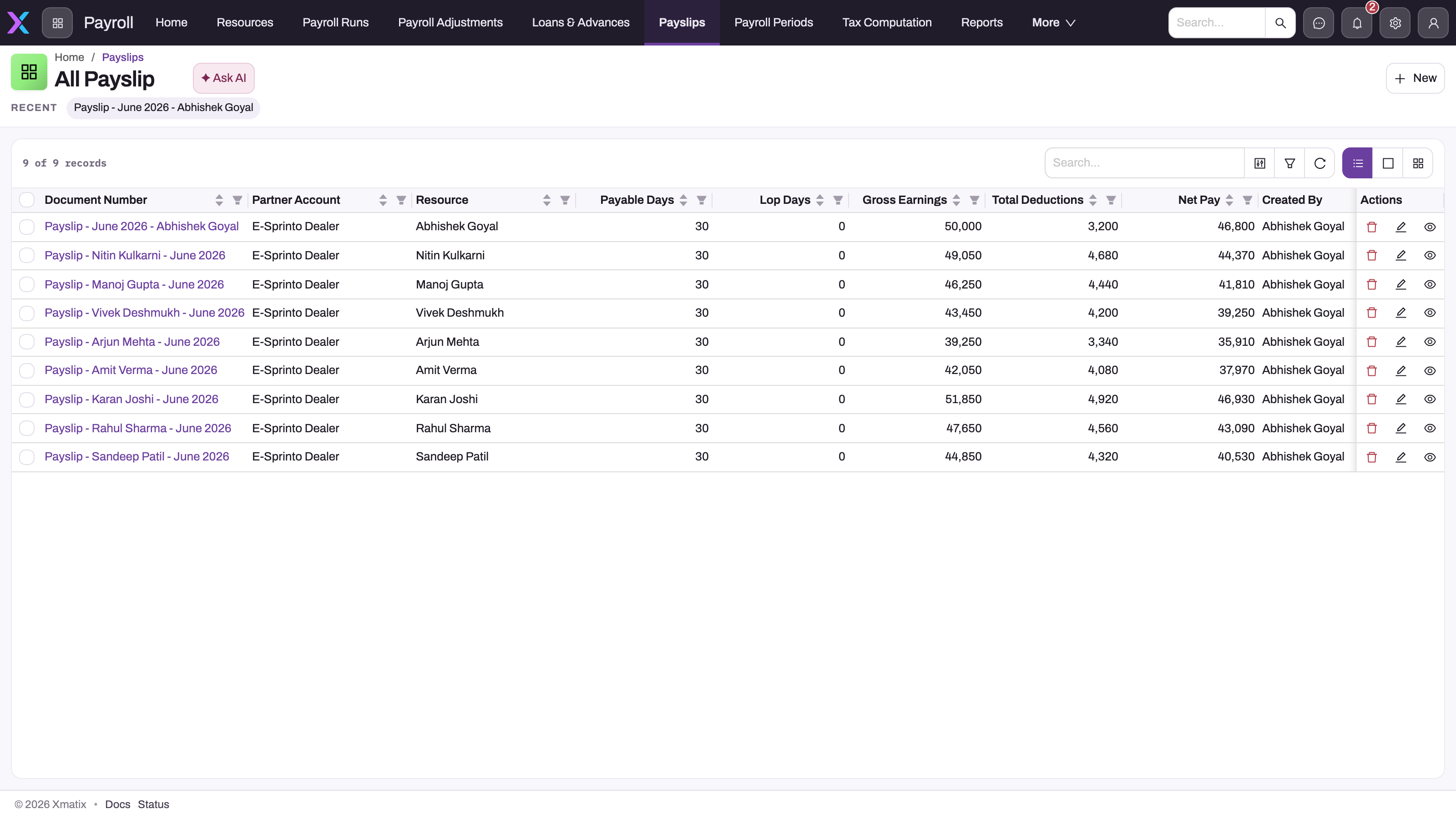
- 1
Payslips on the Payroll app bar — the same records the run's Generate Payslips action creates.
- 2
Document Number opens the slip, where Print Payslip and the Publish Status field live.
- 3
Partner Account and Resource — the paying company and the person; a run generates exactly one slip per processed employee.
- 4
Payable Days and Lop Days — the attendance basis copied from the run detail; 30 and 0 means no proration.
- 5
Gross Earnings, Total Deductions and Net Pay are copied from the run detail at generation; they only change if the run is recalculated and slips regenerated.
- 6
Row actions: delete, edit and view; filter the list by period or run before distributing slips.
Document Number is the stable reference; Partner Account and Resource locate the legal entity and employee; Payable Days and Lop Days expose the time basis used for proration; gross earnings, total deductions and net pay are the calculation's three headline outcomes.
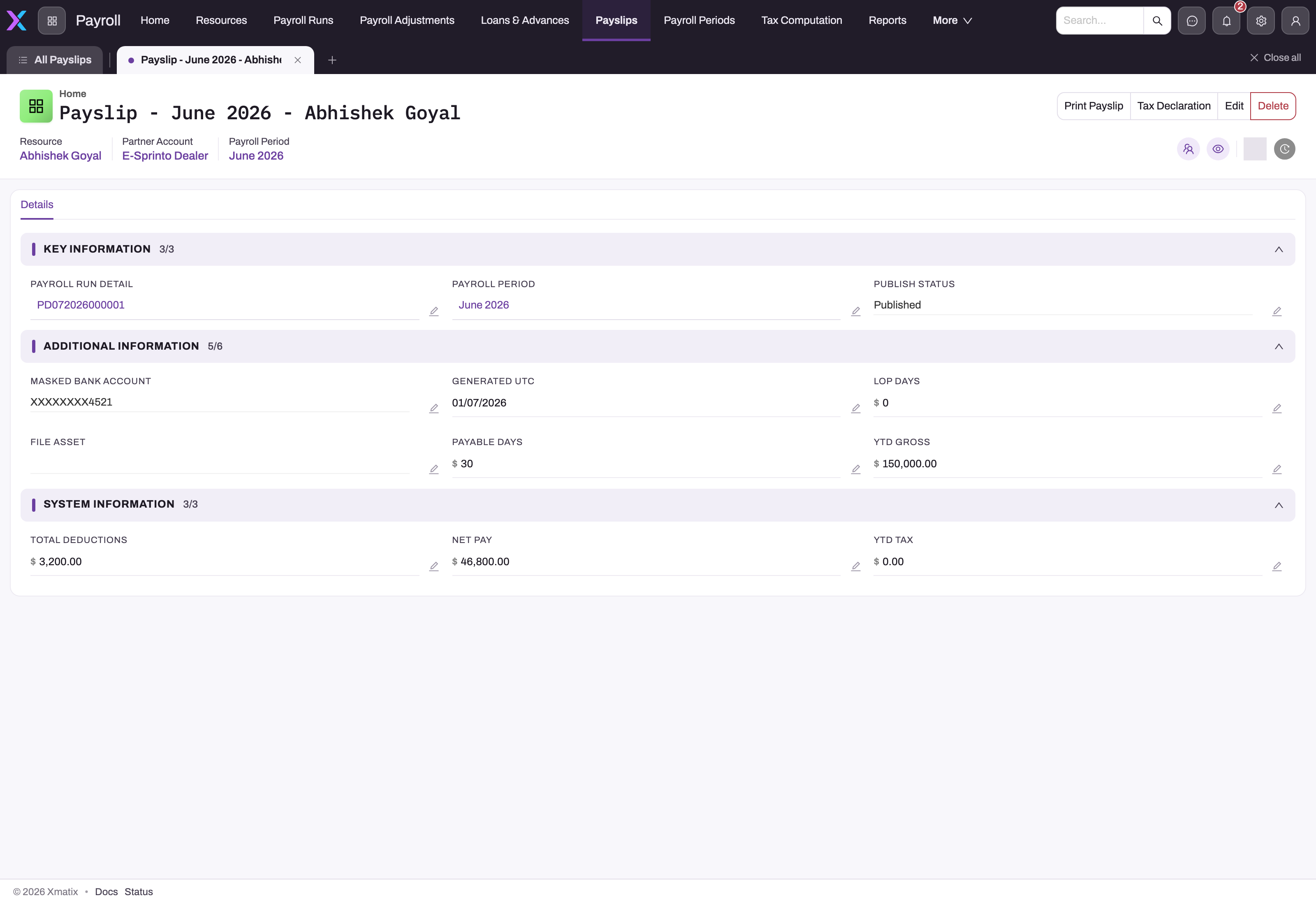
- 1
Print Payslip renders the payslip document for distribution; Tax Declaration opens the employee's declaration. Neither changes the slip.
- 2
Payroll Run Detail — the per-employee run row this slip was generated from; earning and deduction lines are read from that run, never copied here.
- 3
Publish Status — Draft or Published. Generation writes Draft; there is no Publish action, so this is changed with Edit. Once Published, the run can no longer be recalculated.
- 4
Masked Bank Account — the Resource's salary account reduced to its last four digits; File Asset stays empty because no PDF is rendered or stored.
- 5
Payable Days and LOP Days — the attendance basis the run prorated with.
- 6
YTD Gross and YTD Tax sum this employee's run details across the fiscal year that contains the period; Net Pay is the month's headline figure.
The detail confirms the run detail, period, publish state, attendance basis, current totals, year-to-date figures and masked payment account on one record. Component-level earnings and deductions are not stored on the slip — they are the run's calculated component lines, reached through the linked Payroll Run Detail.
What a payslip carries
| Field | What it is |
|---|---|
| Payroll Run Detail, Payroll Run, Payroll Period | The calculation the slip was generated from; the run detail is also the idempotency key — one slip per detail |
| Payable Days, Lop Days | How many days were paid and how many were lost to unpaid leave, copied from the run detail |
| Gross Earnings, Total Deductions, Net Pay | The month's totals, copied from the run detail |
| YTD Gross, YTD Tax | Running totals for the fiscal year the run's period falls in |
| Masked Bank Account | The Resource's salary account shown as a masked prefix plus its last four digits |
| Generated Utc | When the slip was created — not the pay date |
| Publish Status | Draft or Published (see below) |
| File Asset | Reserved for a stored PDF; nothing writes it today |
The earning and deduction lines shown by the printed document are projected from the run's calculated component lines rather than copied — so a payslip can never disagree with its run.
Year-to-date figures
YTD Gross and YTD Tax sum the employee's run details across the payroll periods of the fiscal year containing the run's period — the company's fiscal calendar if one is defined, otherwise the April-to-March year. A year-to-date figure that summed everything ever paid would quietly grow across years, so the scoping is explicit.
Generation, printing and the publish field
Generate Payslips on the payroll run creates one Draft slip per employee detail. Running it again is safe — details that already have a slip are skipped, so a partial generation can be completed without duplicates. If the run is recalculated while its slips are Draft, the slips are retired with the old pass; generate again after reviewing.
Print Payslip on a slip renders the payslip document for printing or saving. It changes no payroll data and does not touch Publish Status. This is how slips reach employees: print or export the document and distribute it through your own channel.
Publish Status is set by editing the slip (the pencil on the field). Changing it to Published has exactly one effect in the product: the originating run refuses to recalculate while any of its slips is Published, because recalculating would contradict a document that has been handed out. Nothing else reads the field — it does not make the slip visible anywhere, send anything, or lock the slip itself. Use it as your own "distributed" marker after the salary has actually been paid.
Tax Declaration on a slip opens the employee's tax declaration record for the financial year (see Income tax on salary).
Payslips and the run lifecycle
| Run event | Effect on payslips |
|---|---|
| Calculate (again) | Draft slips of the run are retired with the old pass; blocked entirely if any slip is Published |
| Generate Payslips | Missing slips created as Draft; existing ones untouched |
| Post / Generate Payment / Pay | No effect on slips |
| Publish Status set to Published (by edit) | The run can no longer be recalculated |
Common questions
How does an employee get their payslip?
By the document you print or export with Print Payslip and send through your own channel. There is no employee portal or mobile screen that lists payslips, so Publish Status does not make a slip visible to anyone.
The payslip is wrong — can we fix it?
If the run is unposted and no slip is Published: fix the inputs, recalculate the run, regenerate. If a slip is Published, set it back to Draft first or the run will refuse to recalculate. If the run is already posted, correct forward with a payroll adjustment in the next period — which is also the honest audit trail.
Where does the year-to-date tax figure come from?
It is the sum of salary TDS across the employee's run details for the fiscal year of the run's period — the same figures the period TDS challans deposit. The authoritative annual computation is the income-tax projection.
Why is the bank account masked?
The payslip is a distributable document; the full account number lives on the Resource and is only needed by the payment batch. The slip shows the last four digits — enough for the employee to recognise the account, not enough to misuse.