
When an employee exits, one document closes the relationship: the Full & Final Settlement. You enter what the company still owes — salary up to the last working day, leave encashment, gratuity, pending reimbursements — and what the employee owes back — notice recovery, unrecovered loans, final TDS — as lines, and Post writes the result once: payable expenses debited, recovery payables credited, and the net owed to the person raised as a Payroll Payable open item. Posting also flips the employee to Settled and Exited, so the next payroll run leaves them out automatically.
The settlement is a posting and closure document, not a calculator: it validates, nets, posts and closes; the amounts themselves are yours to compute per policy.
Where it lives
Open the Payroll app from the App Launcher and choose More → Full & Final Settlements. The list shows every settlement with its Resource, last working day and net; the name opens the record, whose header carries Edit, Delete and Post, and whose tabs are Lines and Details.
Prerequisites
- The employee's exit in motion: last working day known, final attendance and unpaid-leave inputs settled.
- Outstanding loans and advances reviewed, so the recovery amounts are current.
- A Payroll Payable control account configured for the company, and the expense and payable GL accounts at hand for every line you will enter.
- The employee's regular payroll stopped after their final normal run — the settlement is instead of, not in addition to, another month's salary.
Statuses
| Status | Set by |
|---|---|
| Draft | Creation; the record is fully editable |
| Posted | Post — the journal exists, the employee is closed, the record no longer posts |
The picklist also offers Approved, In Progress and Paid, but no action sets them; if your process uses them, set them by editing the record and treat them as labels.
Procedure
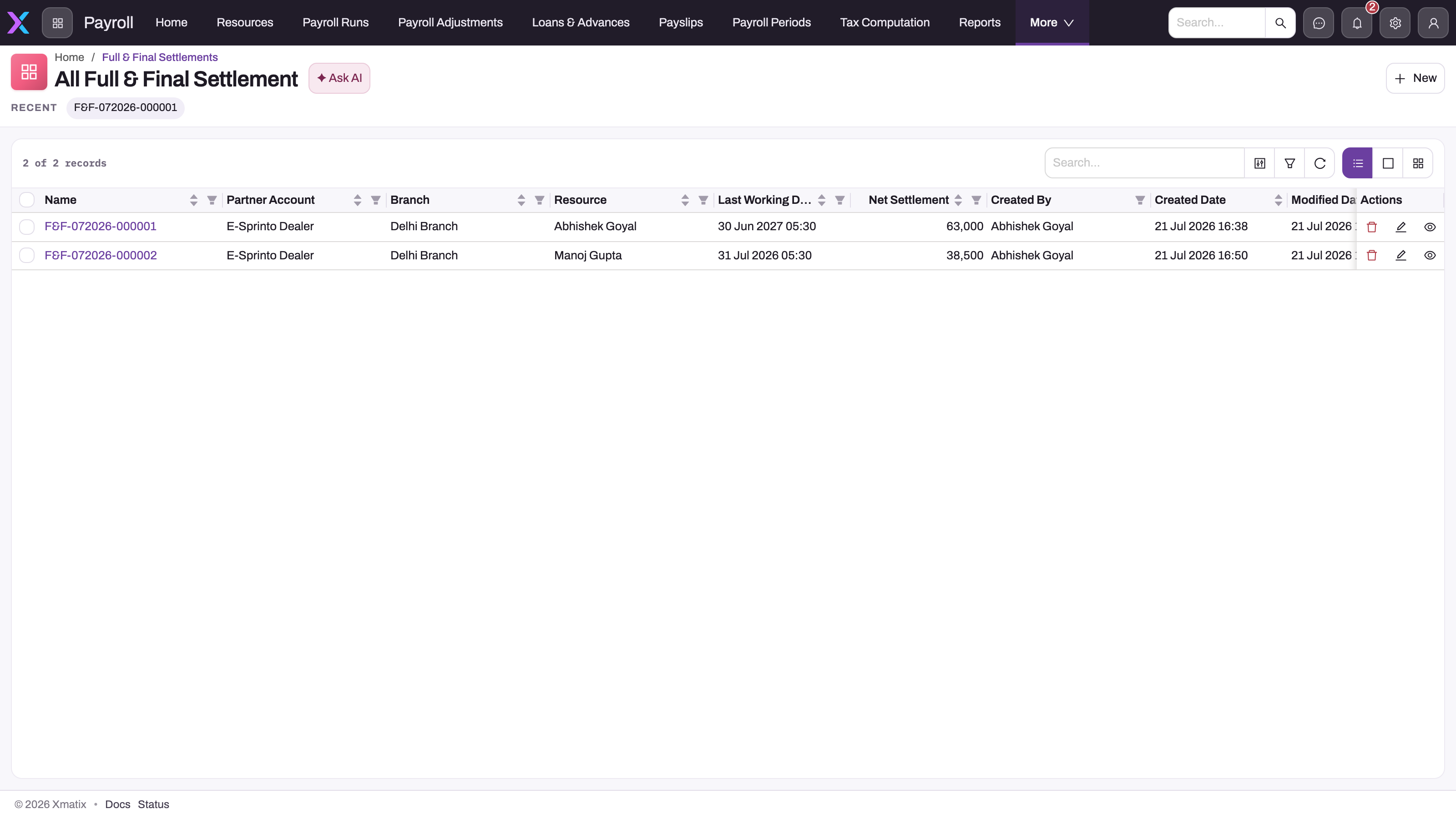
- 1
Full & Final Settlements sits under More on the Payroll app bar.
- 2
The name opens the settlement with its Lines and Details tabs and the Post button; check here before creating a second settlement for the same person.
- 3
Resource — the person being settled; posting flips their Employee record to Settled / Exited.
- 4
Last Working Day becomes the journal date and the Date Of Exit stamped on the employee.
- 5
Net Settlement — payable lines minus deduction lines; posting recomputes and overwrites whatever was typed on the header.
- 6
New opens the header form (Name, Resource, Partner Account, Branch, Last Working Day); lines are added on the saved record.
Step 1 — Create the settlement
Click New and fill the header: Name, Resource (the exiting person), Partner Account (the legal employer), Branch, and Last Working Day. Leave Net Settlement blank — Post computes it. The last working day matters beyond record-keeping: it becomes the posting date of the settlement journal and, if the employee has no exit date yet, their Date Of Exit.
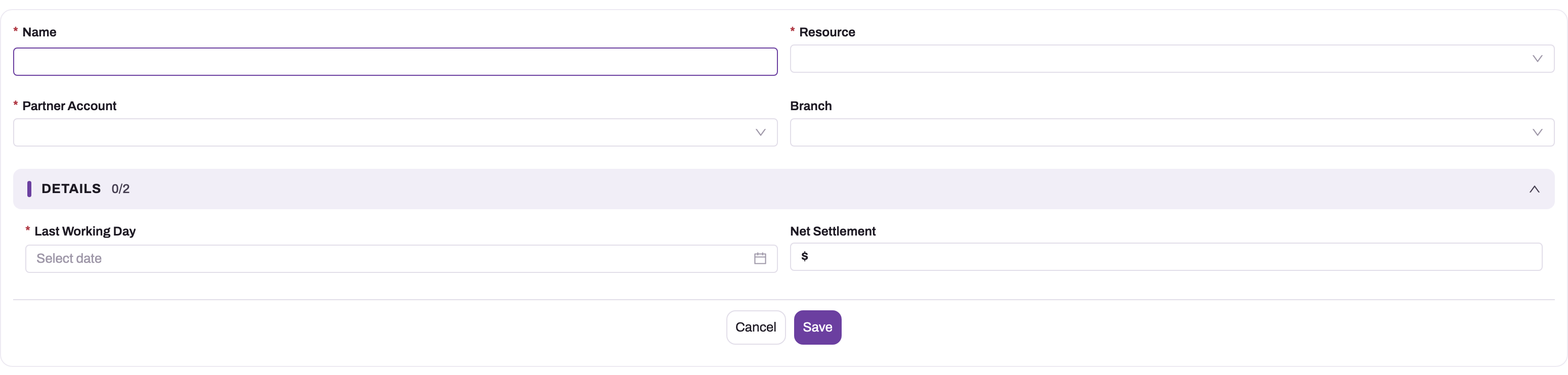
- 1
Name (required) — use a recognisable label; the document number is generated on save.
- 2
Resource (required) — the exiting person; the payable open item and the employee status change are keyed on it.
- 3
Partner Account (required) — the legal employer whose Payroll Payable control receives the net.
- 4
Last Working Day (required) — the settlement journal's date and the employee's Date Of Exit if none is set.
- 5
Net Settlement can be left blank — Post computes payables minus deductions and stores it here.
- 6
Save creates a Draft; add lines on the Lines tab, then Post.
Step 2 — Enter the payable lines
On the saved record's Lines tab, click New for each amount owed to the employee — salary till the last working day, leave encashment, gratuity, pending reimbursement. Each F&F Line has a Name, a Component Type, an Amount, a Description, a GL Account and a Payable GL Account. For a payable line, set Component Type to anything other than Deduction (Earning or Payable read naturally) and fill the GL Account it should debit — Post refuses a payable line without one. Compute the amounts per your policies and keep one line per component so the posted journal stays readable.
Step 3 — Enter the deduction lines
Add a line for each recovery — notice-period recovery, the outstanding balance of any loan or advance, final tax — with Component Type exactly Deduction and the Payable GL Account it should credit: the loan's control account for a loan recovery, the salary-TDS payable control for tax. The settlement's net is payables minus deductions and it must not be negative; if recoveries exceed payables, posting is refused, forcing the excess to be handled explicitly (a receivable, a waiver — a decision, not a silent negative salary).
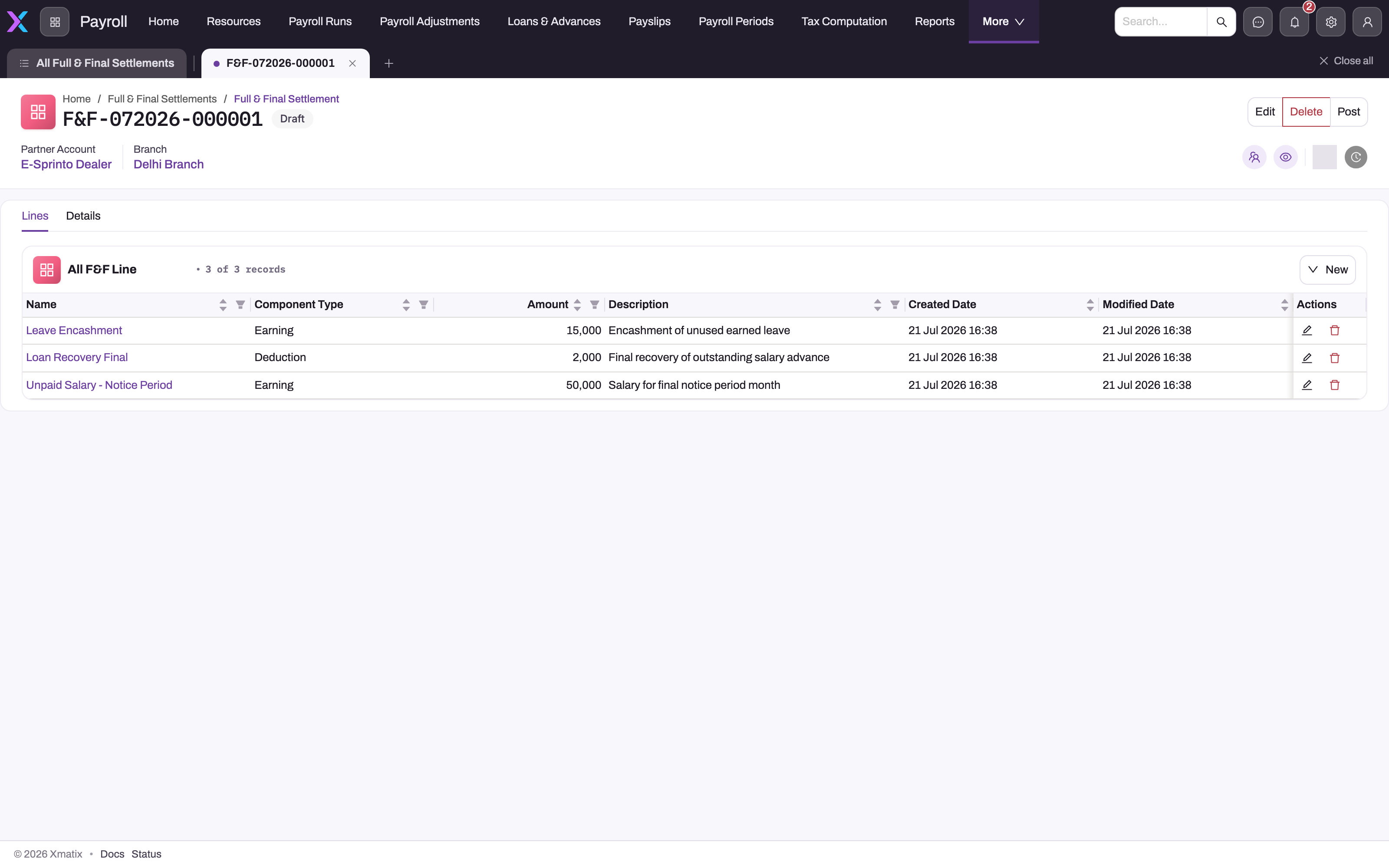
- 1
Draft — the settlement is editable; Post is the only action that changes it.
- 2
Post validates the lines, writes the journal dated on the last working day, raises the payable open item and marks the employee Settled / Exited.
- 3
Component Type is free text: exactly 'Deduction' makes the line a recovery credited to its payable GL; any other value (Earning, Payable…) is a payable debited to its GL account.
- 4
Amount — always positive; direction comes from Component Type. The net (payables minus deductions) must not be negative.
- 5
Description carries the policy basis (encashment days, notice period) — the platform does not compute these figures.
- 6
New adds a line; open a line to set its GL Account (payables) or Payable GL Account (deductions), which Post requires.
Review every line's type, amount and account, and reconcile the total to what you expect the net to be before posting.
Step 4 — Post the settlement
Click Post. Validation runs first — the record is not already posted, it has a Resource, at least one non-zero line exists, every payable line has a GL Account and every Deduction line a Payable GL Account, the net is not negative, and the company has a Payroll Payable control. Any failure names the line. Posting then writes one journal of type Payroll dated on the last working day: payable expenses debited per account, deduction payables credited per account, and the net credited to Payroll Payable — raising a person-keyed open item for exactly the net settlement. The record becomes Posted, stores the journal in GL, the open item in Payroll Payable Open Transaction and the computed Net Settlement; a posted settlement refuses to post again.
Posting also closes the employee: Settlement Status Settled, Employment Status Exited, Date Of Exit filled from the last working day if empty — which is what excludes them from every future payroll run.
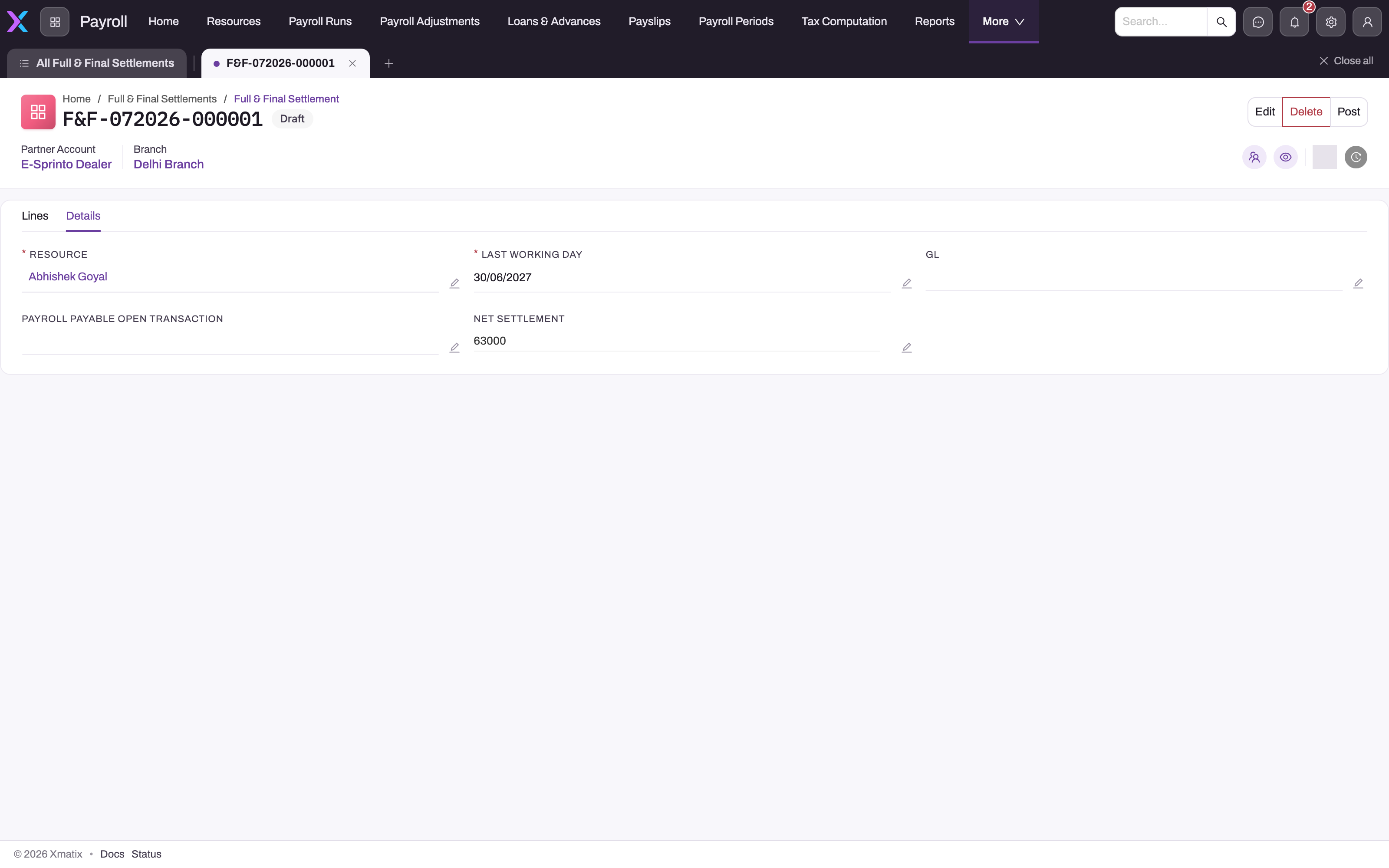
- 1
Resource — required for posting; the Employee record linked to this person is what gets closed.
- 2
Last Working Day — journal date, open-item document date and Date Of Exit.
- 3
GL — empty until Post; once filled it also acts as the already-posted guard, so a settlement never posts twice.
- 4
Payroll Payable Open Transaction — the open item raised for the net; the salary payment batch does not pick it up, so it is discharged by a separate payment.
- 5
Net Settlement — recomputed by Post from the lines; a typed value is overwritten.
- 6
Post is refused when recoveries exceed payables, a line lacks its account, or no Payroll Payable control is configured.
Step 5 — Pay the net settlement
The net sits on the Payroll Payable control as an open item against the person. The monthly salary payment batch does not pick it up — it only settles items raised by a payroll run — so discharge the settlement with a separate payment: post the bank payment (debit Payroll Payable, credit bank) and apply it against the open item as described in Recording and applying payments. Nothing sets the settlement to Paid; record that state in your exit checklist or by editing the Status label.
Step 6 — Close the recovered loan
A Deduction line credited to a loan's control account clears the ledger balance, but it does not update the Loan / Advance record: its Outstanding Amount, its receivable open item and its Active status stay as they were. Edit the loan to set the outstanding to zero and its Status to Closed (or Written Off) so it does not appear as still recoverable, and note the settlement in its name or description.
Expected result
The settlement is Posted exactly once, stores its journal reference, and its net equals total payable lines less total Deduction lines. The employee is Settled / Exited from the last working day, future runs exclude them, and the Payroll Payable open item is either outstanding for the exact net or cleared by the separate payment. If any of those facts disagrees, do not create a second settlement — trace the saved journal, open item and payment application first.
Common problems
Post is refused: "Net settlement is negative; recoveries exceed payables." The Deduction lines total more than the other lines — commonly a large unrecovered loan against a short final month. Reduce the recovery to what the payables cover and pursue the remainder as a receivable, or add the payable you had not entered yet.
A line fails for a missing account. Payable lines need a GL Account; Deduction lines need a Payable GL Account. The error names the line. For loan recoveries use the loan's own control account so the control balance clears.
Post is refused: no Payroll Payable control account. Configure the company's Payroll Payable control in Payroll configuration — the same control the monthly run posts to.
The employee still appeared in this month's run. The settlement had not been posted when the run calculated — exclusion happens at posting, when Employment Status flips to Exited. Post the settlement, then recalculate the run (recalculation replaces the pass).
Common questions
Does the settlement calculate leave encashment, gratuity or notice recovery for me?
No. You enter each payable and deduction as a line with its amount and account; the platform validates, nets, posts, raises the open item and closes the employee. Policy arithmetic happens per your rules before the lines are entered — put the basis in the line's Description so the journal stays explainable.
Can I pay the settlement through the salary payment batch?
No. The batch is built from a payroll run's details and settles only open items that run raised. The settlement's net is a separate open item on the same Payroll Payable control and is discharged by its own payment.
What if something surfaces after posting?
The settlement will not repost, and that is deliberate — the ledger already reflects it. Handle a late item the way finance handles any posted document: a correcting journal or payment for the delta, leaving the original settlement intact as the record of what was decided at exit.
Where does TDS on the settlement go?
Enter it as a Deduction line crediting the salary-TDS payable control. Note that Prepare TDS Challan on a payroll run sums only posted run details, so a settlement's TDS is not included in the drafted challan automatically — add it to the deposit deliberately. See Statutory deductions and challans.