
Indian payroll deducts for several statutory schemes — provident fund (PF), employee state insurance (ESI), state professional tax (PT), labour welfare fund (LWF) and income tax at source (TDS, covered on its own page). In xMatix every one of them rides the salary structure's component machinery and posts to its own payable control account, and each is deposited through a Statutory Challan. What differs between the schemes is how the amount arises, and this page is precise about that, because the product computes two of them and merely records the other three.
What the run computes, and what it does not
| Scheme | How the amount is produced in a run |
|---|---|
| PT | Computed. A component whose statutory type is PT and whose calculation type is Slab is resolved at calculation time against the company's Professional Tax Slabs for the gross accumulated by the lines before it, using the slab's February amount when the period ends in February. |
| TDS | Computed. A component whose statutory type is TDS takes the employee's Monthly TDS Projection for the period, produced from the financial year's tax rule tables and verified declarations. |
| PF, ESI, LWF | Not computed from rule tables. They are deducted only if the salary structure carries a component of that statutory type, and the amount is whatever the line's own calculation yields — typically a Percentage of the basic component (PF), a Percentage of gross (ESI) or a Fixed amount (LWF), clamped with Max Amount where a wage ceiling applies. The PF Rule, ESI Rule and LWF Rule tables can be recorded, and the employee carries PF / ESI / PT / LWF applicability flags and a PF wage-cap override, but the calculation reads none of them. |
Practical consequences: an ESI eligibility threshold, a PF wage ceiling or a per-employee PF cap override has to be expressed on the structure itself (a Max Amount, or a separate structure for employees above the ESI threshold), and a rate change in the law is a change to the component lines, not to the rule tables. Employer-side contributions are components of type Employer Contribution: they cost the employer without reducing the employee's net, and post as an expense and a payable in the same journal.
The run detail sums deduction components typed PF, ESI and TDS into per-employee PF, ESI and TDS totals — the figures the register, the payslip's year-to-date tax and the TDS challan read.
Where the records live
Open the Payroll app (App Launcher → search Payroll). Statutory Challans sits under More; the rule tables — PF Rules, ESI Rules, Professional Tax Slabs, LWF Rules — and Payroll Components are reached by typing their names into the App Launcher search box.
Professional-tax slabs
A Professional Tax Slab row belongs to a company (Partner Account) and carries a gross-wage band, the monthly PT amount, an optional February amount, a state code, an effective-from date and an active flag. The calculation loads every active slab of the run's company — it does not filter by state — so keep one state's slabs per company, or split payroll companies by state. Revise a slab by adding a new row and deactivating the old one. The PT component must sit after the earning lines in the structure's sequence, because the slab is matched against the gross computed so far.
From deduction to payable control
When the run posts, every statutory deduction and employer contribution is credited to the Payable GL Account mapped on its Payroll Component. Give each scheme its own control account with the matching control type — PF payable, ESI payable, professional-tax payable, salary-TDS payable, LWF payable — so the ledger answers "how much do we owe each authority" as an account balance, and so a challan without an explicit payable account can find the right control by its statutory type.
Challans: recording what you deposit
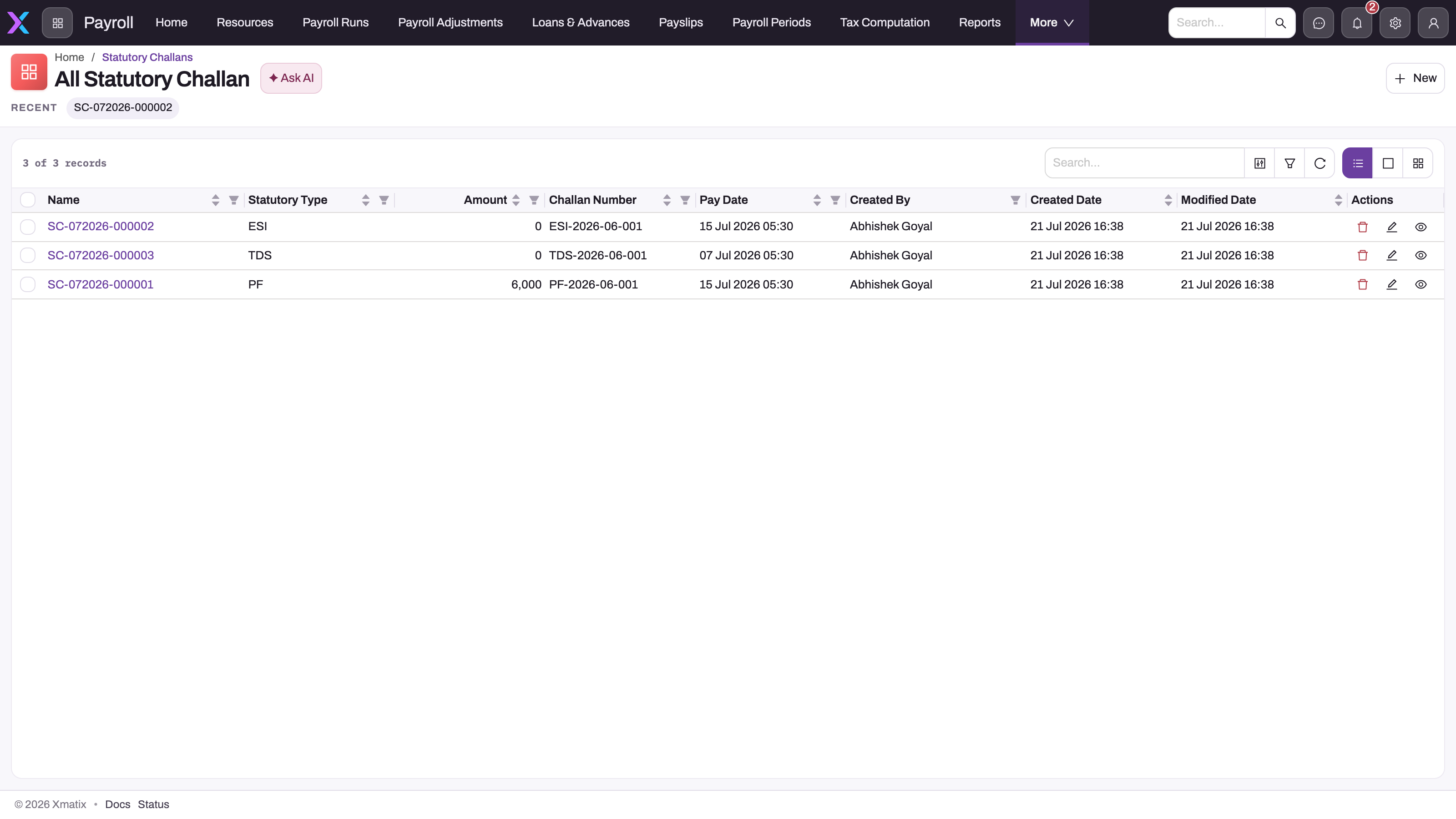
- 1
Statutory Challans is reached under More on the Payroll app bar (or by searching the App Launcher).
- 2
The name opens the challan, where Post Challan records the deposit in the ledger.
- 3
Statutory Type — PF, ESI, PT, TDS, LWF or Gratuity; only TDS challans are drafted by the run's Prepare TDS Challan action, the rest are entered by hand.
- 4
Amount — the deposit total for the company and period; for a drafted TDS challan it is the posted TDS summed across the period's posted runs.
- 5
Challan Number and Pay Date preserve the acknowledgement; Pay Date also becomes the posting journal's date.
- 6
New creates a manual challan for PF, ESI, PT or LWF — the platform does not compute those deposit amounts.
A Statutory Challan records one deposit to one authority for one payroll period: Partner Account, Statutory Type (PF, ESI, PT, TDS, LWF, Gratuity), Payroll Period, Amount, Challan Number, Pay Date, Payable GL Account, Bank GL Account and, once posted, the GL journal. The record also stores a BSR Code and Challan Serial for the TDS CIN, although the default form does not show them. Two actions drive the flow:
- Prepare TDS Challan — on a posted payroll run. It sums the TDS of every posted run detail in the run's period (so off-cycle and correction runs deposit together) and creates or refreshes the company's TDS challan for that period. It is idempotent per company and period: an unpaid draft has its amount refreshed after late postings; a challan already Paid is never touched, and the difference between its amount and the posted TDS is reported so the shortfall can go on the next deposit deliberately.
- Post Challan — on the challan. It requires an amount above zero and a Bank GL Account, resolves the payable control from Payable GL Account or, when blank, from the Statutory Type, and writes one journal dated on Pay Date (today if blank): payable control debited, bank credited. The challan's Status becomes Paid and its GL link is filled; a challan with a journal refuses to post again.
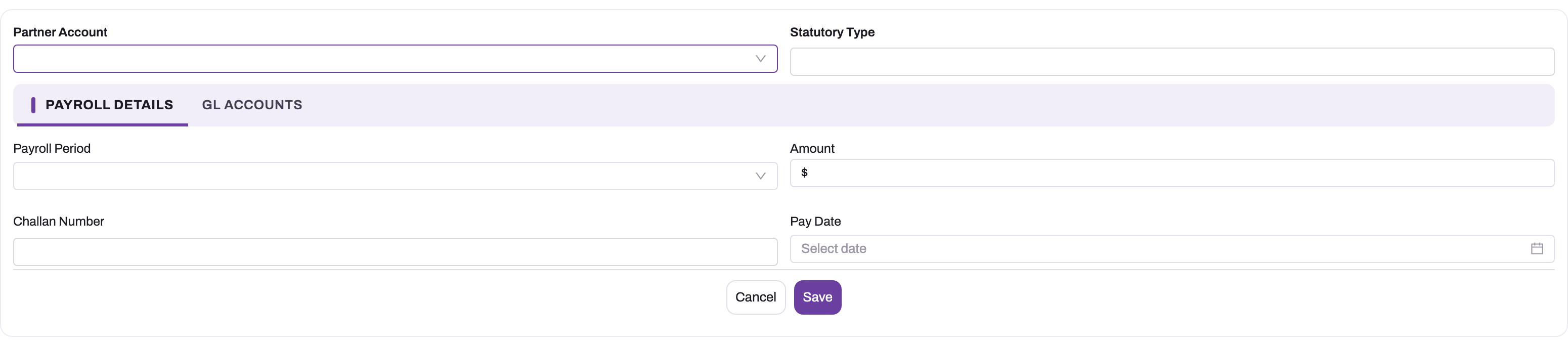
- 1
Partner Account — the company whose statutory payable control is cleared; it also scopes the control-account lookup when the payable GL is left blank.
- 2
Statutory Type — PF, ESI, PT, TDS, LWF or Gratuity; when Payable GL Account is blank, posting resolves the control from this type.
- 3
Payroll Details holds the deposit facts; GL Accounts holds Payable GL Account, Bank GL Account and (after posting) the GL journal.
- 4
Payroll Period — the period whose liability the deposit clears; TDS challans are unique per company and period.
- 5
Amount — reconcile it to the posted run liabilities for the scheme before paying; Post Challan posts exactly this figure.
- 6
Challan Number and Pay Date — the acknowledgement; Pay Date dates the posting journal (blank falls back to today).
PF, ESI, PT and LWF challans are entered by hand with New: choose the company, scheme and period, type the amount you are depositing (reconcile it to the posted payable balance for that scheme and period first), fill the acknowledgement fields, and post. The platform does not compute those deposit amounts — the payable control's balance is the figure to match.
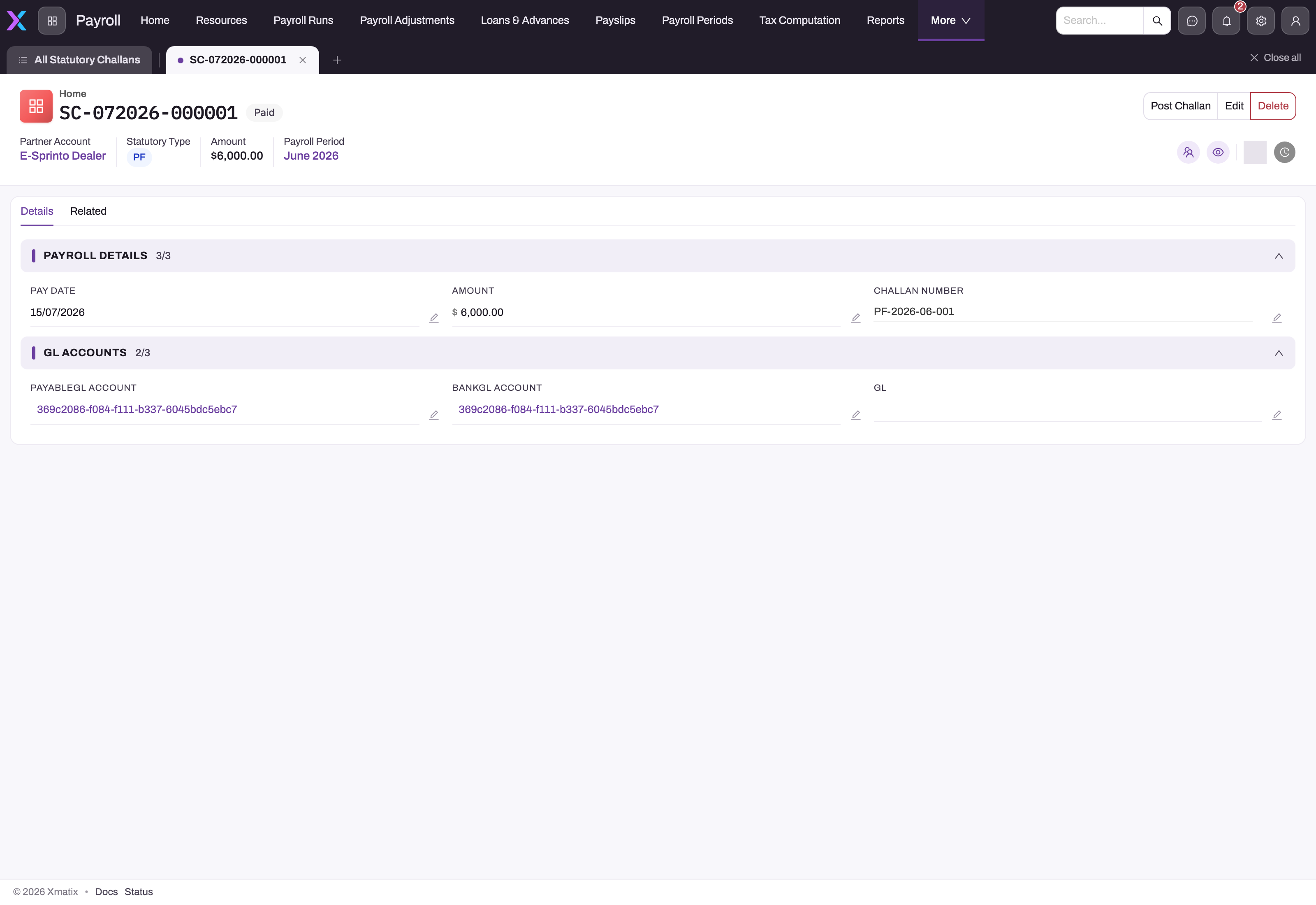
- 1
Post Challan — debits the payable control, credits the bank GL, dates the journal on Pay Date and sets Status to Paid; refused without a bank account, with a zero amount, or if GL is already filled.
- 2
Statutory Type, Amount and Payroll Period identify which liability this deposit clears — reconcile Amount to the payable control's balance for the period.
- 3
Amount is posted exactly as entered; Pay Date is the journal date and Challan Number the acknowledgement reference.
- 4
Payable GL Account — the control debited; leave it blank and posting resolves the control from the Statutory Type (PF payable, ESI payable, PT payable, salary-TDS payable, LWF payable).
- 5
Bank GL Account — required for posting; the account the deposit leaves from.
- 6
GL — the posting journal; empty means the challan has not been posted whatever the status label says.
The status vocabulary is loose: a drafted TDS challan is written as Pending, posting writes Paid, and the field's picklist offers Draft, Paid and Reconciled — treat the presence of a GL journal, not the label, as proof of posting.
Common questions
Where do I change a rate when the law changes?
For PF, ESI and LWF: on the salary structures' component lines (the percentage or fixed value, and the Max Amount for a ceiling) — the rule tables are not consulted. For PT: add a new Professional Tax Slab row and deactivate the old one. For TDS: in the financial year's tax rule tables (see Income tax on salary). Runs calculated after the change pick up the new configuration; recalculate an unposted run to apply it.
An employee's PF should cap at a different wage than the rest — possible?
Not through the employee record: the PF wage-cap override there is stored but not read. Put the employee on a salary structure whose PF line carries the different Max Amount.
Why does the February professional tax differ?
Some states collect a different amount in February so the year totals to the statutory annual figure. The slab row carries both the monthly amount and an optional February amount, and the calculation uses the February amount for periods ending in that month.
One period had two payroll runs — how many TDS challans?
One. The challan is per company and period, and Prepare TDS Challan sums posted TDS across all of the period's runs. If a correction run posts after the challan was already paid, the difference is reported rather than silently edited, and you deposit it separately.
Does a full-and-final settlement's TDS reach the challan?
Not automatically — Prepare TDS Challan reads run details only. Add the settlement's TDS deduction to the deposit yourself. See Full and final settlement.