
Salary TDS is a projection problem: every month the employer must estimate the employee's tax for the whole financial year and deduct a proportionate slice. xMatix makes that projection explicit and persistent — a Monthly TDS Projection record per employee per payroll period — computed from configured tax rule tables and the employee's verified declarations, always under both regimes so the comparison is never guesswork, with the elected regime driving the actual deduction. The payroll run's TDS component then reads that record, so deduction and comparison come from one computation.
Where the records live
Open the Payroll app (App Launcher → search Payroll). Tax Declarations is under More; Monthly TDS Projections and the rule tables — Tax Regime Rules, Salary Tax Slabs, Tax Surcharge Slabs, Tax Deduction Sections — are reached by typing their names into the App Launcher search box. A payslip's Tax Declaration button opens the employee's declaration directly.
Two tax screens deserve a warning. The app bar's Tax Computation page renders fixed sample figures — it does not read your payroll data, so do not use it for operations; the real numbers are the Monthly TDS Projection records and the run register. The TDS Calculation Sheet tab on an Employee record is a worksheet preview that may render empty for an employee without projectable data.
Regimes are data, elections are per employee
Everything that changes with a Budget lives in per-financial-year rule tables, one set per regime:
- Tax Regime Rules — the scalar parameters: standard deduction, the rebate's income ceiling and maximum, whether rebate marginal relief applies, the surcharge cap, the cess rate, the rounding unit, and what the regime allows at all (chapter deductions, house-property loss set-off and its cap).
- Salary Tax Slabs — the progressive bands and marginal rates, by regime and financial year (and age band for the Old regime).
- Tax Surcharge Slabs — the income thresholds and surcharge rates, capped per regime.
- Tax Deduction Sections — one row per declarable section: its ceiling, a senior-citizen variant where the law provides one, availability per regime, whether the employer may allow it against salary TDS, and membership of an aggregate-cap group for sections that share one combined ceiling.
Rule rows with no company (Partner Account blank) are shared by every legal entity; a company-specific row overrides the shared one. Each employee elects a regime on the Employee record's Tax Regime field; where none is recorded, the New regime applies as the statutory default. One limitation to know: the projection has no date of birth to work from, so every employee is taxed in the general age band — senior-citizen slabs can be seeded but never apply.
Declarations: only verified amounts count
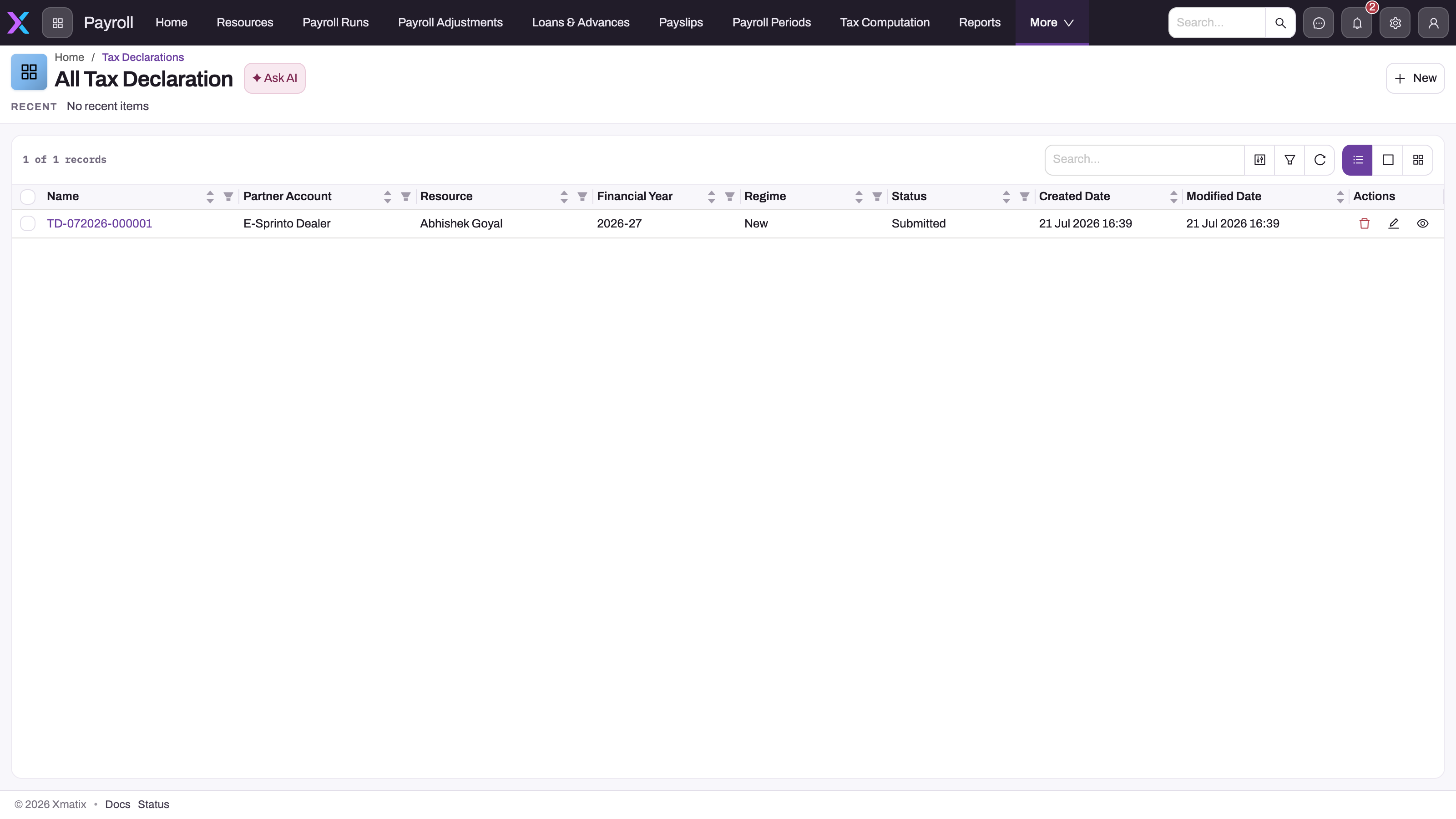
- 1
Tax Declarations is under More on the Payroll app bar (or search the App Launcher); a payslip's Tax Declaration button opens the same record.
- 2
Open the declaration to review its lines — one per deduction section with the declared amount and, after proof-checking, the verified amount.
- 3
Resource — the employee; the projection matches declarations by Resource and Financial Year.
- 4
Financial Year in the form 2026-27 must equal the year derived from the payroll period, or the declaration is ignored.
- 5
Status — Draft, Submitted, Verified, Approved or Rejected; the projection reads Verified and Approved only, using the verified amount when present.
- 6
New creates a declaration header for an employee and year; add section lines on the saved record.
Employees' deductions and investments are entered as a Tax Declaration per financial year — a header (Resource, Partner Account, Financial Year in the form 2026-27, Regime, Status) with a Tax Declaration Line per deduction section carrying the declared amount and, once proof is checked, the verified amount. Status moves Draft → Submitted → Verified or Approved (or Rejected). The projection reads only Verified and Approved declarations whose Financial Year matches the period's year, and uses the verified amount when present, otherwise the declared one. A declaration sitting in Draft or Submitted contributes nothing — the safe direction: tax is over-deducted, not under-deducted, until proof arrives. There is no employee self-service form; declarations are entered and verified by the payroll operator.
The monthly projection
Project TDS on a payroll run computes a projection for every non-exited employee of the company whose Tds Applicable flag is on (the run's Calculate action does this first, so the deduction always reads a fresh figure). For each employee it:
- Sums the financial year's already-calculated run details, excluding the current run — gross to date and TDS already deducted.
- Projects the annual gross: actuals to date plus a monthly figure for each month remaining in the year (April counts twelve, March one). The monthly figure is the average of the calculated months; an employee with no calculated months yet is projected from the CTC on their Resource Compensation, treated as a monthly amount.
- Builds the income facts — projected salary plus the verified declaration claims, each capped by its section's ceiling and by any shared aggregate ceiling its cap group imposes, and dropped if the regime does not allow the section.
- Computes the full-year tax under both regimes in the statutory order: slab tax, less rebate where income is at or under the ceiling, less rebate marginal relief where the regime provides it, plus surcharge with marginal relief at each threshold, plus cess, rounded to the configured unit.
- Applies the elected regime, spreads the remaining liability over the remaining months — monthly TDS is the annual tax less what is already deducted, divided by the months left — and persists the projection, replacing any earlier one for the same employee and period.
The record keeps the whole comparison: Taxable Income If Old / If New, Tax If Old Regime / If New Regime, Recommended Regime, Annual Saving, Applied Regime, and On Dearer Regime — raised only when the employee's elected regime is genuinely dearer — a ready-made review list for HR before proof season closes. If the financial year's rule tables are not seeded, no projection is written and the run's TDS component deducts nothing rather than guessing. The Revised After Proof field exists but no code path sets it.
When the run calculates, a component whose statutory type is TDS reads the month's projection as its amount. Without such a component on the structure, the projection is computed and ignored.
Depositing and Form 16
The month's deducted TDS posts to the salary-TDS payable control and is deposited per period through Prepare TDS Challan on the run — see Statutory deductions and challans.
Form 16 buttons appear on the payroll run and on payslips, but neither produces a certificate: the run's button has no server implementation and returns an error, and the payslip's is a screen-only action. Certificates are issued from the Tax Center's TDS return and certificate flow — see TDS and TCS.
Common questions
Why did an employee's TDS jump mid-year?
The projection trues up every month: annual tax less what has already been deducted, spread over the months that remain. Anything that raises the annual estimate — a raise reflected in the monthly average, a declaration that failed verification and dropped out, rule tables corrected — lands entirely on the remaining months. The projection record shows the inputs, so the jump is explainable.
An employee never elected a regime — what deducts?
The New regime, as the statutory default. The election lives on the Employee record and can be changed; the next projection picks it up. The On Dearer Regime flag exists precisely to catch people defaulted onto a regime that costs them more.
Employees submitted declarations but tax didn't drop. Why?
Almost always status: only Verified or Approved declarations count. Check the status, that the Financial Year label matches the period's year exactly, that the section is one the elected regime allows (most chapter deductions do not apply under the New regime), and that the claim survived its section ceiling and any shared cap group.
Where do I see both regimes for an employee?
On the Monthly TDS Projection record: taxable income and annual tax under each regime, the recommended regime, the saving, and which regime was applied. It is stored, not recomputed on demand, so what you see is exactly what drove the month's deduction.
TDS is zero for one employee only.
Their Tds Applicable flag is off, they have no active Resource Compensation to project from, or their annual estimate falls under the rebate ceiling. Open their projection record — if none exists for the period, the first two apply.