
Not everything in a month's pay comes from the salary structure. A Payroll Adjustment is a one-off earning or deduction — a bonus, a penalty, arrears — applied to one employee in one payroll period. A Loan / Advance is money given ahead of salary and recovered in installments run by run. Both flow into the run automatically at calculation time; the procedure below covers entering them so they land where you expect, and states what the calculation does and does not read.
Both live on the Payroll app bar (App Launcher → search Payroll): Payroll Adjustments and Loans & Advances.
Prerequisites
- The Payroll Period the item belongs to, already created.
- For adjustments that should post to a specific account: a Payroll Component with the right type and GL mappings to reference — an adjustment without a component has no accounts and will fail the run's posting.
- For disbursing loans and advances: an Employee Loan or Employee Advance control account configured for the company, and the bank GL account the money leaves from.
Procedure
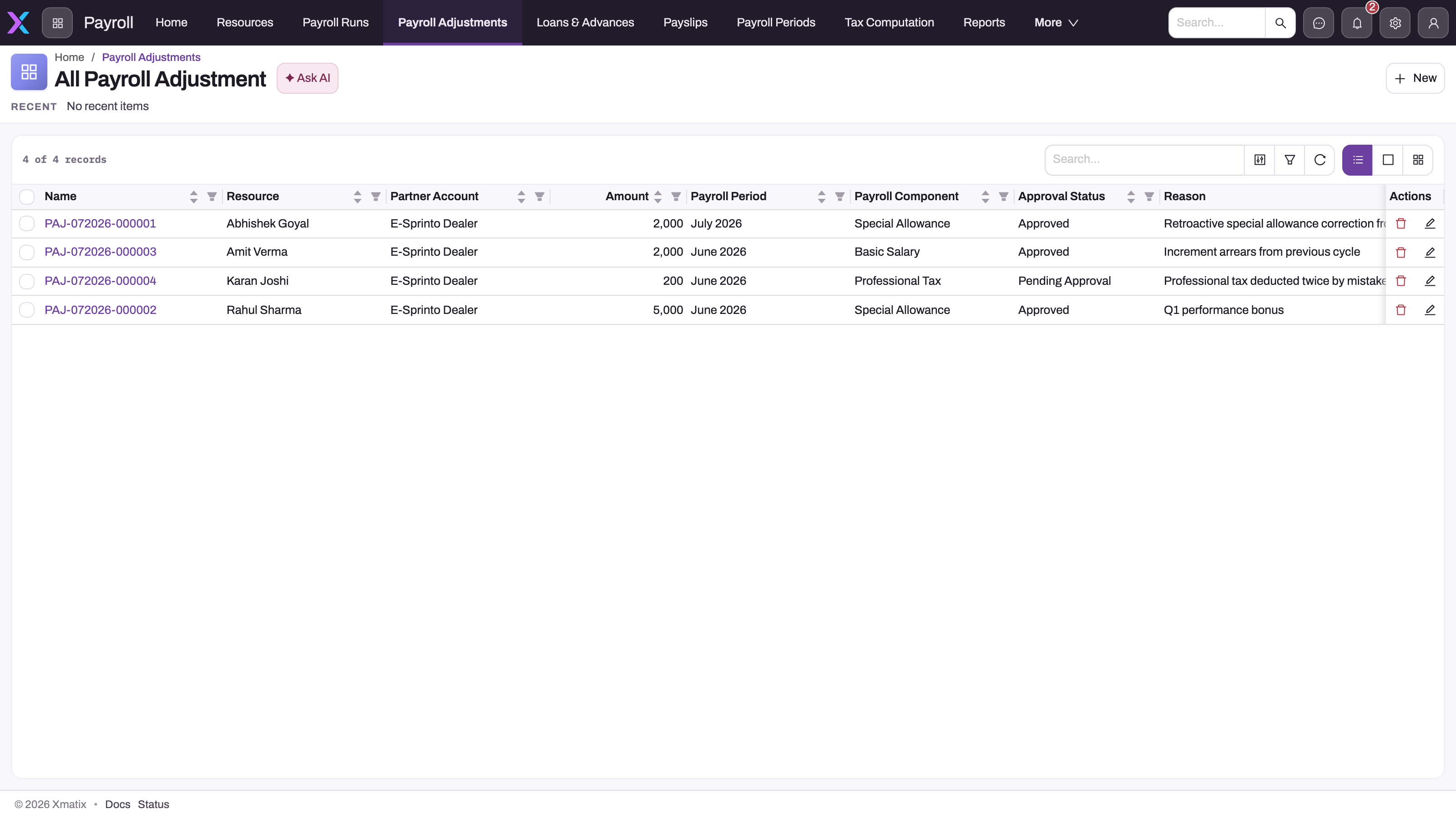
- 1
Payroll Adjustments on the Payroll app bar, beside Loans & Advances.
- 2
Amount — always positive; whether it adds to gross or to deductions comes from Adjustment Type and the linked component's type.
- 3
Payroll Period — must be the very period record the run uses; an adjustment on a different period is never picked up.
- 4
Payroll Component supplies taxability and the GL / payable GL accounts; without one the line cannot be posted.
- 5
Approval Status — only Approved or blank is included; Pending Approval is skipped by the calculation. No approval process ships, so the value is set by editing the record.
- 6
New opens the adjustment form: Resource, Payroll Period, Adjustment Type, Amount, Reason, Payroll Component, Is Arrear.
Step 1 — Enter a payroll adjustment
On Payroll Adjustments, click New and fill: Resource (the employee), Payroll Period, Adjustment Type (Earning or Deduction), Amount, Reason, optionally the Payroll Component it belongs to, and Is Arrear where the item relates to an earlier period. What the run does with it when it calculates:
- Every adjustment on the run's period for the employee is included when its Approval Status is Approved or blank; a value such as Pending Approval or Rejected excludes it. No approval process ships for adjustments — the status is set by editing the record — so use it as your own review gate: enter items as Pending Approval and flip them to Approved before Calculate.
- A zero amount is ignored. The amount becomes an extra component line on the employee's detail: a deduction when the Adjustment Type is Deduction or the linked component's type is Deduction; otherwise it follows the component's type (Earning, Reimbursement, Employer Contribution), defaulting to Earning.
- The linked component supplies taxability and the GL and payable GL accounts. Without a component the line posts nowhere — the run's Post fails naming it — so link a component for anything that must reach the ledger.
- Adjustments are never prorated, and Is Arrear is recorded for reporting only; the amount is taxed and posted in the period it is entered on.
Put the adjustment on the same Payroll Period record the run uses, not merely the same month.
Step 2 — Create the loan or advance
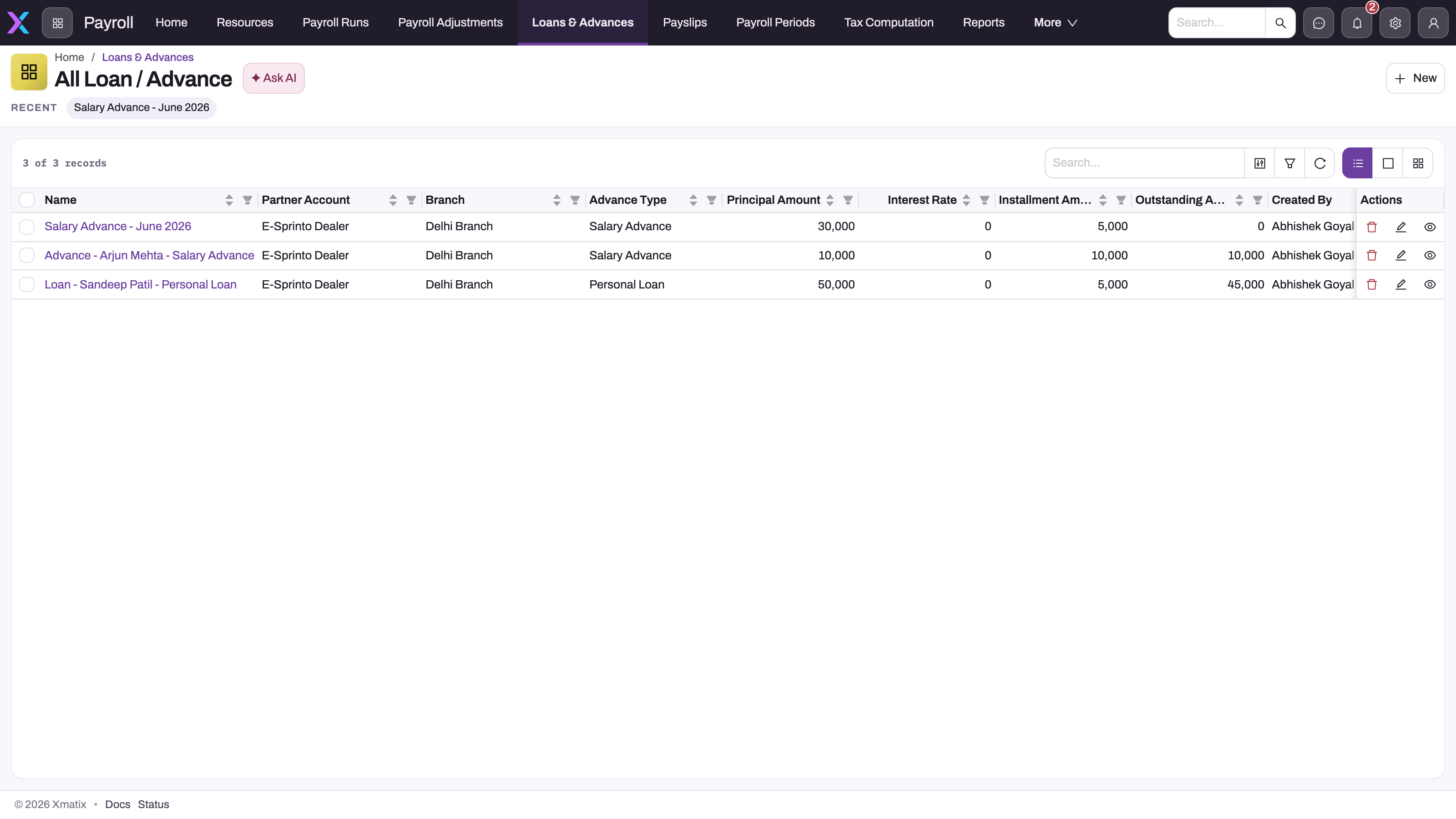
- 1
Loans & Advances on the Payroll app bar; Payroll Adjustments, the one-off items, is the entry to its left.
- 2
The name opens the arrangement with its Recovery history and Details; the Disburse button lives on that page.
- 3
Advance Type decides the control account at disbursement: Loan types debit the Employee Loan control, advance types the Employee Advance control.
- 4
Principal Amount is copied to Outstanding Amount when the record is disbursed.
- 5
Installment Amount is deducted by every calculated run while the loan is Active (or the remaining balance if smaller); Interest Rate is stored but never applied.
- 6
Outstanding Amount falls with each run; at zero the loan closes itself and drops out of future runs.
On Loans & Advances, click New and fill the header — Name, Resource, Partner Account, Branch — and the details: Principal Amount and Installment Amount (the amount to recover each run); leave Outstanding Amount blank. Interest Rate and End Payroll Period are stored for reference only. After saving, set Advance Type (Salary Advance, Travel Advance, Loan, Personal Loan, Vehicle Loan, Education Loan, Home Loan) by editing the record — the create form does not show it. The record starts in Requested: a record of intent, invisible to payroll until disbursed.
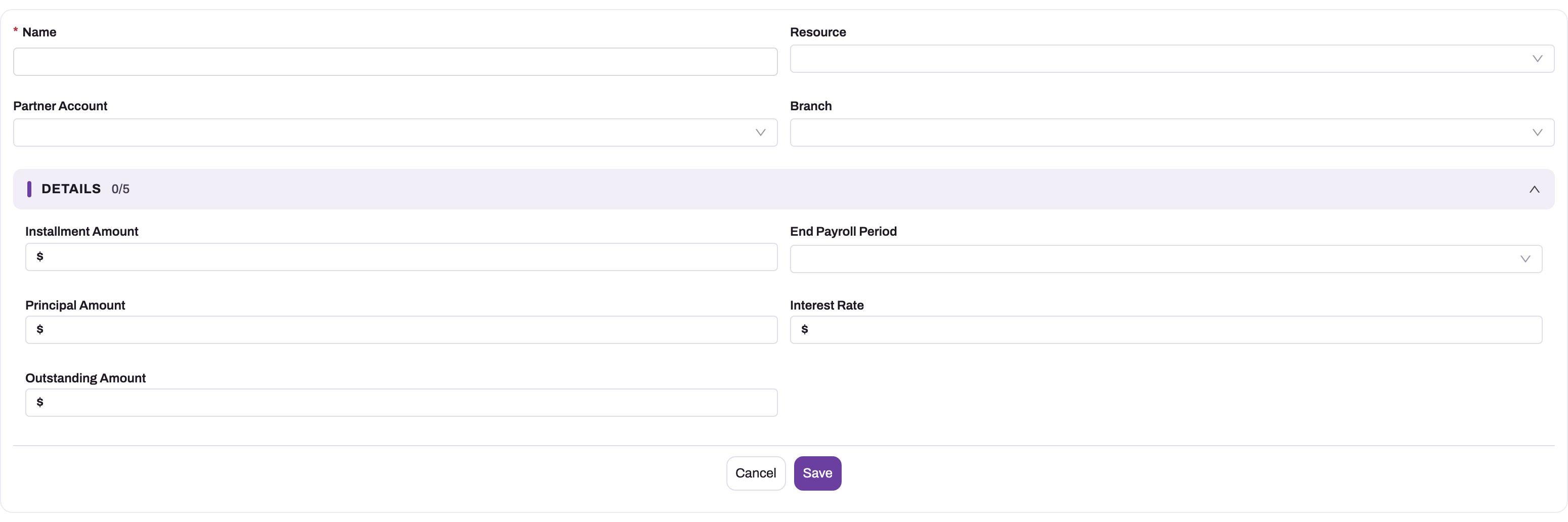
- 1
Resource — the employee whose runs will carry the deduction; Disburse refuses a record without one.
- 2
Partner Account and Branch — the company whose Employee Loan / Employee Advance control is used and the branch dimension on the postings.
- 3
Installment Amount — deducted by every calculated run while the loan is Active (the remaining balance if smaller); zero means nothing is ever recovered.
- 4
Principal Amount — what Disburse posts and copies into Outstanding Amount; leave Outstanding blank here.
- 5
End Payroll Period and Interest Rate are recorded for reference only — the calculation neither stops at the end period nor charges interest.
- 6
Save creates the record in Requested status; set Advance Type on the saved record (Loan vs advance types choose the control account), then Disburse.
Step 3 — Disburse it
Click Disburse on the saved record, naming the bank GL account the money leaves from. Disbursement posts the payout — the control account debited, the bank credited — and raises a receivable open item against the person for the full principal. The control is the record's Control GL Account if set; otherwise the company's Employee Loan control when Advance Type is exactly Loan, and the Employee Advance control for every other type (including Personal, Vehicle, Education and Home Loan — set Control GL Account explicitly if those should hit the loan control). The record becomes Active, Outstanding Amount equals the principal, and the disbursement date, journal (GL) and open item are stamped. Disburse refuses a record that already has a journal, has no Resource, or has a principal of zero.
Step 4 — Let payroll recover it
No further action is needed: every payroll calculation deducts one installment from each of the employee's Active loans that has a positive outstanding balance and a positive installment amount — the configured installment, or the remaining balance if that is smaller. The recovery reduces net pay, the loan's Outstanding Amount and the open item in the same pass, and writes a Loan Recovery row (amount, outstanding after, run, period) so the register builds itself. When the balance reaches zero the loan sets itself to Closed.
Three things the recovery does not do: it does not wait for Start Payroll Period or stop at End Payroll Period (an Active loan is recovered in every run of any period), it does not charge interest, and it does not distinguish advance types. If recovery must pause, edit the installment amount to zero or set the Status away from Active for that run, and restore it afterwards.
If a run is recalculated, its recoveries are rolled back first — the balance and open item are restored and a loan the recovery had closed is reopened — and then recovered afresh, so a recalculation can neither eat a second installment nor lose one.
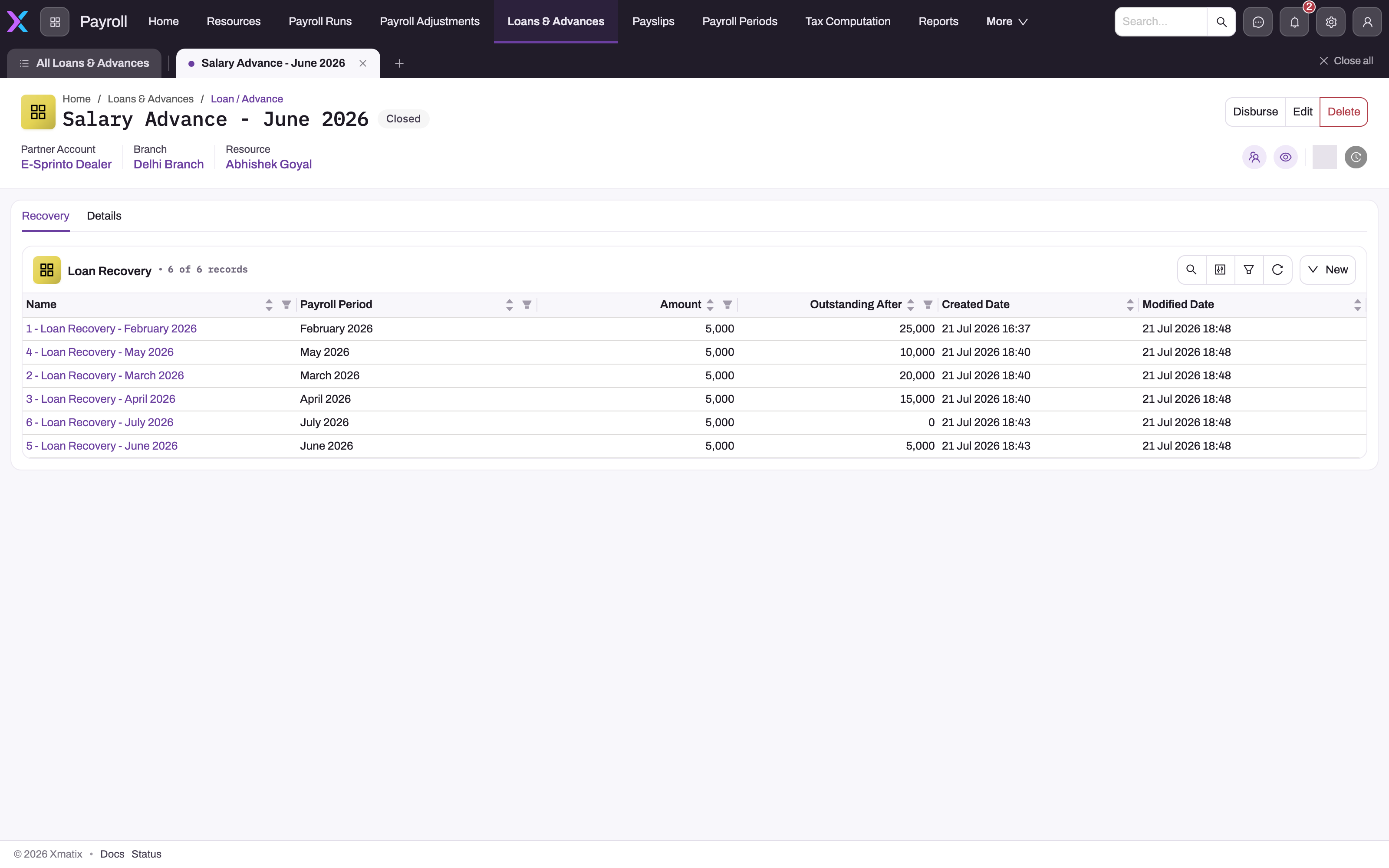
- 1
Status Closed — set automatically by the run whose installment took the balance to zero; recalculating that run would reopen it.
- 2
Disburse posts the payout (control account debited, bank credited), raises the receivable open item and sets the record Active; it refuses if the record already has a journal.
- 3
Payroll Period of each recovery row — the run that calculated that period took this installment.
- 4
Amount is the configured installment, or the remaining balance for the final row.
- 5
Outstanding After must chain down to zero; a gap means a period whose run did not recover this loan or was recalculated.
- 6
New here creates a manual recovery row only — it does not change Outstanding Amount or the open item; let the run write recoveries.
Step 5 — Review the balance
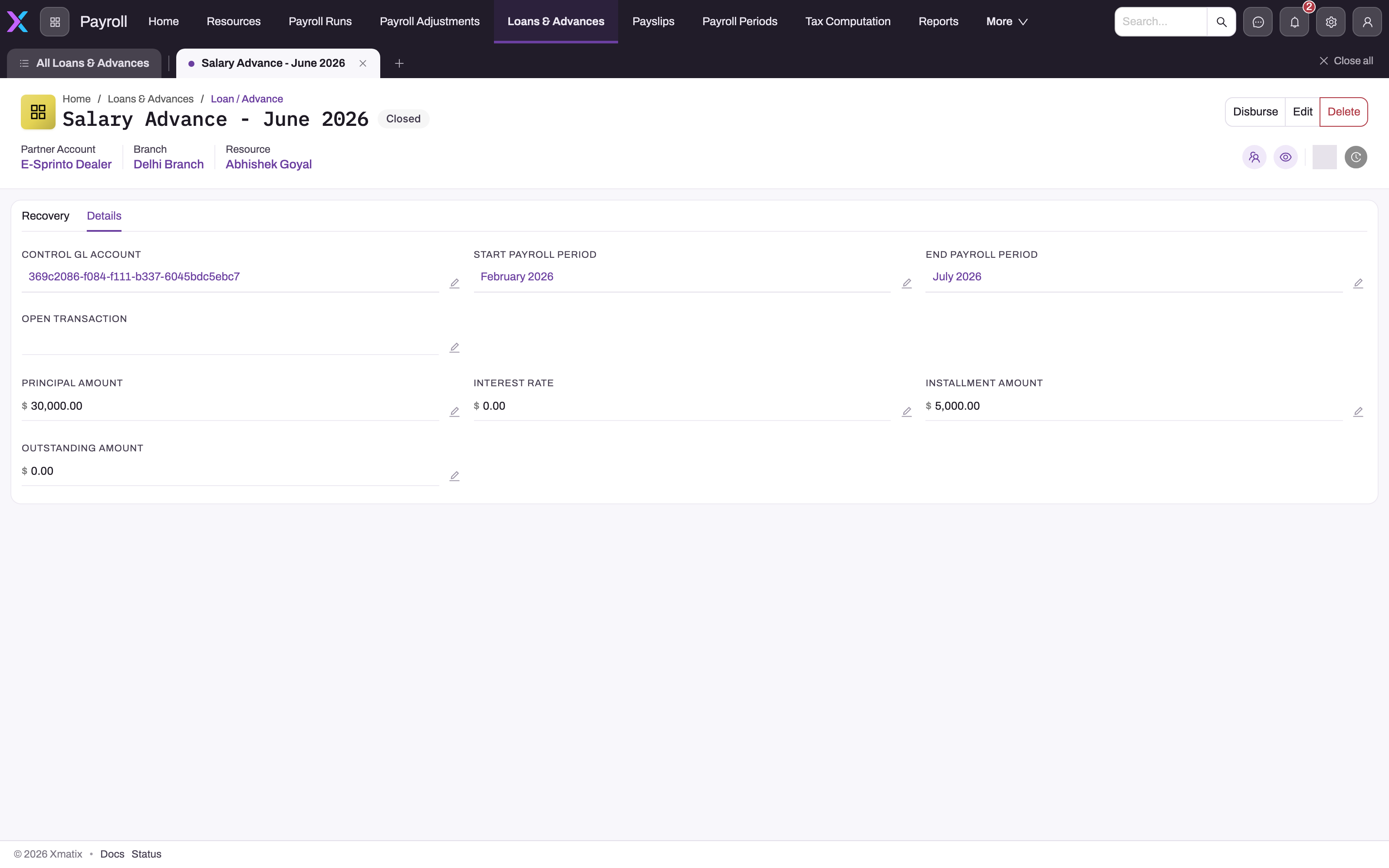
- 1
Control GL Account — the Employee Loan or Employee Advance control debited at disbursement and credited by every recovery; set at disbursement if left blank.
- 2
Start and End Payroll Period document the intended recovery window, but the calculation does not read them — an Active loan is recovered in every run.
- 3
Open Transaction — the receivable open item raised at disbursement and reduced by each recovery.
- 4
Principal Amount is what Disburse posts and copies into Outstanding Amount.
- 5
Installment Amount — the per-run deduction; Interest Rate is recorded only, no interest is ever computed.
- 6
Outstanding Amount reconciles to Principal minus the Recovery tab's rows; zero closed the loan.
The Details tab holds the persisted terms and references; Outstanding Amount should equal the principal minus the Recovery tab's rows. For a register across employees, use the Loans & Advances list (principal, installment, outstanding per arrangement) and the Loan Recoveries entity (search the App Launcher), which lists every installment with its run and period. A fiscal-year loan movement schedule exists in the finance engine but is not exposed as a button on the Fiscal Year record.
Expected result
An adjustment appears once, as one extra line on the intended employee's detail for the intended period. A disbursed loan shows Active, an Outstanding Amount equal to its principal, a journal and a receivable open item. After each calculated run, the loan's outstanding, its Recovery rows, the payroll deduction line and the control-account balance move by the same installment; any disagreement is a reason to stop before posting and recalculate after the source record is corrected.
Common problems
The adjustment didn't show up in the run. Check four things: it is on the same Payroll Period record the run uses, it is on the right Resource, its Amount is not zero, and its Approval Status is Approved or blank — Pending Approval is deliberately excluded. Fix and recalculate; recalculation replaces the pass.
The run posted the adjustment nowhere / Post failed on the adjustment line. The adjustment has no Payroll Component, so the line has no GL accounts. Link a component and recalculate before posting.
The loan isn't being recovered. Recovery requires Status Active with a positive Outstanding Amount and a positive Installment Amount. A loan still in Requested was never disbursed; a loan with no installment amount has nothing to recover per run.
Disbursement is refused. The principal must be positive, the record must have a Resource, it must not already carry a journal, and a control account must resolve — on the record or from the company's Employee Loan / Employee Advance control configuration.
The loan hit the wrong control account. Only the exact type Loan selects the Employee Loan control; every other type falls to Employee Advance. Set Control GL Account on the record before disbursing.
Common questions
Can I recover more or less than the configured installment one month?
The calculation takes the configured installment (or the remainder, if smaller). To change the pace, edit the Installment Amount before the run calculates — the change applies from the next calculation. A final short installment needs no action; the recovery never exceeds the outstanding balance.
How do adjustments differ from editing the salary structure?
Scope. A structure change affects every employee on that structure, every period. An adjustment affects one employee in one period and leaves a reasoned record behind. Use adjustments for one-offs and corrections; change structures when the ongoing deal changes.
What happens to an unrecovered loan when an employee leaves?
Enter the outstanding balance as a Deduction line in the full and final settlement, crediting the loan's control account; the settlement refuses to post if recoveries exceed what is payable. The settlement does not update the loan record itself — edit the loan to zero its outstanding and set it Closed or Written Off afterwards.
Where does the money show in the ledger?
Disbursement: employee loan/advance control debited, bank credited, plus a receivable open item on the person. Each recovery: a deduction line in the payroll accrual crediting that same control, with the open item reduced in step. The control account's balance is therefore the sum of open loan balances — reconcilable, like every control in the subledger model.