
A stock adjustment corrects on-hand inventory when the system's figure and reality disagree for a known reason: goods were damaged, a batch expired, a shelf count came up short or over, stock was put on hold or lent out. The adjustment is a document — partner account, branch, date, and one line per correction — and it changes nothing until it is posted. At posting, each line becomes an entry in the inventory ledger like any other movement, so the correction, who made it and what it changed are all on record.
When to use an adjustment — and when not to
Use an adjustment when you already know the discrepancy and its cause. Use a cycle count instead when the question is "what do we actually have?" — counting is the scheduled program that measures stock and, when its variances are released, generates the adjustment for you with the count linked as evidence (see Cycle counting). Adjustments are also generated automatically when a part-to-part claim or claim batch is approved, so not every adjustment in the register was typed by hand. This page covers the document itself, which is what every one of those paths ends in.
Prerequisites
- Access to the Inventory app (the Adjustments entry in its navigation) through your security profile. Posting is a separate entity action, so a profile can allow creating and editing adjustments without allowing Post Inventory.
- The partner account (the stock-owning company) and branch whose stock is being corrected — both are required and fixed once the adjustment is created.
- Items with Track Inventory set. A line for a non-tracked item is rejected at posting. For items with Track Lots set, the lot being adjusted — a lot-tracked line without a lot is rejected.
- Optionally a price list and a price-as-on date, if line unit costs should default from your purchase pricing.
Procedure
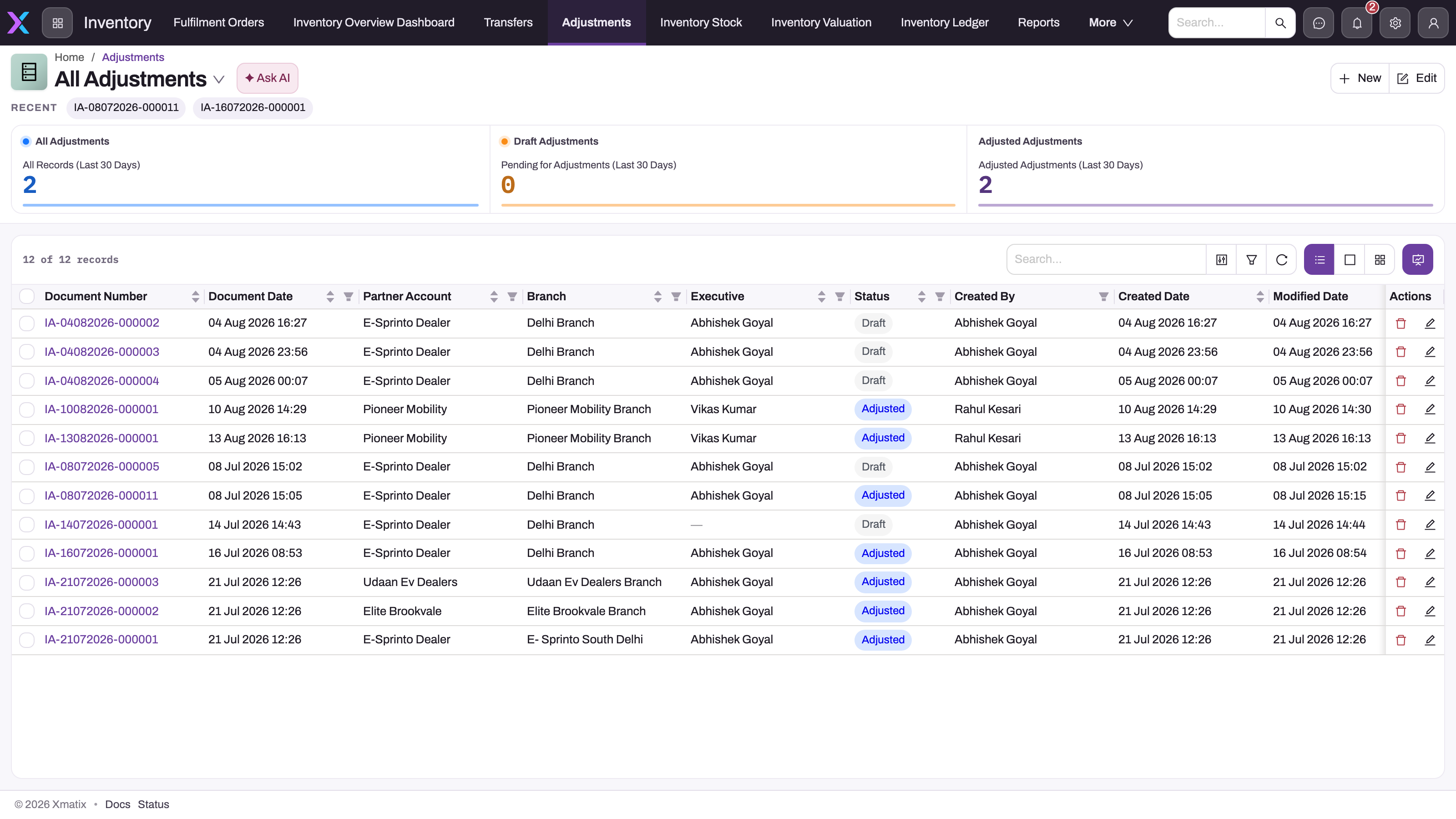
- 1
New opens the create form for a fresh adjustment header (Step 1).
- 2
Summary cards count the last 30 days' documents as Draft or Adjusted.
- 3
The document number opens the adjustment; its Lines tab is where lines are added and posted.
- 4
Partner Account and Branch fix whose stock the document corrects — they cannot be changed after creation.
- 5
Status is a convenience label; the proof that a line reached the ledger is its Inventory Ledger reference.
- 6
Search, column filters and refresh narrow the register to a document, branch or period.
Inventory → Adjustments opens the register (default view All Adjustments). The summary cards count the last 30 days' documents as Draft or Adjusted; the table shows document number, document date, partner account, branch, executive and status. Use the search and column filters to find a document before opening it — the document number links to the record, and New in the header starts a fresh adjustment.
Step 1 — Create the adjustment

- 1
Partner Account — the stock-owning company; required and fixed after save.
- 2
Branch — the location whose stock buckets the lines will move; required and fixed after save.
- 3
Document Date defaults to now and cannot be edited later.
- 4
Price List (defaults to the default purchase list), Executive and Price As On Date — the pricing context that defaults each line's unit cost.
- 5
Save creates the header only; no stock moves until lines are added and Post Inventory runs.
Click New. The form asks for Partner Account, Branch and Document Date (defaulted to now), plus an Additional Details group with Price List, Executive and Price As On Date. Check partner account and branch against the count sheet or incident evidence before saving: neither can be changed afterwards, and neither can the document date — a wrong branch means a new document. If you leave the price list empty it defaults to the default purchase price list, and changing Price As On Date later re-prices every line from that list.
Step 2 — Add lines
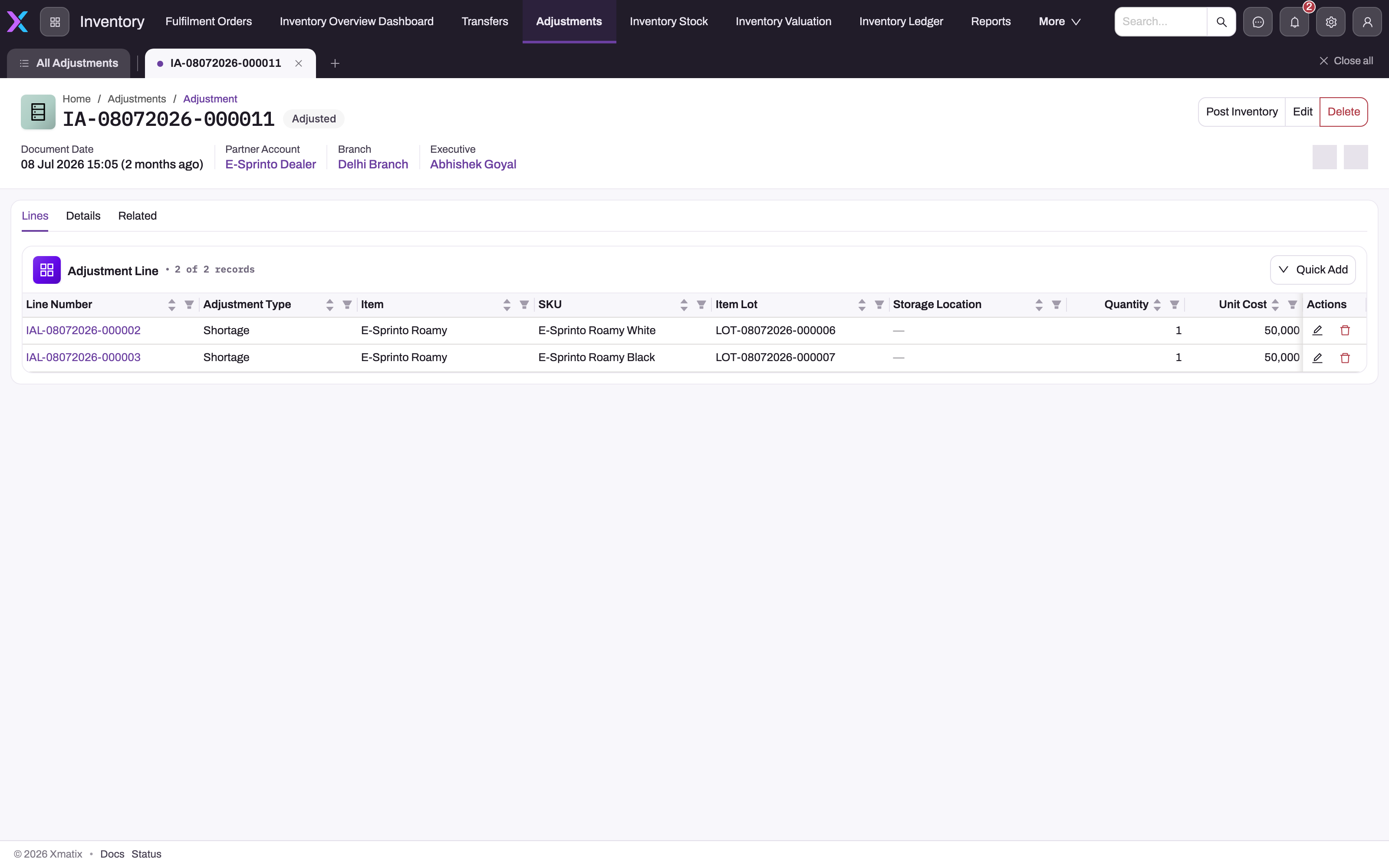
- 1
Lines is the default tab of a saved adjustment — add, edit and review lines here.
- 2
Quick Add opens the inline line editor (adjustment type, item, quantity, unit cost); New adds a line with every field.
- 3
Adjustment Type: empty for a signed correction, or Excess, Shortage, Damaged, Expired, OnHold, OnLoan, Assemble, Disassemble.
- 4
Item Lot and Storage Location name the exact stock bucket — the usual cause of an Insufficient stock rejection when wrong.
- 5
Quantity is the correction magnitude (sign matters only for untyped lines); Unit Cost defaults from the price list.
- 6
Post Inventory posts every line without a ledger reference; already-posted lines are skipped.
On the saved adjustment, the Lines tab lists the adjustment lines and lets you add them. Each line carries one correction for one item, SKU, lot and storage location:
| Field | What to enter |
|---|---|
| Adjustment Type | Leave empty for a plain correction, or pick the reason: Excess, Shortage, Damaged, Expired, OnHold, OnLoan, Assemble or Disassemble. The type decides which stock bucket the posting moves — see below. |
| Item, SKU | What is being corrected. |
| Item Lot, Item Lot Type | Required for lot-tracked items; identifies the exact batch or serial. |
| Storage Location | The bin holding the stock, where your branch uses locations. |
| Quantity | The magnitude of the correction. For an untyped line the sign matters: positive adds stock, negative removes it. For typed lines enter the quantity found damaged, expired, short, over, held or lent — the direction is implied by the type. |
| Unit Cost | Defaults from the matching price-list rule (an adjustment is costed as a purchase-side line); a value typed on a new line is kept. It becomes the unit cost on the ledger entry. |
| Remarks | Free text for the evidence reference. |
Keep one line per item/lot/location and per reason. Two causes on the same stock — say three damaged and two missing — are two lines, not one netted figure, because each type posts to its own bucket and reports on damage or expiry depend on that. The saved rows show line number, type, item, SKU, lot, storage location, quantity and unit cost, so the whole document can be reconciled against the evidence before posting.
Assemble and Disassemble lines are special: they explode the item's bill of materials into generated component lines of the opposite type, so assembling one kit adds the kit and removes its components in one document. Only the parent line is entered by hand.
Step 3 — Post to the ledger
Review the lines, then run Post Inventory from the record header (the Perform Inventory Posting action). It posts every line that does not yet have an Inventory Ledger reference and stamps the created ledger entry onto the line. Retrying is safe — already-posted lines are skipped — and when nothing is left to post the action stops with No Adjustment Lines found for Inventory Posting.
What posting does per line: it writes the ledger entry, moves the matching stock bucket at the branch (and the lot's counters for lot-tracked items) and hands the movement to the costing engine. A movement that would take the stock bucket negative is rejected with an Insufficient stock message naming the bucket, and nothing is written for that document. Correct the quantity, lot or storage location on the line and post the same document again rather than raising a duplicate.
Two controls on the form are not what they look like. The Perform Inventory Posting and Inventory Posted check boxes on the Details tab are never set by the posting code, and the Post Inventory button offered on an individual line has no server behavior — post from the document header only. The definitive proof that a line reached the ledger is its Inventory Ledger reference.
Step 4 — Verify
Open the ledger entry from a posted line, or find the document in Inventory → Inventory Ledgers, and confirm source document, branch, lot, storage location, signed quantity and ledger type. Then read the item's balance on Inventory Stock to confirm the bucket moved as intended. Later corrections must appear as reversal-and-replacement pairs; the original entry stays.
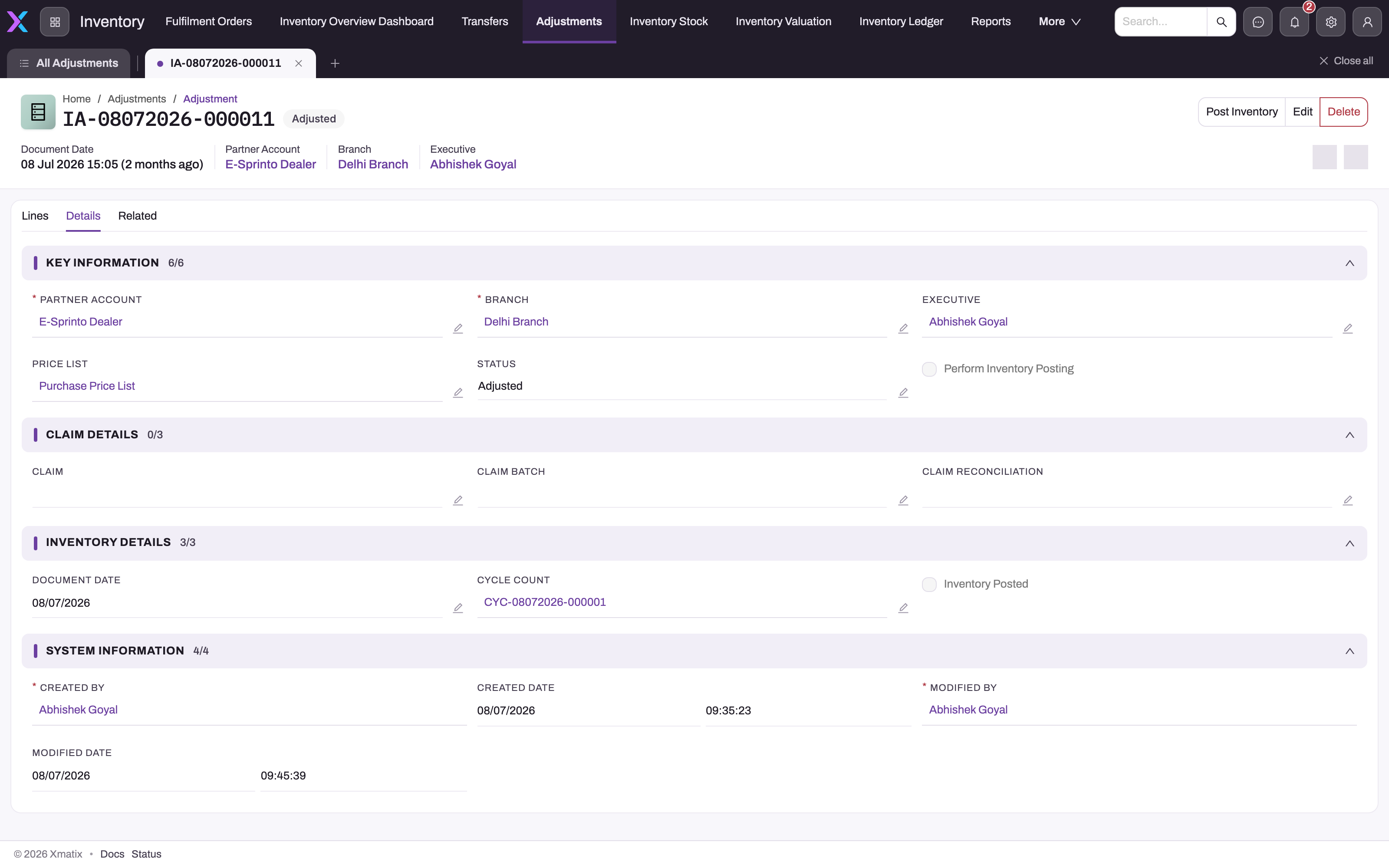
- 1
Details shows the persisted header; Lines is where the stock effect lives.
- 2
Key Information: partner account and branch (locked), executive and price list.
- 3
Status and the Perform Inventory Posting check box are not maintained by the posting action — do not read them as proof of posting.
- 4
Claim Details is filled when the adjustment was generated from an approved part-to-part claim or claim batch.
- 5
Cycle Count links the count whose released variances created this adjustment.
- 6
Inventory Posted is never set by code; check the lines' Inventory Ledger references instead.
The Details tab holds the saved header: Key Information (partner account, branch, executive, price list, status), Claim Details and Inventory Details (document date, the originating cycle count where there is one) and System Information. It is where you confirm provenance — a cycle count or claim reference means the document was generated, not typed. It does not replace line-level verification.
What each adjustment type does to stock
| Adjustment type | Effect at posting |
|---|---|
| (empty) | Positive quantity increments the positive-adjusted bucket; negative quantity increments the negative-adjusted bucket. Both count fully in available and in-hand stock. |
Excess | Adds the quantity to the excess bucket — stock found over the book figure. |
Shortage | Adds to the shortage bucket — stock found under the book figure; reduces available stock. |
Damaged, Expired | Adds to the damaged or expired bucket; reduces available stock, and the reason survives into reporting. |
OnHold | Moves stock to the on-hold bucket: still present, no longer available to promise. |
OnLoan | Moves stock to the on-loan bucket: lent out, no longer available. |
Assemble / Disassemble | Books the produced kit (and, through generated component lines, consumes or returns its components). |
Each type posts its own ledger entry type, which is why a single document can move stock in both directions and still say why.
Expected result
Each posted line changes only its intended branch, item, lot and location, receives an Inventory Ledger reference, and shows up as one entry (per type) in the ledger with the adjustment line as its source document. Later edits to a posted line's quantity or unit cost — or deleting the line — post reversal entries automatically and, for edits, fresh entries for the new values; the originals remain.
Common problems
Wrong branch or document date. Both are locked after creation; create a new adjustment. If lines were already posted on the wrong document, delete or reverse them there first (each deletion posts a reversal) so stock is not corrected twice.
"Insufficient stock" on posting. The bucket you are decreasing does not hold that much. The usual cause is a line pointing at a different lot or storage location than the one that actually holds the stock — compare the line with the item's stock row before changing the quantity.
Lot required. The item has Track Lots set; add the lot to the line.
"No Adjustment Lines found for Inventory Posting." Every line already carries a ledger reference. To correct a posted document, edit the posted line (which posts a reversal and a replacement) or raise a new adjustment.
Status looks wrong. The Draft / Adjusted badge is a convenience label; the posting action neither requires nor updates it. Trust the lines' Inventory Ledger references.
Common questions
Can one adjustment both increase and decrease stock?
Yes. Lines carry their own type — excess for stock found over, shortage for stock found under, damaged and expired for write-downs with a recorded reason, plus untyped signed corrections — so one document can correct in both directions. Each type posts as its own ledger entry type.
How do cycle counts and adjustments relate?
A cycle count is the measuring program; an adjustment is the correcting document. When a count's variances are released, xMatix creates an adjustment for the count's partner account and branch with one untyped line per discrepancy and separate Damaged and Expired lines where those were recorded, each carrying the count line's item, SKU, lot, storage location and unit cost. The count is linked on the adjustment's Details tab, and from there the document is posted exactly as described here.
Why did an adjustment appear that nobody created?
Approving a part-to-part claim (or a claim batch) generates an adjustment that writes the approved quantity back into stock, with the claim linked under Claim Details. Post it like any other adjustment.