
A macro is a named, ordered set of steps an agent runs against a record in one click — the standard triage, the canned response, the closure ritual — so the ten small edits a routine touch requires become one action with one result. Macros are authored centrally, are scoped to one entity (a case macro cannot be run against anything else), and every run is recorded on the record's timeline with a per-step account of what applied and what was skipped.
Prerequisites
- To build macros: access to Setup → Feature Hub → Service → Macros.
- To run one: the Run Macro action on the entity, granted through your security profile, and at least one active macro for that entity.
- For email steps: an email template if you use Send email (template); sending (rather than drafting) also requires your tenant's outbound email to be configured.
Procedure
- 1
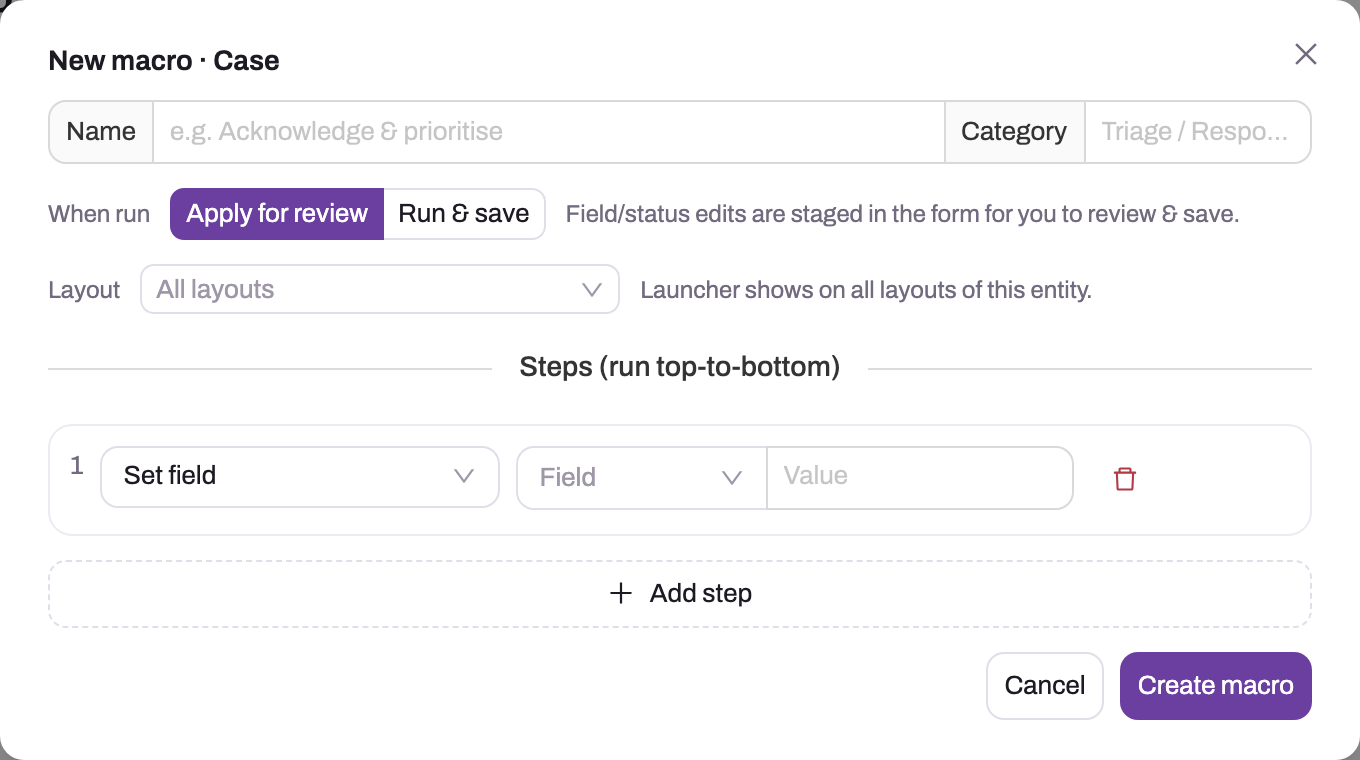
Name and Category: agents pick macros from a list under pressure, so name the routine, not the mechanism.
- 2
Apply for review stages field and status edits in the open form for the agent to check; Run & save persists them immediately.
- 3
Layout limits the launcher to one record layout; All layouts offers the macro on every Case layout.
- 4
Each numbered step chooses an operation (Set field, Change status, Add note, Create task, Send email, Call server action), its target and its value.
- 5
Add step appends the next operation; steps always execute in the displayed order.
- 6
Create macro saves it; mark it active before agents can run it.
The builder makes the macro's contract visible before it is activated: who will recognize it, whether editable changes are staged or saved, which layouts expose it, and the exact top-to-bottom operation order. Design irreversible steps such as notes, emails and server actions with particular care because Review mode can stage field edits, but it cannot undo an external effect that has already run.
Step 1 — Open the macro builder
Go to Setup → Feature Hub → Service → Macros and pick the target entity (Case is preselected; any metadata entity is eligible — the runner is entity-agnostic). The list shows that entity's macros; select New macro to open the builder dialog, or open an existing macro to edit.
Step 2 — Name it and choose how it applies
Give the macro a name agents will recognize in a picker, a description, and optionally a category to group the list (for example triage, response, closure). Then choose the run mode:
- Review (the default) — reversible edits (set field, change status) are staged into the open form for the agent to check and save; only the irreversible steps (notes, tasks, emails, server actions) execute immediately.
- Save — everything applies and persists immediately.
You can also scope the macro to one specific form layout; unscoped macros appear on all of the entity's layouts.
Step 3 — Add the steps, in order
Steps run top to bottom. The builder binds its pickers to the target entity's metadata, so you choose real fields, statuses and actions rather than typing names:
| Step | What it does |
|---|---|
| Set field | Sets a chosen field to a value |
| Change status | Sets the status field — same staging behavior as Set field |
| Add note | Appends a note to the record's timeline |
| Create task | Creates an open task on the record |
| Send email (template) | Renders an email template against the record; sends, or drafts for review |
| Send email (compose) | A written message — recipient, subject, body — with field merge tokens resolved from the record; sends or drafts |
| Call server action | Invokes any of the entity's own actions — on a case, for example, Escalate, Pause SLA, Resume SLA or Close |
Email steps that draft (or that can't send — no recipient resolved, or no mail sender configured) land the message on the record's timeline as a draft email for the agent to review and finish; the run reports say so rather than failing.
Step 4 — Activate and save
Mark the macro active and save. Inactive macros refuse to run — deactivation is the safe way to retire one without deleting it.
Step 5 — Run it against a record
On the record, run Run Macro and pick the macro (the macros panel lists the entity's active macros with their steps). In Review mode, check the staged field edits in the form and save; in Save mode the changes are already applied. Either way you get a per-step result — applied or skipped, with the reason — and the timeline gains an entry recording that the macro ran.
Expected result
The active macro appears only on records of its target entity and, when scoped, only on the selected layout. A run processes the numbered steps in their displayed order and returns a result for every step instead of hiding partial work. In Apply for review mode, field and status edits are visible in the open form awaiting the agent's save, while notes, tasks, emails and server actions that cannot be staged have already executed; in Run & save mode, valid edits are persisted immediately. The record timeline identifies the macro run, and created notes, tasks or messages remain independently auditable. Review every skipped result before considering the routine complete, because a successful run can still contain a deliberately skipped invalid or inapplicable step.
Common problems
- The macro isn't offered on my record. It is inactive, it targets a different entity, or it is scoped to a layout other than the one you're on.
- A step reports "skipped". Steps skip rather than abort: a set-field step naming a field the entity doesn't have, an email step with no content or no template, or a value invalid for the field each skip with an explanation in the run result. Fix the step in the builder.
- The email went to drafts instead of sending. The step is configured to draft, no recipient could be resolved from the record, or outbound email isn't configured. The draft is on the timeline waiting for you either way.
Common questions
When should I choose Review over Save?
Review is the right default for anything agents run mid-conversation: the field edits appear in the open form, the agent stays in control, and the irreversible pieces (notes, emails) still happen once. Save suits mechanical closures where reviewing would be theater.
Can a macro pause the SLA or escalate the case?
Yes — through Call server action, which invokes the entity's own actions from inside the macro. On a case that includes Pause SLA, Resume SLA, Escalate and Close, so a "waiting on customer" macro can set the status, add the note and stop the clock in one click.
Is there an audit of what a macro changed?
Every run appends a timeline entry naming the macro and its step count, the run itself returns per-step results, and the notes, tasks and emails the macro created are ordinary timeline items. Field-level history follows your entity's normal auditing.