
In xMatix a phone call is not an event that evaporates when the line drops — it is a record. Every call handled where your organization has telephony configured lands in the call register with its parties, timings, agent, queue, outcome and links, and it stays queryable like any other record: listed, filtered, reported on. This page explains what a call record carries and where recordings and transcripts fit.
The call register
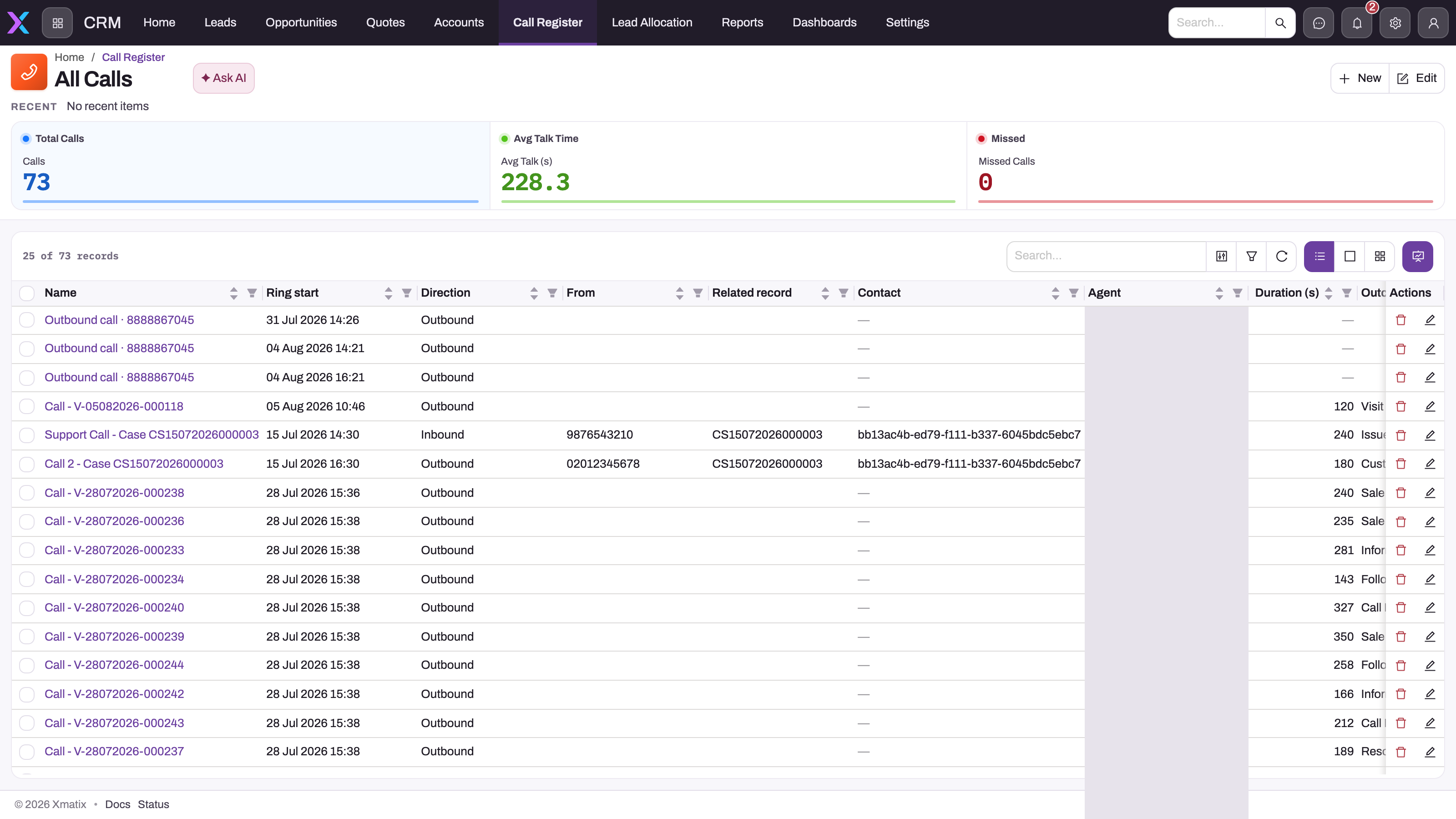
The register is the Call Register list (entity Call, in the CRM app and the Service settings app): every call is a row, with headline cards for Total Calls, Avg Talk Time and Missed over the current view, and the usual list tools — search, filters, column filters, saved views and export. The default columns are Name, Ring start, Direction, From, Related record, Contact, Agent, Duration (s) and Outcome; the call form adds the rest of the fields below.
- 1
Headline cards summarise the current view — total calls, average talk time and missed calls — so the missed count is one glance away.
- 2
Search, column filters and refresh narrow the register by time, agent, direction or outcome before you conclude a call is missing.
- 3
Name and Ring start identify the call and its chronology; Direction and From describe the phone leg.
- 4
Related record is the case, order or other record the agent linked the call to — the record that received the timeline Call activity.
- 5
Agent, Duration (s) and Outcome carry who handled it, the computed talk time and the wrap-up disposition; a recording player and transcript status live on the call form, not in this list.
The call record
A call is created the moment it starts ringing (or the moment you dial) and is updated live as it progresses:
| Facet | What it holds |
|---|---|
| Direction | Inbound or Outbound |
| Status | Ringing → In progress → a terminal status: Completed, Missed, Voicemail, Failed or Declined |
| Parties | The from and to numbers, plus the matched contact and account where the caller's number is on file |
| Timings | Ring start, Answered and Ended times; Wait (s) (ring → answer) and Duration (s) (answer → end) are computed for you when the call reaches a terminal status |
| Handling | The agent who answered and the queue that routed the call, stamped as readable names so lists and reports need no lookups |
| Outcome | The Outcome field — the disposition the agent chose at wrap-up — plus their Notes |
| Artifacts | A Recording URL and a Transcript status (None, Pending, Ready or Failed), where those exist |
| Provider | Which telephony provider handled the call |
Caller matching is automatic: the number is compared — by its tail digits, so formatting and country codes don't matter — against every phone field on your contacts, then account phone numbers. A match fills the call's contact and account; no match leaves them empty rather than guessing.
Dispositions
The disposition is the agent's one-word verdict on the call — the field that turns a pile of call logs into an answerable question ("how many complaints this week?"). The built-in choices are Resolved, Follow Up Required, Call Back Later, Escalated, No Answer, Voicemail, Wrong Number, Complaint, Sale and Information Provided. In the softphone's wrap-up view the six most common appear as one-tap chips (Resolved, Follow-up, Call Back Later, Escalated, Sale, Complaint) with the rest under More…; the choice is stored in the call's Outcome field, which can also be edited later on the call record. Because Outcome is an ordinary picklist, an administrator can extend it with organization-specific values.
Linking calls to business records
A call knows who called; it does not presume to know what about. The agent links the call to its subject — an existing case, order or any other record — or creates one from the call, pre-filled with the caller's details. Once a call reaches a terminal status while linked, xMatix writes exactly one timeline activity of type Call onto the linked record: subject, direction, counterpart number, duration and disposition. That is what colleagues see when they open the case or order — the call story on the record it belongs to, without opening the register. Re-linking the call moves that activity to the new record.
Calls handled in a third-party dialer outside the platform's own audio path can be logged into the same register through the call-logging endpoint (POST …/telephony/log, called as the signed-in agent with the call's direction, numbers, timings and outcome), so the register stays the single history even in mixed setups.
Recordings
Where your organization records calls, the recording is produced by the telephony infrastructure after the call ends and attached to the call record. The call's form then shows a recording player — an inline audio player plus a download link, fed by the call's Recording URL. The player renders only when a recording actually exists; a call with no recording shows nothing rather than an empty player, so its absence is informative: recording wasn't on, or the recording hasn't arrived yet.
Transcripts
A transcribed call gets a transcript record of its own — channel, direction, the text, word count and timing — linked back to the call, which carries just a status flag. Keeping transcripts as separate records keeps call lists light while letting the transcript power what sits on top: post-call insights are generated from the transcript and stored alongside it.
Common questions
Why does a call show no recording?
Three explanations, in order of likelihood: your organization doesn't record calls; recording exists but this call's file hasn't been delivered yet (it arrives after the call ends, not during); or the call never connected — there is nothing to record on a missed or declined call. The player appearing on some calls and not others is the design working, not a fault.
Who can see call records and play recordings?
Calls are ordinary records under your organization's security model — entity and record permissions decide who lists them and opens them, and the recording player lives on the call form, so playing a recording requires being able to open the call. The one deliberate exception is the supervisor console, where a separately-granted permission shows supervisors every live call.
Are missed and declined calls kept?
Yes. A call that rang and was never answered ends as Missed (or Declined), keeps its ring timing and caller match, and counts in per-agent and daily statistics. Missed-call rows are often the most valuable ones in the register — they are the callers you still owe a conversation.