
Use the right help surface
Where licensed, Sense Agent provides the in-product place to ask a new question in plain language. Start a fresh conversation so the request is not mixed with an earlier topic, describe the app, entity, record or action involved, and include the exact result you expected. Sense operates with your own permissions; it cannot retrieve records or configuration you are not allowed to see.
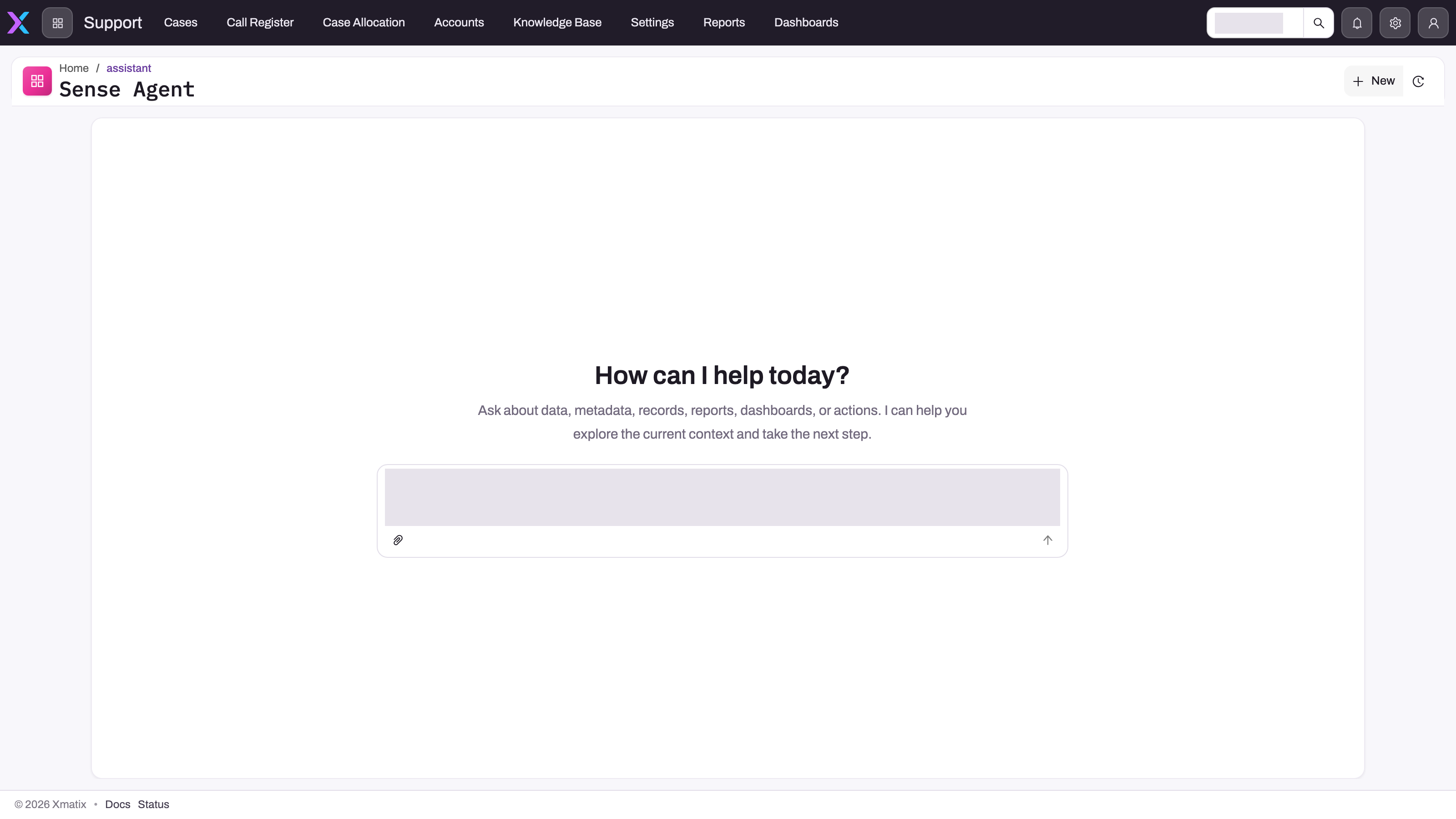
- 1
Sense Agent is the in-product help surface where the feature is licensed for your account.
- 2
New clears prior conversation context before you begin a separate problem.
- 3
A fresh conversation confirms that no earlier topic will influence the request.
- 4
Use the composer to include what you attempted, where you were and the exact result you expected. The input is concealed in this documentation image.
For a problem report, include the app, entity and view name; the action you attempted; the expected and observed result; the time and time zone; whether the issue repeats; and the exact error text. Add a screenshot only after checking it for customer names, recent records, insights, email addresses, phone numbers and search terms. Demo2 documentation images may show synthetic business records, but screenshots from any other tenant must stay inside authorized support channels.
When something in xMatix is unclear — a screen you do not recognize, a record you cannot find, a question about your data — help comes from a few places, each good at different things: this documentation, your organization's administrator, Sense AI chat where your organization has licensed it, and a clear problem report when something is genuinely broken.
Start with this documentation
The Knowledge Center explains how xMatix works in general: getting started covers signing in, navigation and the mobile app, and the concepts section explains the ideas behind the platform — apps, entities, records, tenants. It is the right place for "how does this work?" questions. It cannot answer questions about your organization's specific setup — which apps you have, why a field is named the way it is — because those are decisions your organization made.
Your administrator, for access questions
What you can see and do in xMatix is decided by your organization, not by the platform. If an app is missing from your app switcher, a record will not open, or an action you expect is not offered, that is almost always an access question — and your administrator is the person who can check your access and change it. The same goes for account matters: invitations, password trouble your mailbox cannot solve, and getting set up on mobile.
Sense AI, where your organization has it
If your organization has licensed Sense AI, you can open its chat and ask questions in plain language — about your data ("which customers have not ordered this month?") and about the screens you are on. Its answers are grounded in your organization's actual records rather than guessed, and it is permission-aware: it works with the same access you have, so it cannot show you data you could not open yourself. If you do not see Sense AI, your organization has not enabled it for you — that, too, is an administrator question.
Reporting a problem
When something behaves wrongly — an error message, a save that fails, a page that will not load — report it to your administrator with three things: what you were doing and what you expected to happen, where you were (the app, the list or record, its name or number), and when it happened, including whether it happens every time or happened once. That detail is the difference between a report that can be acted on immediately and one that starts with a round of follow-up questions.
Common questions
Who do I ask when I cannot see an app or record?
Your administrator. Visibility in xMatix is controlled by the access your organization granted you, so a missing app, list, record or action is an access question, not a fault — and administrators are the ones who can check and adjust access. Mention exactly what you expected to see and where you looked; a colleague who can see the item is a useful reference point, because it tells the administrator the difference is in the two accounts' access.
What kinds of questions can Sense AI answer?
Questions about your organization's data and the screens you work in, asked in plain language — sums, counts, comparisons, "show me" and "explain this" questions. Its answers are grounded in your organization's records and respect your permissions: it sees only what you can see, so it will not reveal data your access does not cover. It is available only where your organization has licensed it. For access changes or account problems, it will still point you to your administrator.
What makes a good problem report?
What, where, when. Describe what you did and what you expected, name the exact place — app, list, record name or number — and say when it happened and whether you can reproduce it. Include the exact text of any error message. The goal is that someone who is not looking over your shoulder can retrace your steps; reports that allow that get fixed much faster than "it doesn't work".