
A transfer between branches is one document with two warehouse moments: the source warehouse releases the goods outward, and the destination warehouse receives them inward. The full procedure — creating the transfer, releasing, receiving, the selective variants — is documented in Transferring stock between branches; this page is about what each step means for the people at the bins. Transfers appear in the Warehouse app alongside fulfilments and delivery orders.
Read the screen
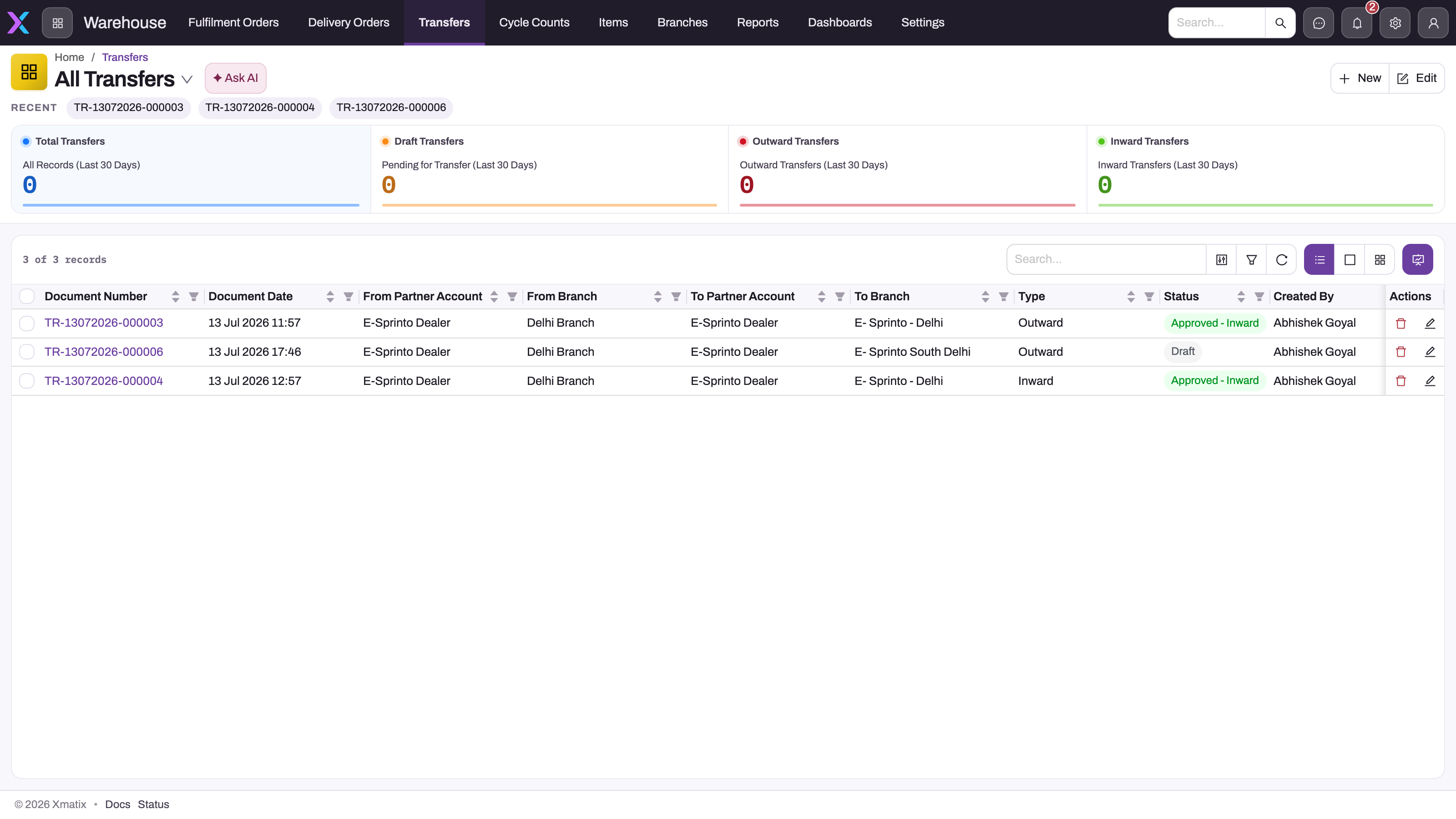
Transfers are a fixed tab of the Warehouse app (Transfers, default view All Transfers). The same list is reachable from the Inventory app.
- 1
Transfers is a fixed tab of the Warehouse app, next to fulfilments, delivery orders and cycle counts.
- 2
Summary cards count the last 30 days by stage — Draft, Outward and Inward — so the warehouse sees pending work at a glance.
- 3
Document Number opens the transfer; an outward document and its generated inward document are separate rows.
- 4
From Branch and To Branch are the two ends of custody — stock leaves the first at release and lands in the second at receive.
- 5
Type: Outward is the source side, Inward the generated destination side, Single Step a same-document move with no in-transit stage.
- 6
Status walks Draft → Pending/Approved Outward → Released → Pending/Approved Inward → Received.
The list is the custody register. Type tells you which side of a movement a row is — Outward is the source document, Inward is the destination document that release generates, Single Step is a same-branch or same-document move with no in-transit stage — and Status tells you how far it has gone. Summary cards count the last 30 days by stage.
| Status | Meaning at the bins |
|---|---|
| Draft | Lines can still be added or changed; nothing has moved. |
| Pending Approval - Outward / Approved - Outward | The source side is waiting for, or has, approval to release. Stock is still on the source shelf. |
| Released | Released quantities have left the source location and sit in transit; the inward document exists. |
| Pending Approval - Inward / Approved - Inward | The destination side is waiting for, or has, approval to receive. Stock is still in transit. |
| Received | Received quantities have landed in the destination locations. |
- 1
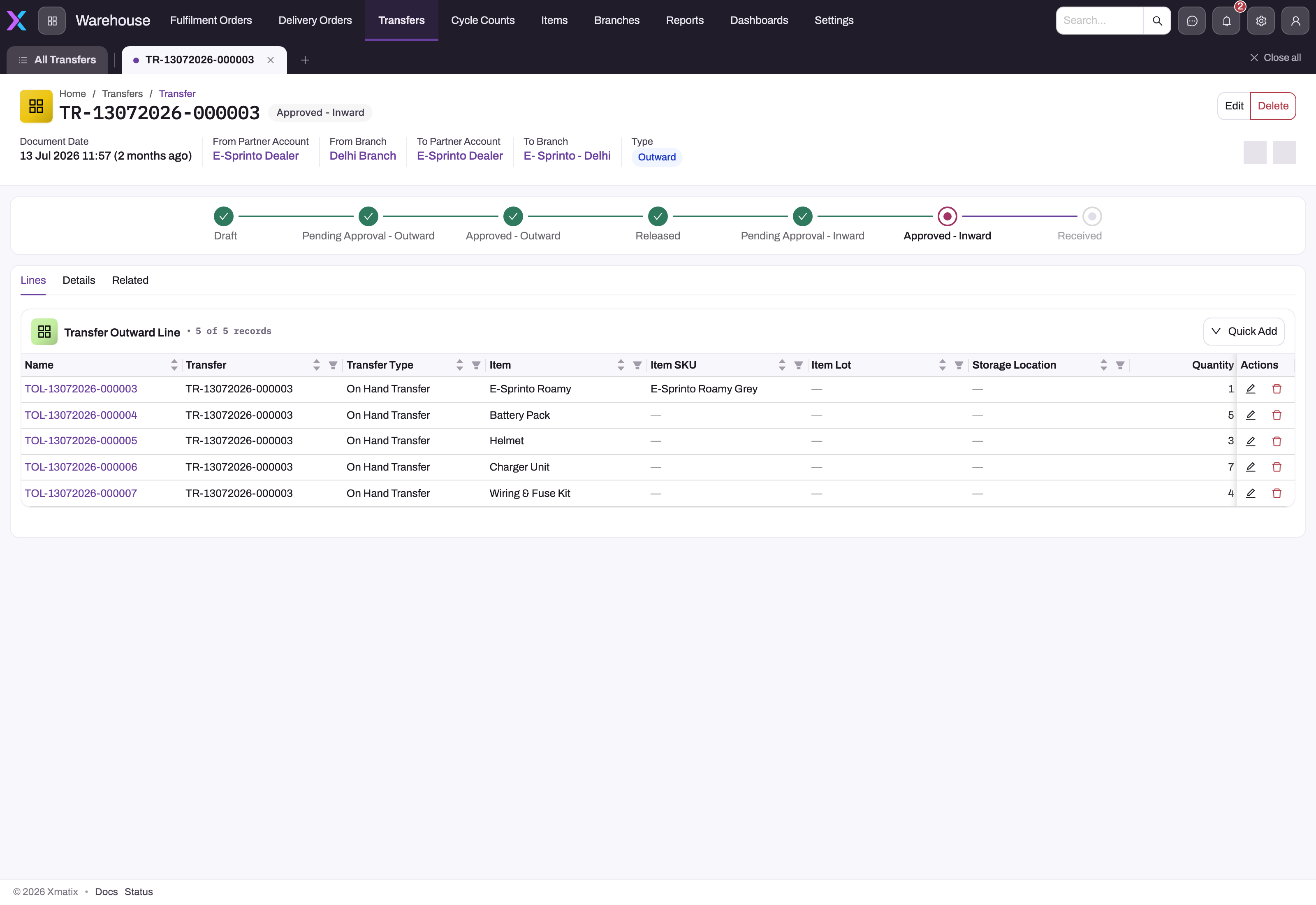
Header strip: status badge, both partner accounts and branches, and the Type (Outward) of this document.
- 2
The status ladder shows the outward approval, Released, and the inward approval and Received stages — this document is Approved - Inward, so the goods are still in transit.
- 3
Transfer Type per line: On Hand Transfer moves stock that is in the bin; Pending Deliveries Transfer moves stock already committed to deliveries and posts no in-transit quantity.
- 4
Item, Item SKU and Item Lot identify exactly which stock leaves; lot-tracked items carry their lot through to the inward line.
- 5
Storage Location is the source bin the quantity is posted out of at release; empty means the branch-level stock position.
- 6
Quantity is what should move; open a line for Requested, Released, Pending Release and Pending Inward quantities.
The Lines tab lists one Transfer Outward Line per item (and lot) with the source storage location and the quantity to move. Opening a line shows the quantity trail — Requested Quantity, Released Quantity, Pending Release Quantity and Pending Inward Quantity — which is where partial movements stay explainable: what is still on the shelf shows as pending release, what has gone shows as released, what the destination has not yet accepted shows as pending inward. On the generated inward document the lines are Transfer Inward Lines carrying Quantity, Received Quantity, Pending Received Quantity and the discrepancy buckets Damaged, Shortage and Excess Quantity.
Each line also has a Transfer Type: On Hand Transfer moves stock that is physically in the bin and is what the in-transit accounting below describes; Pending Deliveries Transfer moves stock that is already committed to deliveries and posts no in-transit quantity.
- 1
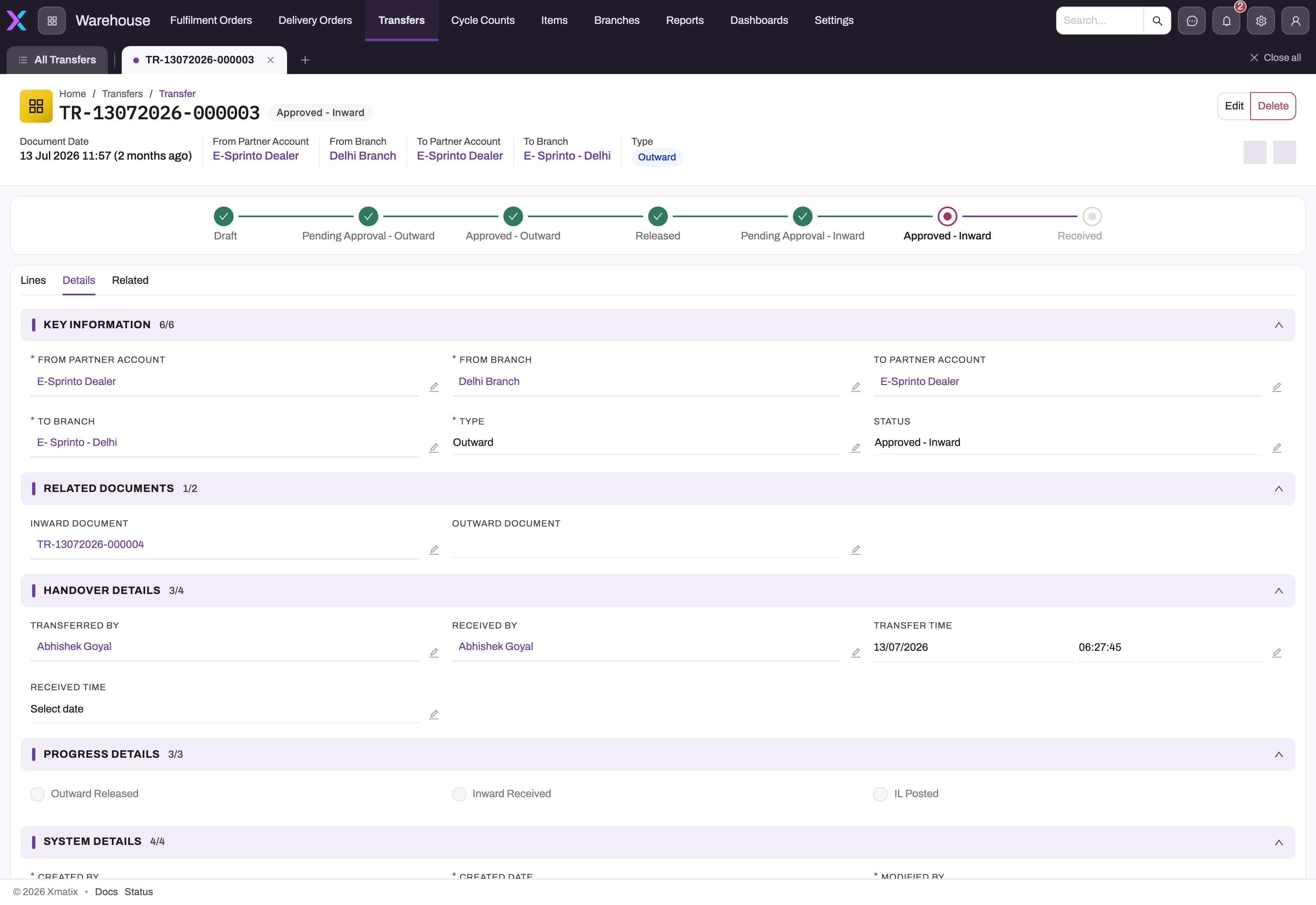
Key Information: From and To partner account and branch, Type and the current Status.
- 2
Related Documents: Inward Document is filled in on the outward transfer when release generates the destination's document; the inward document links back through Outward Document.
- 3
Handover Details record Transferred By, Received By, Transfer Time and Received Time — the custody trail across the in-transit gap.
- 4
Progress Details: Outward Released, Inward Received and IL Posted are set by the actions, not typed — read them rather than the Status label when reconciling stock.
Details proves the lane and the chronology. Related Documents links the outward document to the inward one it generated (and back). Handover Details hold Transferred By, Received By, Transfer Time and Received Time. Progress Details — Outward Released, Inward Received, IL Posted — are set by the actions themselves; when reconciling stock, trust these flags over the Status label.
Outward: the stock leaves the bin
Releasing outward posts the quantity out of the source location's on-hand stock and into the in-transit bucket. From the source warehouse's perspective the shelf is now genuinely empty of that quantity — a count at the source after release should not find it. Release can be run for the whole document or selectively, line by line and quantity by quantity, so a transfer dispatched over several truckloads stays honest at every step: what is still on the shelf shows as pending release, what has gone shows as released. The release also generates the inward document the destination will act on.
In transit: in no bin at all
Between release and receive, the quantity has no storage location — deliberately, because goods on a truck are not in any bin. The ledger keeps it in an In Transit bucket on a location-less stock position at the destination branch (and, for lot-tracked items, in the lot's in-transit quantity), so the source no longer counts the stock, the destination does not yet, and the traveling quantity is visible only as in-transit. A stock check at either end that ignores in-transit will look short by exactly the traveling amount. A Single Step transfer skips this stage entirely: release and receipt post together and nothing is ever in transit.
Inward: the stock lands in a named bin
The destination warehouse receives on the generated inward document — again in full or selectively, as the goods actually arrive. Each received quantity posts into the storage location on the line, so deciding which bin the stock lands in is part of receiving, exactly as it is on a goods receipt. Where the delivery does not match what was shipped, shortage, damage and excess quantities are recorded on the line — the discrepancy is documented at the moment it is discovered, not reconstructed later.
Vans are transfers too
Loading a van posts an outward transfer from the depot to the van's mobile storage location, and the evening check-in posts the transfer back. The warehouse-side mechanics are identical to a branch transfer; the operational wrapper — capacity checks, take-in confirmation, settlement — is described in Van sales.
Common questions
The truck arrived short — what do I do?
Receive what actually arrived and record the shortage on the line. The books then say precisely what happened: released quantity, received quantity, and a documented shortage, each with its ledger entries. Never receive the paper quantity "to make it match" — that manufactures stock the destination does not have.
Who runs the inward receive?
The destination warehouse, on the inward document that the source's release generated automatically. Nothing needs to be created at the destination — but someone does need to act: a released transfer that nobody receives parks its stock in transit indefinitely, which is the first thing to check when transferred stock seems to have vanished.
Why does my branch's stock look short during a transfer?
Because in-transit stock belongs to neither branch's bins. The source posted it out at release; the destination gains it only at receive. The transfer document's released and pending figures, and the in-transit views, are where the traveling quantity is visible — see Troubleshooting inventory.