
xMatix Warehouse is where physical stock is worked: goods coming in, orders going out, counts that keep the books honest, and the storage locations everything sits in. The Warehouse app collects the operational documents — fulfilments, delivery orders, transfers and cycle counts — and the Warehouse Settings app holds the master data behind them — storage locations and item lot types. Every action here posts through the same inventory ledger that the Inventory module documents, so stock figures are always the sum of posted movements, never a typed number.
The Warehouse app
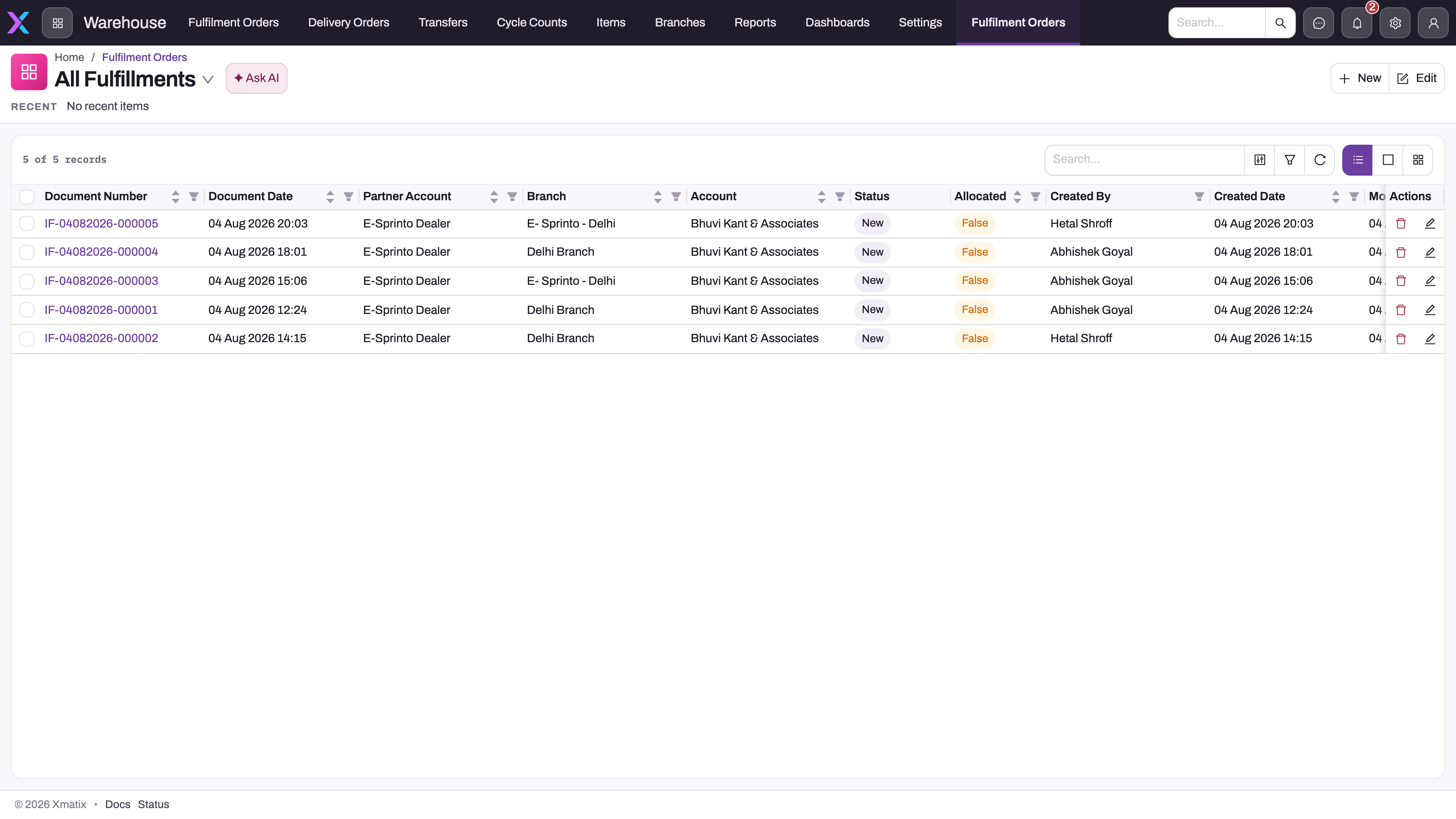
- 1
Fulfilment Orders, Delivery Orders, Transfers and Cycle Counts are the four warehouse documents; each has its own page in this section.
- 2
Items and Branches give quick access to the master data the documents reference; Settings holds document numbering and templates.
- 3
Document Number (IF-…) opens the fulfilment with its order, allocation and picking lines.
- 4
Account is the customer the demand belongs to; Branch is the warehouse that will pick it.
- 5
Status New with Allocated False means nothing has been reserved yet — the first warehouse action is Perform Allocation.
- 6
New creates a fulfilment header by hand; normally fulfilments arrive from the order's release, so this is rarely needed.
Open the Warehouse app from the App Launcher (it sits behind More if it is not pinned). Its bar carries the four operational documents — Fulfilment Orders, Delivery Orders, Transfers, Cycle Counts — plus Items, Branches, Reports, Dashboards and Settings. Goods receipts live in the Procurement app and storage locations in the Warehouse Settings app (reachable through the launcher's entity search), which is why neither appears on this bar. The fulfilment list is the natural landing page: it is the outbound work queue, and a row with status New and Allocated = False is work nobody has started.
The flow is deliberately lean. Goods are received straight into the storage location named on each receipt line — there is no separate putaway document — and dispatch goes straight from picked lines to a delivery order, with no packing document in between. What xMatix asks of the warehouse is exactly the steps that change stock truth: receive, allocate, pick, deliver, count.
What this section covers
- Receiving into the warehouse — inbound goods arrive through procurement goods receipts; what the warehouse controls on the receipt and where the stock lands.
- Fulfilment picking — the fulfilment document: allocate stock, create and confirm picking lines, and release the delivery from picked lines.
- Delivery orders and dispatch — the dispatch document: populate the delivery checklist, record transport details, release the shipment, create the invoice.
- Cycle counting — scope a count, start counting (optionally locking the counted stock), record quantities, finish, and release the variance as an adjustment.
- Storage locations and vans — the location record: branch, type, hierarchy, and the vehicle attributes that turn a location into a van with declared capacity.
- Branch transfers: the warehouse view — what outward release, in-transit and inward receive mean for the bins at each end.
- Warehouse configuration reference — for administrators: locations and lot types, document numbering, delivery checklist templates, the van capacity check.
- Troubleshooting warehouse operations — the exact refusals the warehouse actions give and what each one means.
Where Warehouse ends and neighboring modules begin
Receiving is a procurement activity: the goods receipt belongs to the purchase order lifecycle, and this section covers only its warehouse face — the procurement documentation owns the full procedure, inspection included. Stock truth — the ledger, adjustments, lots, valuation — belongs to the Inventory documentation, and the sales side of picking (releasing fulfilments from orders, invoicing) to the sales documentation. Warehouse work posts into all three.