
A credit limit in xMatix caps how much a customer may owe one selling company. It is a Credit Limit record keyed by Partner Account (the company extending credit) and Account (the customer), and its Credit Limit Amount is checked against the customer's live receivable exposure when a sales order or invoice is created. A customer over the limit is blocked from new documents with a message that names the customer, the open amount, the document amount and the limit.
Where the records live
Credit limits are ordinary records of the Credit Limit entity. In the first-party configuration they sit in the Field Sales setup list, so open the Field Sales app and choose Credit Limits from its settings entries; your administrator may also have added the entity to another app. Maintaining them is an administrator or finance task granted through the security profile.
Find the control record
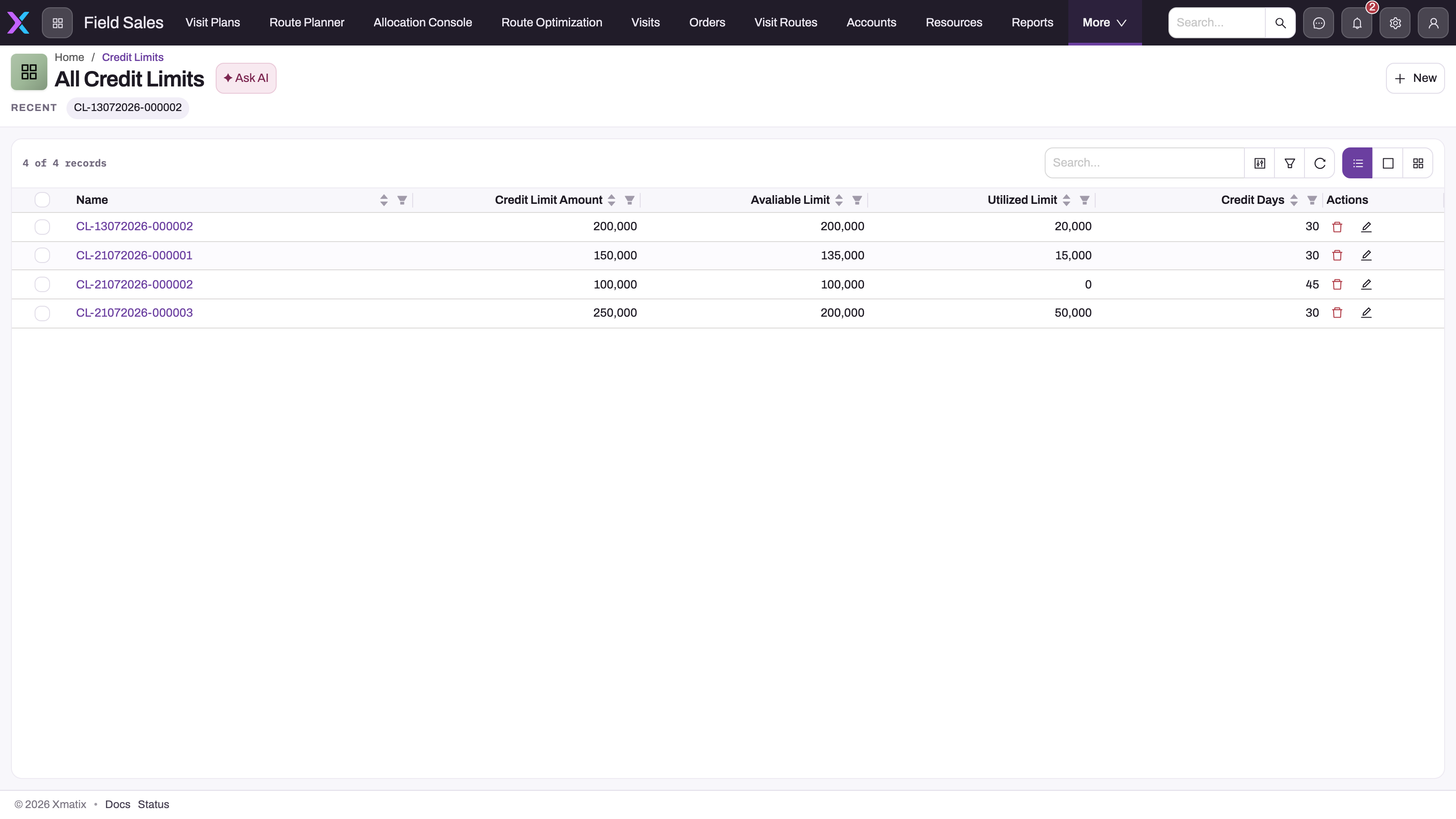
- 1
New opens the create form for a company/customer pair.
- 2
Name is generated on save; open it to see the Partner Account and Account the limit applies to.
- 3
Credit Limit Amount is the only column the enforcement check reads; it must be greater than zero to count as a limit.
- 4
Avaliable Limit (spelled this way in the schema) and Utilized Limit are stored notes, not the live exposure.
- 5
Credit Days is informational; the gate compares amounts and never ages receivables.
- 6
Search, column filters and refresh find the record without changing it.
Start from the All Credit Limits list and find the exact selling-company/customer pair. The list shows the generated name, Credit Limit Amount, Avaliable Limit (the property really is spelled this way in the schema, so a query using the correct spelling matches nothing), Utilized Limit and Credit Days; open a record to see its Partner Account and Account. A record for a different pair does not govern the document: the handlers look the limit up by the document's partner account and customer account, and a limit stamped with another company is simply not found.
Create or update a limit

- 1
Partner Account is the company extending credit; it must equal the document's partner account or the limit is never found.
- 2
Account is the customer whose trading is capped.
- 3
Avaliable Limit is stored only; real headroom is limit minus live open receivables.
- 4
Credit Limit Amount: the ceiling. Null or zero means no limit, so every document passes.
- 5
Utilized Limit and Credit Days are informational; neither is read by first-party code.
- 6
Save creates the record in Draft; the gate applies it immediately regardless of status.
Choose New, select the Partner Account and Account, enter a positive Credit Limit Amount and save. That amount is the only value the enforcement service reads: a null or zero limit is treated as no limit, not as zero credit, and lets every document through. Credit Days is informational; the gate compares amounts and never ages receivables, so due dates and overdue behaviour come from the documents themselves. Utilized Limit and Avaliable Limit are stored values that no first-party code refreshes or reads — do not type a calculated exposure into them and assume it is authoritative.
The record has a Status of Draft, Pending Approval or Approved and shows an Approval Process panel, so your organization can route changes to a limit through an approval flow. Enforcement does not inspect that status: the check selects the row by company and customer alone, so a limit still in Draft blocks orders and invoices exactly as an Approved one does. Do not save an unapproved positive limit against a live customer as a staging step.
Raising a limit is a credit decision: collect or settle valid balances, correct erroneous open items, and document approval before increasing risk.
Read a saved record
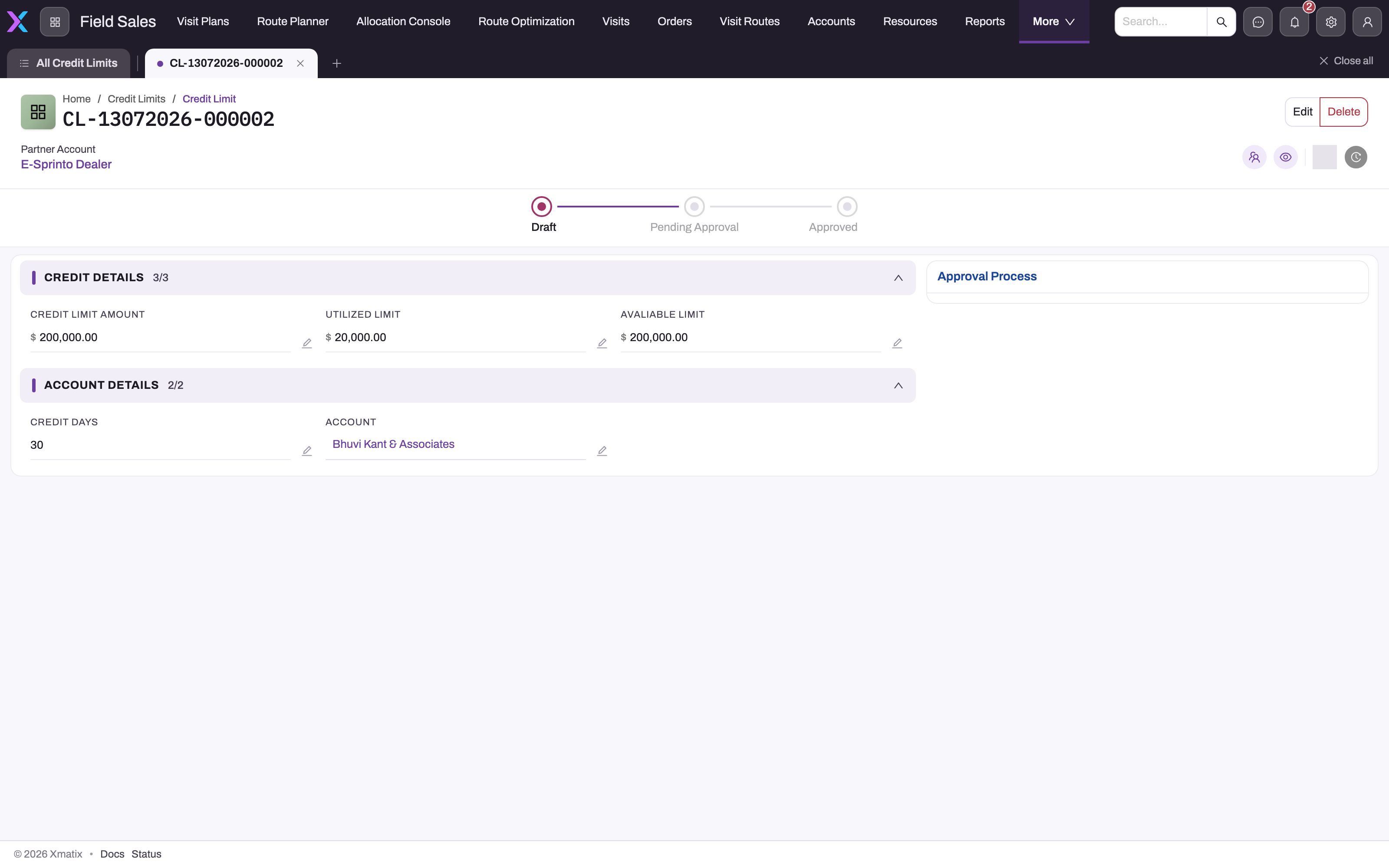
- 1
Partner Account in the header is the company under which this ceiling applies.
- 2
Draft, Pending Approval, Approved: the record's own workflow. A Draft limit already blocks documents.
- 3
Credit Limit Amount is the enforced ceiling.
- 4
Utilized Limit and Avaliable Limit are whatever was last typed; compare with the subledger, not with these.
- 5
Account is the customer half of the lookup key; Credit Days is not used by the amount gate.
- 6
Approval Process shows any tenant approval flow configured for credit-limit records.
The detail page shows the partner account in the header, the status stepper, Credit Details (limit, utilised, available) and Account Details (credit days, customer). Treat it as the configuration record, not as a live credit dashboard. To decide whether a document should pass, combine the positive ceiling here with the customer's current open receivable balance from the finance subledger.
What counts as exposure
Exposure is the sum of the customer's open receivable transactions with the selling company — receivable open items that are neither Settled nor Reversed, summed on their remaining open amount. These open items are created when invoices (and other receivable documents) are posted to the general ledger, and reduced when posted payments and credit notes are allocated against them. Exposure is recomputed from the subledger at the moment of the check, so collecting and posting a payment reduces it immediately; nothing is recalculated overnight, and the stored utilised and available columns play no part.
How the gate works
| Document | When checked | Rule |
|---|---|---|
| Sales order | Header creation | Current exposure plus Finance Amount (falling back to Total Amount, then zero) must not exceed the limit. In interactive entry the lines do not exist yet, so the proposed amount is normally zero and the check gates the customer's existing position; API and import callers can supply an amount. |
| Sales invoice | Header creation | Only when the invoice carries a positive Finance Amount: current exposure plus that amount must not exceed the limit. An invoice with no finance amount is not checked. |
A clean breach rejects the save with Credit limit exceeded for <customer>: open <amount> + this order/invoice <amount> would exceed the limit of <limit>, pointing at the Account field. Edits to existing documents are not re-checked; only creation is.
Both checks fail open. A customer with no positive credit limit configured is never gated, whatever their open receivables. The invoice check also skips silently if the finance subledger service cannot be resolved or queried, so monitoring that service is part of the control. And when the Sales module setting Route credit limit breaches to an approval process is on (Setup → Feature Hub → Sales → Settings, Credit Limit group; off by default), neither handler blocks — the tenant is expected to configure an approval process that gates the override instead.
Releasing a blocked customer
Three levers, in the order usually tried:
- Collect. Record and post payments, or apply credit notes, against the customer's open invoices; the allocated open items shrink exposure at once.
- Adjust. Settle or reverse stale open items that no longer reflect reality.
- Raise the ceiling. Increase Credit Limit Amount on the record for that company/customer pair once the business has approved new terms.
Editing Utilized Limit or Avaliable Limit does not release the gate because neither field participates in the calculation.
Common questions
Why was a small order blocked when the order itself fits easily?
Because the customer was already over the limit before the order — the order-time gate normally weighs the customer's existing open position, since the new order has no lines yet. Even a tiny order is refused until exposure comes down; the message shows the open amount that caused it.
Does an unpaid order count as exposure?
No. Exposure comes from the receivables subledger, so it is the posted-but-unpaid position that counts. Orders not yet invoiced, and invoices not yet posted to the ledger, do not add to exposure — which is why the invoice-time check exists as the second gate.
Can the same customer have different limits with different selling companies?
Yes. Limits are kept per customer per partner account, and the check always runs in the context of the document's partner account — a customer can be blocked with one company and clear with another.
Does the approval status on the credit limit matter?
Only to your review process. A Draft, Pending Approval or Approved record is enforced identically; use the approval flow to control who may change the amount, not to hold a limit back from taking effect.